Overview
An exploratory study measuring per-serving kavalactone delivery in traditionally hand-prepared kava, and the spread across preparers working to a single written recipe. Six independent batches by five preparers with 2 to 12 years of daily commercial practice, two commercial lots randomized across them, and unclarified beverage aliquots assayed by UHPLC alongside both raw materials. Mean total kavalactone delivery per 355 mL shell was 337.0 mg for House Vanuatu and 377.7 mg for House Fijian, with within-lot coefficients of variation of 8.6% and 6.7%.
Abstract
This exploratory study quantified kavalactone delivery per 12 fl oz (355 mL) serving and observed variability across commercial preparers using a defined hand-preparation recipe. Five preparers with 2 to 12 years of daily commercial experience produced six batches from two commercial lots, Root of Happiness House Vanuatu and House Fijian, with three batches per lot. One preparer contributed a batch of each lot. Each batch used 226.8 g of ground material and a 5.68 L water charge at 38 °C, divided into two equal washes with two minutes of hand squeezing per wash. The combined washes were thoroughly stirred, and unclarified aliquots were drawn immediately afterward for UHPLC analysis alongside both raw-material lots. Mean total kavalactone delivery per 355 mL was 337.0 mg for House Vanuatu (SD 29.0; CV 8.6%) and 377.7 mg for House Fijian (SD 25.2; CV 6.7%). Raw-material total kavalactone contents were 4.77% and 7.25% (w/w), respectively. Secondary nominal-volume apparent transfer estimates were 49.9% and 36.8%, calculated using the water charge because measured final beverage volumes were unavailable. Beverage chemotypes were 245613 for all three House Vanuatu batches and 462315 for two of three House Fijian batches, with the remaining batch showing a near-tied rank inversion. These measurements provide lot-specific per-serving reference values and an initial description of variability across preparations, not a universal potency for the 12-ounce shell. The small, partially overlapping preparer groups and absence of repeated same-lot batches per preparer prevent separation of preparer, batch, and analytical contributions. Additional trials are underway to strengthen the evidence base.
Key Findings
- Mean total kavalactone delivery per 355 mL shell was 337.0 mg for House Vanuatu (SD 29.0; CV 8.6%; range 303.6–355.9 mg) and 377.7 mg for House Fijian (SD 25.2; CV 6.7%; range 360.3–406.7 mg).
- Raw-material total kavalactone content was 4.77% w/w for House Vanuatu and 7.25% w/w for House Fijian. Nominal-volume apparent transfer, calculated against the 5.68 L water charge, was 49.9% and 36.8% respectively — a secondary estimate, not a measured whole-batch yield, since final beverage volumes were not recorded.
- Beverage chemotype was 245613 in all three House Vanuatu batches and 462315 in two of three House Fijian batches, the third showing a near-tied rank inversion.
- Flavokavain delivery followed the raw material: House Vanuatu beverages carried a mean 28.56 mg total flavokavains per shell against 3.78 mg for House Fijian, roughly 7.6 times more — but hand preparation retained about two-thirds of each lot's raw-material flavokavain-to-kavalactone ratio.
- Across all six batches, potency normalized to its lot mean correlated with preparer experience (Pearson r = 0.91, n = 6, p = 0.011) — a descriptive, hypothesis-generating pattern: preparer P3, the most experienced and the only one represented in both lots, produced the highest value in each.
- The design — four preparers contributing one batch each, one preparer contributing to both lots, no assayed marc — cannot separate preparer, batch, and analytical contributions, and does not establish a universal per-shell potency for the 12-ounce shell.
How to read this paper — Every number in this discussion rests on eight UHPLC certificates of analysis issued by Cambium Analytica (Traverse City, MI; ISO/IEC 17025:2017 accredited, certificate #108157): one for each of two raw-material lots and one for each of six finished beverages, drawn from six independently prepared batches produced by five commercial preparers with 2 to 12 years of daily service experience. Each reported value is a single certificate result; replicate injections were not provided. That scale and its limits — a small, partially overlapping preparer group and no assayed marc — are treated in full under What this design can and cannot settle.
The serving unit nobody has measured
Kava bars dispense by volume. The 12 fl oz (355 mL) shell has become the de facto serving unit across much of the American sector, and until now it had no analytical definition. No published measurement established how much kavalactone a hand-prepared 12-ounce shell actually delivers, or how far that figure moves when the same written recipe passes through different hands. Both gaps bear directly on labeling, on what a bar can honestly tell a customer about what they are drinking, and on any regulatory framework that would treat a serving of kava as a quantified unit.
The analytical literature has approached kava potency from the raw material inward rather than from the served beverage outward, and a strained kava beverage is not a clarified extract: a substantial, and in some lots dominant, share of its kavalactone rides on suspended plant solids rather than true solution. A shell of kava can only be characterized by measuring the beverage in the state in which it is poured, particulates included — which is what this study does.
How the study was run
Five kava bar employees, with 2 to 12 years of daily commercial experience (8, 3, 12, 2 and 3 years for preparers P1–P5), produced six independent batches from two commercial lots supplied by Root of Happiness Kava Company: House Vanuatu (peeled Santo Island chips, LOT HVF-0901526) and House Fijian (60% lateral root, 40% peeled chips, LOT HFF-0901526). Lot assignment to preparer was randomized, yielding three batches of each lot. Four preparers each prepared a single batch; one preparer, P3 — the most experienced of the pool at twelve years — prepared one batch of each lot, the only within-preparer comparison across materials available in this dataset.
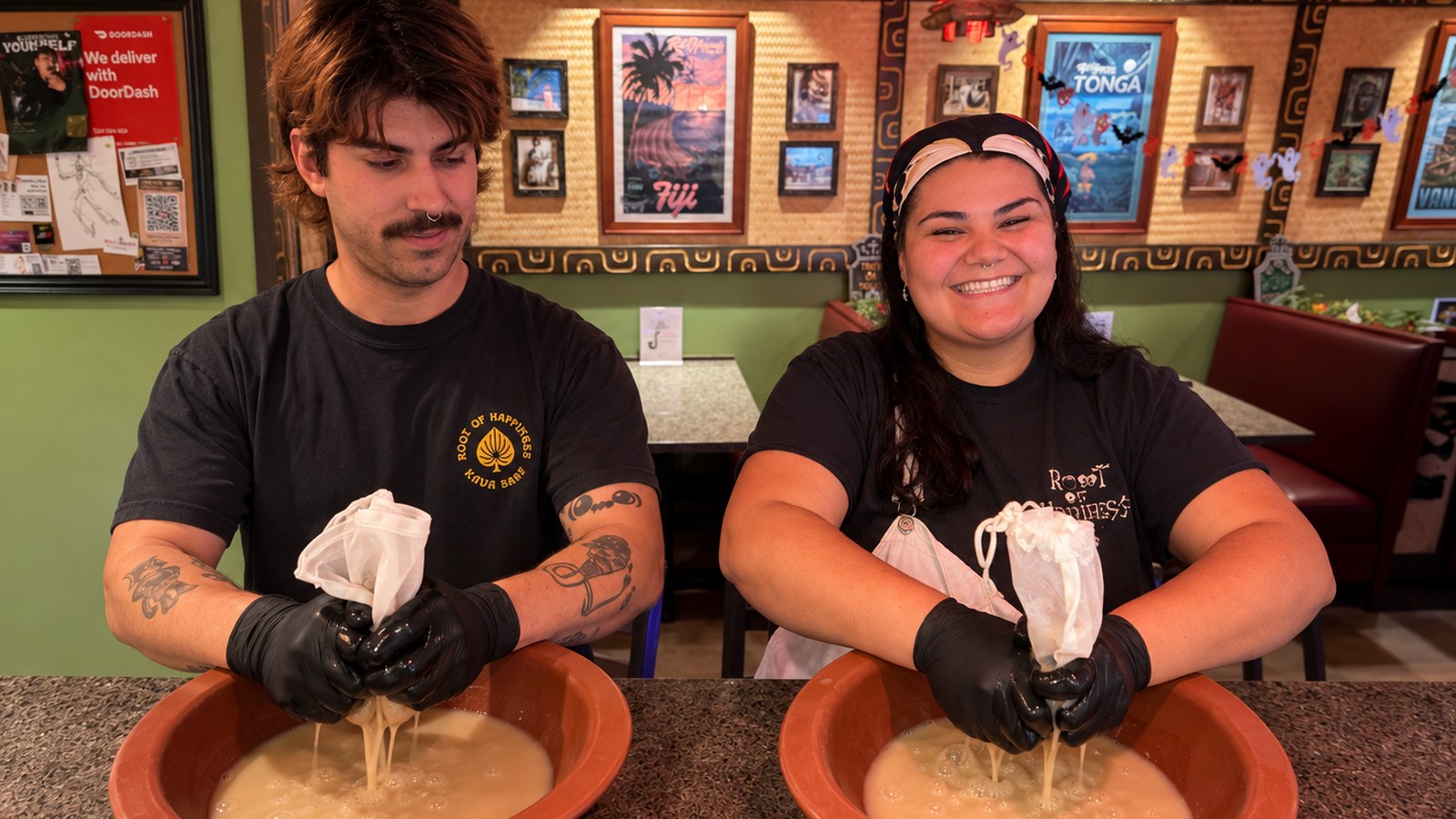
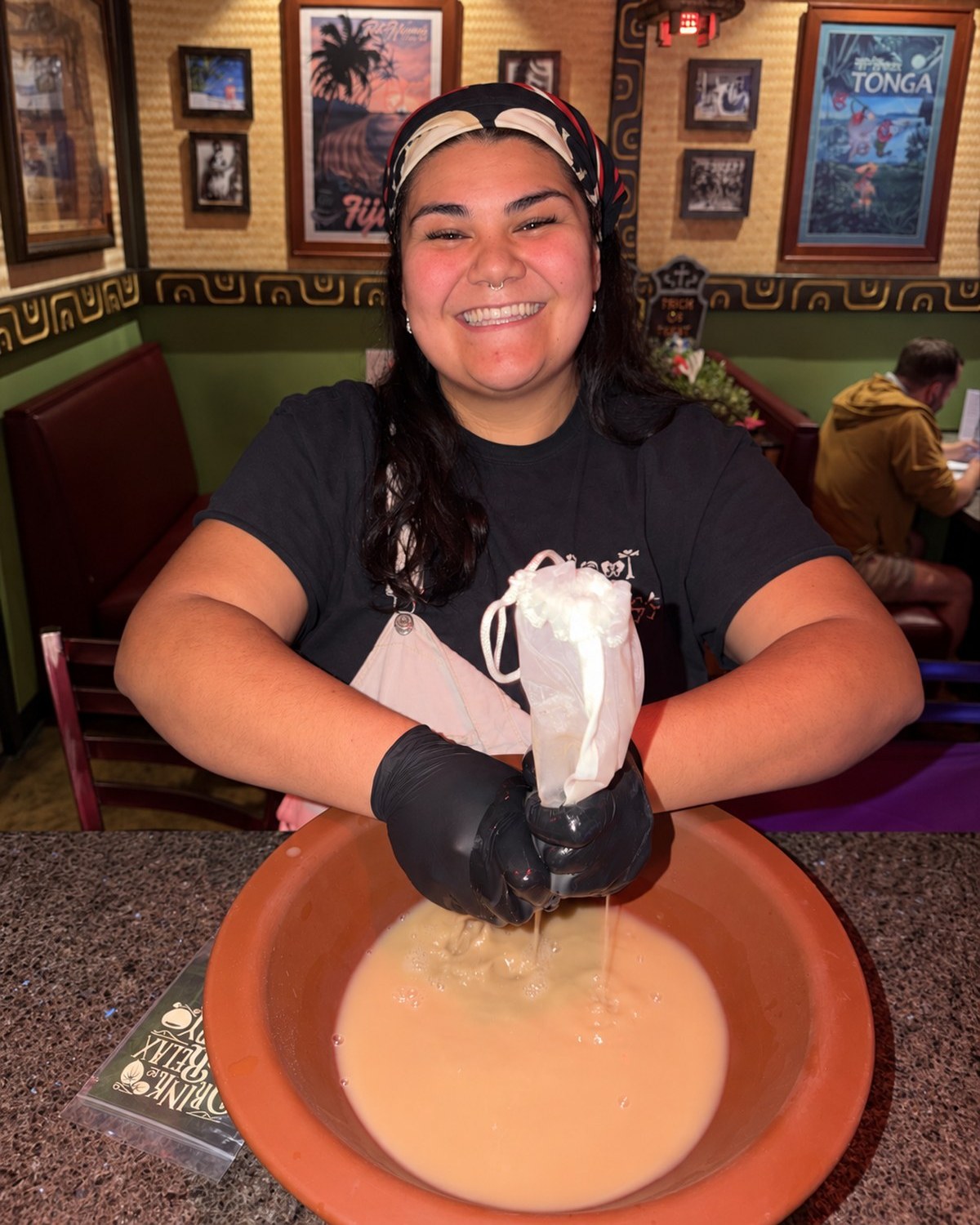
Each batch used a single fixed specification: 226.8 g (0.5 lb) of ground root to 5.68 L (6 US quarts) of filtered municipal tap water at 38 °C — a nominal mix concentration of 39.9 g dry root per litre, or 1:25 w/v — divided into two equal 2.84 L washes. For each wash the kava was placed in a 150 µm nylon mesh strainer bag, immersed, and hand-squeezed and kneaded continuously for two minutes at the preparer's ordinary working force, then lifted and expressed until free drainage ceased. No blending, milling or mechanical agitation of any kind was applied at any stage; all mechanical energy was delivered by hand. Preparers were instructed in the fixed recipe and wash structure and otherwise used their own established technique.
The two washes were combined into a single finished batch, thoroughly stirred, and an 8 fl oz (237 mL) aliquot was drawn immediately to simulate commercial serving practice. Because much of the delivered kavalactone in a strained kava beverage is carried on suspended solids rather than dissolved, the whole aliquot — particulates included — was submitted for UHPLC quantification of the six major kavalactones and flavokavains A, B and C, alongside both raw-material lots, at Cambium Analytica.
The 5.68 L water charge describes water added, not finished beverage volume: the finished batches slightly exceeded it, carrying an estimated 114 g of root particulate per batch, and numerical final-volume measurements were not recorded. Per-shell potency is therefore based on the assayed beverage concentration and the stated 355 mL serving volume; apparent transfer, reported separately below, is a secondary estimate against the nominal water charge rather than a measured whole-batch yield.
Per-shell potency
Total kavalactone delivery per 355 mL shell is reported for each lot below, with the same statistics computed for the individual kavalactones. House Vanuatu beverages delivered 303.6–355.9 mg total kavalactones per shell across three preparations, and House Fijian beverages delivered 360.3–406.7 mg.
Table 1. Total kavalactone delivery per 355 mL shell, by lot (n = 3 batches per lot).
- House Vanuatu — Mean mg/shell: 337.0 · SD: 29.0 · CV: 8.6% · Range: 303.6–355.9 mg
- House Fijian — Mean mg/shell: 377.7 · SD: 25.2 · CV: 6.7% · Range: 360.3–406.7 mg
Welch's t-test on total kavalactone per shell: t(3.9) = −1.83, p = 0.14 — an exploratory, nominal comparison; see Statistical Analysis below. Across all six batches and both lots, the observed spread was 28.8% of the pooled mean, from 303.6 mg to 406.7 mg per shell.
Raw-material assay set the kavalactone charge available to each mix: House Vanuatu contained 4.77% total kavalactones (w/w), House Fijian 7.25%, corresponding to a charge of 10.81 g and 16.44 g respectively at the 226.8 g weighed input.
Table 2. Raw-material content and the kavalactone and flavokavain charge to each 226.8 g batch.
- House Vanuatu — Total KL (% w/w): 4.77 · KL charge: 10.81 g · Total FK (% w/w): 0.609 · FK charge: 1.38 g · FK:KL ratio: 0.13 · Raw chemotype: 425631
- House Fijian — Total KL (% w/w): 7.25 · KL charge: 16.44 g · Total FK (% w/w): 0.112 · FK charge: 0.25 g · FK:KL ratio: 0.02 · Raw chemotype: 463215
Variability across preparations
Per-compound CVs ranged from 7.1% (dihydrokavain) to 12.4% (methysticin) in House Vanuatu and from 4.7% to 12.9% in House Fijian, with dihydrokavain showing the lowest CV in both lots. Within House Vanuatu, P2 had the lowest value for all six kavalactones; within House Fijian, P3 had the highest value for all six — the differences involved the overall measured kavalactone concentration rather than a single compound.
These CVs describe variation between the six sampled batches, not variation among sequential servings poured from one batch, and they do not isolate an operator effect. Four preparers contributed only one batch each, and P3 prepared different lots, so the design cannot separate preparer technique, ordinary batch-to-batch process variation, and analytical contribution from one another. Distinguishing them would need repeated same-lot batches from each preparer, which this design does not have.
P3 prepared one batch of each lot, delivering 355.9 mg total kavalactones per shell from House Vanuatu and 406.7 mg from House Fijian — a 14.3% difference, against a 12.1% difference between the lot means. P3 produced the highest value within each lot and was the most experienced preparer at twelve years; this pair shows the results obtained by one person using two materials, but does not hold technique constant or isolate a material effect. Across all six batches, potency normalized to its lot mean correlated with preparer experience (Pearson r = 0.91, n = 6, p = 0.011). The coefficient and p-value are descriptive and exploratory: P3 contributes twice, six observations represent only five preparers, and experience is confounded with individual preparer characteristics — this is a hypothesis-generating pattern, not evidence that experience caused higher delivery.
Chemotype of the hand-mixed beverage
Beverage chemotype was 245613 in all three House Vanuatu batches, and 462315 in two of the three House Fijian batches, with the third (P5) showing a near-tied rank inversion at ranks 2–3 (methysticin 61.9 vs dihydrokavain 63.2 mg/shell).
Table 3. Chemotype — raw material versus finished beverage.
- House Vanuatu — Raw chemotype: 425631 · Beverage chemotype: 245613 (consistent across all 3 batches)
- House Fijian — Raw chemotype: 463215 · Beverage chemotype: 462315 (2 of 3 batches; 1 near-tied rank inversion)
Relative to the raw-material chemotypes, the finished beverages differed at two near-tied rank positions in House Vanuatu (kavain/dihydrokavain, and yangonin/desmethoxyyangonin — raw shares within a point of each other) and at one rank position in House Fijian (yangonin/dihydrokavain, a larger raw-material gap and a comparably large difference in apparent transfer: 25.6% for yangonin vs 46.9% for dihydrokavain). The House Vanuatu inversion held consistently across all three independently prepared batches (paired t-test on the dihydrokavain–kavain difference, t(2) = 13.5, p = 0.005), which may reflect compound-selective transfer, though a consistent analytical bias between the two compounds cannot be excluded from single determinations. Near-ties, single analytical determinations, and limited replication constrain how far these rank patterns can be read as selective transfer.
Flavokavain delivery
Flavokavain delivery followed the raw material. House Vanuatu beverages carried a mean 28.56 mg total flavokavains per shell against 3.78 mg for House Fijian — roughly 7.6 times more, against a 5.4-to-1 ratio in raw-material flavokavain content.
Table 4. Flavokavain delivery per shell and nominal-volume apparent flavokavain transfer.
- House Vanuatu — Mean FK mg/shell: 28.56 · CV: 8.4% · Range: 26.85–31.31 mg · Apparent FK transfer: 33.1% (31.1–36.3%)
- House Fijian — Mean FK mg/shell: 3.78 · CV: 7.5% · Range: 3.49–4.06 mg · Apparent FK transfer: 23.7% (21.9–25.5%)
Flavokavain transfer ran lower than kavalactone transfer in every batch, at a ratio of 0.59–0.71 across all six. Expressed as a flavokavain-to-kavalactone ratio, the beverages carried 0.085 (House Vanuatu) and 0.010 (House Fijian) against 0.128 and 0.016 in the raw materials — hand preparation retained roughly two-thirds of each lot's raw-material relative flavokavain share. The similarity between the two lots on this point is a descriptive finding from two lots, not evidence of a general property of hand preparation, and the mechanism cannot be resolved without assaying the marc.
Nominal-volume apparent transfer
Multiplying the mean beverage concentrations by the nominal 5.68 L water charge gives reference-volume kavalactone quantities of 5.39 g for House Vanuatu and 6.04 g for House Fijian — 49.9% and 36.8% of the respective input charges.
Table 5. Nominal-volume apparent kavalactone transfer, calculated against the 5.68 L water charge.
- House Vanuatu — Reference-volume KL quantity: 5.39 g · Apparent transfer: 49.9%
- House Fijian — Reference-volume KL quantity: 6.04 g · Apparent transfer: 36.8%
These are not measured whole-batch yields: the 5.68 L figure describes water added, and numerical final beverage volumes were unavailable, so this calculation is secondary to the concentration-based per-serving measurements above. The exploratory comparison of nominal-volume apparent transfer between lots gave Welch's t(3.2) = 4.59, p = 0.017 — again a nominal result, not adjusted for multiple comparisons and not treated as confirmatory, and the two lots share preparer P3, so independence between groups is not assured.
How this compares with prior beverage measurements and companion studies
The SD of nominal-volume apparent transfer here was 4.3 percentage points for House Vanuatu and 2.5 points for House Fijian, against 0.5–7.3 points across process replicates in the Association's companion mass-balance study of standardized and mechanized preparation (Blythe, Bowman, & Masifilo, 2026). That companion study also found that 78.7–97.2% of beverage kavalactones were particle-associated across three cultivars at a 150 µm straining threshold — the basis for analyzing the unclarified beverage here rather than treating the drink as a dissolved extract. None of this is a controlled comparison of methods: the studies differ in plant material (fresh-frozen versus dried commercial root), apparatus, straining conditions and replication structure, and a shared beverage-state measurement basis does not remove those differences.
What this design can and cannot settle
The main design limitation is the absence of repeated same-lot batches per preparer: four preparers contributed one batch each, and P3 contributed one batch of each lot. A crossed design — each preparer preparing each lot, with at least two or three batches per preparer per lot and replicate analytical determinations — would be needed to distinguish preparer, batch, and analytical contributions, and to evaluate the experience pattern without relying on one preparer at the high end of both lots.
Only two commercial lots were evaluated, each a single homogenized source batch. Origin, varietal composition, plant-part composition and processing were not independently varied, so differences cannot be assigned to any one of them or generalized to Vanuatu-origin and Fijian-origin kava as categories. One combination of water temperature, dry-material-to-water ratio, wash count and squeeze duration was tested; other preparation conditions were not evaluated, and this study cannot demonstrate an advantage of two washes over one or establish that this recipe is optimal.
Measured final beverage volumes were unavailable and the spent marc was not recovered or assayed, so apparent transfer uses the nominal water charge rather than a closed mass balance; unmeasured beverage volume, marc retention and other losses cannot be resolved from each other. Settling during standing and changes across sequentially poured shells were not assessed. The study addresses chemical composition only — not sensory quality, consumer preference, clinical effect or safety, and the per-serving measurements reported here should not be read as recommended intake levels or a safety threshold.
Additional trials are underway to expand the evidence base; results from those trials are not included here, and the conclusions above remain limited to the six batches and two commercial lots analyzed.
Implications for commercial preparation
A written recipe paired with measurement of the resulting beverage gives a practical basis for monitoring a defined commercial preparation. These per-serving values are reference measurements for these two lots and this recipe — not stand-alone labeling specifications for other products or future batches. Further sampling across lots, repeat preparations and poured servings would be needed to assess how well a stated value represents routine service, and beverage testing alone does not distinguish low raw-material content from incomplete transfer, settling, or other preparation effects.
Disclosures and conflicts of interest
Both authors hold ownership interests in Root of Happiness Kava Company and share affiliations with Root of Happiness Kava and the American Kava Association. The two kava lots evaluated are commercial products of Root of Happiness Kava Company, and the five preparers are employees of Root of Happiness kava bars — the authors therefore stand to benefit commercially from favorable findings about the potency and consistency of their own products and service practices. Against that: all analytical data were generated by an independent laboratory from samples submitted without any of the interpretations offered here; neither author performed the laboratory analyses; both authors jointly supervised preparation and sample collection, and no batch was excluded from the dataset; and the points at which the evidence is weakest — a single batch from four of the five preparers, no assayed marc, and two lots each represented by one homogenized batch — are stated explicitly above. This research received no external funding. No comparison against any competing product, preparation method or apparatus was performed, and no claim of superiority over any other preparation is made or supported here.
Claude (Anthropic) assisted with compiling analytical data from the laboratory certificates of analysis and performing statistical calculations; its role was limited to data compilation and statistical assistance, not drafting manuscript prose. The authors reviewed the compiled data and calculations against the source records and retain responsibility for the analyses, interpretation and manuscript content.
References
- Balick, M. J., & Lee, R. (2002). Traditional use of sakau (kava) in Pohnpei: lessons for integrative medicine. Alternative Therapies in Health and Medicine, 8(4), 96–98.
- Blythe, T., & Bowman, J. (2026). Standardized preparation and extraction efficiency of traditional aqueous kava beverages. American Kava Association Technical White Paper No. 5. Zenodo.
- Blythe, T., Bowman, J., & Masifilo, M. (2026). Quantitative mass-balance determination of kavalactone transfer, partitioning, and chemotype behavior in American-grown kava (Piper methysticum) beverages. Preprint. Zenodo.
- Brown, A. C., Onopa, J., Holck, P., Kaufusi, P., Kabasawa, D., Craig, W. J., Dragull, K., Levine, A. M., & Baker, J. D. (2007). Traditional kava beverage consumption and liver function tests in a predominantly Tongan population in Hawaii. Clinical Toxicology, 45(5), 549–556.
- Jhoo, J.-W., Freeman, J. P., Ang, C. Y. W., & Mihalov, J. J. (2006). Assessment of kavalactones in kava beverage products and aqueous infusions. Journal of Food Science, 71(6), C345–C351.
- Lebot, V., Merlin, M., & Lindstrom, L. (1997). Kava: The Pacific Elixir: The Definitive Guide to Its Ethnobotany, History, and Chemistry. Healing Arts Press.
Cite This
Blythe, T.; Lowin, T. Kavalactone Delivery and Between-Preparer Variability in Traditionally Hand-Prepared Kava: An Exploratory Study of the 12-Ounce Shell. American Kava Association Technical White Paper No. 24; American Kava Association: Las Vegas, NV, USA, 2026.
Supporting Data and Access
The signed UHPLC analytical reports issued by Cambium Analytica (sample codes DTS-260911-042 through -049) and the calculation workbook underlying the tables are available from the corresponding author on reasonable request.
Write to admin@americankavaassociation.org to enquire.