Overview
The third edition of the American Kava Association's California history runs to ninety-three pages and rests on eighteen documentary exhibits, twenty-three numbered findings and more than two hundred footnoted sources — customs ledgers, a Kingdom licensing statute, the Hawaiian consul's own wholesale newspaper advertising, a landing manifest, pharmaceutical compendia, the Sears catalogue page, a 1984 University of California dissertation, California corporate filings, community video, customs shipment records and federal and state correspondence. It follows kava through four distinct Pacific migrations, a nineteenth-century commercial trade measured in tons, a century of church, household and kalapu practice that left almost no public paper, the grocery counters that preceded the kava bars, and the regulatory framework that arrived last. The book treats the record as history rather than as a determination of the safety or legal status of any particular preparation.
Abstract
Kava reached California through people before it reached it through trade. Native Hawaiians were counted in the Fort Ross census of 1821, were living at La Playa on San Diego Bay in 1835, were hired by John Sutter in 1839 to build the fort that became Sacramento, and were forty of the 459 recorded residents of San Francisco in June 1847 — roughly one resident in eleven, and, in the words of the 1855 Annals, "very expert boatmen" on the bay. The commercial corridor those communities worked is the corridor that later carried 'awa into California. By 1865 the Hawaiian Kingdom licensed 'awa sale by statute at $100–$500 a year by district; by 1884 the Kingdom's consul at San Francisco was advertising 6,500 pounds of dried root to druggists and manufacturing chemists; by 1886–88 the Kingdom's customs tables recorded tons of it consigned to United States Pacific ports alongside sugar, rice and coffee; by 1900 Sears, Roebuck & Co. was selling it to any household in the country with a postal address. In 1920 a California weekly reported that "many Americans, however, having acquired a liking for it, drink it by the gallon."
Samoans, Chamorros, Tongans and Fijians followed in the twentieth century through four distinct migrations, and the practices they sustained ran through churches, households and kalapu rather than through shops. A 1984 University of California dissertation records kava ceremonies hosted by a Bay Area Samoan congregation founded in 1962 — twenty-six years before California's first dedicated kava bar. An early named California kalapu was incorporated in San Mateo on 2 May 1978. Kava root was sold by the pound over import-grocery counters before any room existed in which to drink it. The commercial kava bar arrived in San Diego in 2010 by way of Florida and Vanuatu, and Northern California's first opened in Rancho Cordova in 2012.
Regulation is part of this history rather than its frame. The federal food-and-drug system, the 1958 GRAS cutoff and DSHEA's 1994 line all postdate the commercial record assembled here, and the book sets the two chronologies side by side. It does not resolve the toxicological questions the FDA has raised, and does not claim to. What it establishes is that kava is not a novel ingredient that recently entered the American food supply, and that California's part in its American history is one of continuous Pacific relationship as well as new public gathering places.
Key Findings
- This is a history of people before it is a history of a product. Native Hawaiians were resident on this coast before California was a state and before it was American: counted in the Fort Ross census of 1821 under the Russian-American Company, described in 1835 living at La Playa on San Diego Bay, contracted by John Sutter in 1839 to build the fort that became Sacramento, and enumerated at 40 of 459 recorded San Francisco residents in June 1847 — 8.7 percent, roughly one in eleven — where the 1855 Annals describe them as "engaged in navigating the bay" and "very expert boatmen." They were the labor force that moved cargo through the port through which the later shipments landed.
- Kava was in documented American commerce by the ton, in public, generations before any of the rules existed. A Hawaiian Kingdom licensing statute approved 10 January 1865; a consulate at San Francisco from 1868 held by a consul who was simultaneously a commission merchant in Sandwich Islands produce; 6,500 lbs advertised wholesale from a San Francisco warehouse by that consul in 1884; Kingdom customs tables recording 20,372 lbs in 1886 — 20,132 lbs of it to U.S. Pacific ports — then 9,636 lbs in 1887 and 9,209 lbs in 1888, entered in the same ledger as sugar, rice, coffee and cattle; 76 sacks landed at San Francisco on 14 March 1888.
- It was retailed to the general public, on both sides of the Atlantic, as a beverage. A full-column London advertisement of January 1887 sold it as "A NATIONAL DRINK"; an American syndicated newspaper item of 1882 explained it to readers without ceremony; an imported preparation was sold by mail nationwide from 1895; fluid extract of kava held official status in the National Formulary from 1888 and a full monograph in King's American Dispensatory in 1898, alongside tea, coffee, chamomile, peppermint and ginger; and in 1900 Sears, Roebuck & Co. offered it as catalogue item No. 6717 — "MAKE YOUR OWN TEMPERANCE WINE" — to any household with a postal address, six years before the Food and Drugs Act.
- Americans, not only Pacific Islanders, were drinking it. The Sausalito News reported on 6 November 1920 that "many Americans, however, having acquired a liking for it, drink it by the gallon," and that they had adopted a meat grinder because the customary preparation was too slow. An Associated Press dispatch of 3 September 1926 described "great quantities" of 'awa still moving through San Francisco, used "for beverage purposes."
- The practice survived the century through churches, households and kalapu, not through shops — and that is why it is nearly invisible in public documents. The earliest dated record of communal kava drinking in California located for this book is a 1984 University of California, San Francisco dissertation on a Samoan congregation founded in 1962: "the church often hosts important cultural events, for example kava ceremonies." That is twenty-six years before the first dedicated California kava bar.
- Four migrations, not one, and they did not carry a single kava culture. Samoans came largely through the Navy and farm-labor recruitment from 1951; Chamorros through the Navy, Typhoon Karen and the fruit companies, leaving California with the largest Chamorro population of any state; Tongans through the churches and chain migration after 1965, sustaining the organized kava clubs known as kalapu; Fijians last and fastest, driven by the coups of 1987 and 2000, in an emigration roughly ninety percent Indo-Fijian.
- California's kalapu history has a corporate paper trail. Kalapu Tala-Kei-Ola for Tonga of California was incorporated in San Mateo on 2 May 1978 — the same year Kalapu Fofo'anga began in Grey Lynn, Auckland — and held federal tax exemption until 2010. Three more incorporated between 2007 and 2008, and a dozen named Bay Area clubs are documented in Tongan-language video from 2008 onward. Church kava circles are tied to named buildings in Lennox and Oakland, and a May 2000 Los Angeles Times report on a six-hour San Mateo County church kava circle described such circles as common.
- The counter came before the kava bar. Kava root was sold by the pound in named Fijian and Samoan import groceries in Anaheim, San Jose, Modesto and Oceanside, documented in August 2013 and described there as long established, before any California room existed in which to drink it.
- The retail category began in San Diego, not Sacramento, and the distinction between a bar that served kava and a dedicated kava bar matters. The Kava Lounge on Kettner Boulevard was operating by October 2005, but its listings are DJ nights and band bookings — a nightclub that put kava on the menu. The first dedicated California kava bar was Mystic Water Kava Bar and Yoga Studio at 3811 Ray Street, North Park, San Diego, dated by the company to 2010 and evidenced by its own website in April 2011, opened by the proprietor of a Hollywood, Florida kava bar of September 2009. Root of Happiness opened in Rancho Cordova in 2012 and now operates six California rooms; MeloMelo opened in Berkeley in February 2015, a Fijian-owned Kava Bar in San Bruno's Fiji Town the same year, and a Kava Lounge on Divisadero Street in San Francisco in April 2016.
- The wholesale trade has two documented centres, and they are not the ports. Hayward — called "the capital of the United States' Fijian community" by the East Bay press in 2005 and the second-largest Fijian city in the 2020 census — holds at least four kava businesses, including an importer issued an FDA Foreign Supplier Verification Program warning letter in February 2022 and a firm self-dated in that city since 1999. The Modesto corridor holds the other, with a Fijian import grocery selling kava by the pound since at least 2013 and a container-scale distributor in Salida receiving kava powder from Suva through the Port of Oakland in 2014 and again in 2025. The Los Angeles and Long Beach entries document container-scale shipments consigned to Florida-based companies supplying the national kava-bar trade.
- California's kava-bar culture is a hybrid with two documented routes, and it was observed from Fiji. Commercial service and take-away kava were adaptations of Port Vila's urban nakamals, carried into the United States through Florida from 2002 and into California through particular people and businesses. In October 2015 a delegation from Fiji's Ministry of Agriculture visited the Sacramento room on a market-scoping mission; the Fiji Sun reported on 2 October 2015 that it had "redefined the kava bar as we know it in Fiji."
- The regulatory machinery arrives last in this chronology, and the FDA has already addressed the category question. In a letter to Representative Ed Case dated 5 July 2024, the agency wrote that "this traditional use of kava prepared in the customary manner is considered a conventional food, and as such the Generally Recognized as Safe (GRAS) provision of the Federal Food, Drug, and Cosmetic Act does not apply," because "the GRAS provision only concerns certain substances added to food that would otherwise require pre-market approval as a food additive." California's Department of Public Health cites that federal letter as the authority for its own published position that kava "would generally not be regulated as a food additive if kava is steeped in only water to brew tea and consumed as a single-ingredient conventional food."
- The pre-1958 record examined here is domestic, which matters to how the common-use provisions are read. 21 C.F.R. § 170.30(c)(2) sets a harder evidentiary bar for use that occurred primarily outside the United States; Hawai'i's Department of Health held that subsection "inapplicable as Hawai'i has been a territory of the United States since 1898" and proceeded under (c)(1). California has been a state since 9 September 1850, and the 1884 advertisement, the 1888 manifest, the 1900 catalogue page and the 1920 and 1926 press reports are American commerce and reporting on American soil. What each document establishes about the material, its preparation and its use is a separate question from where it occurred.
- The FDA's objection is evidentiary, and it has two halves that are usually argued as one. The agency acknowledges that "the traditional use of kava in beverages extends before 1958." What it says is that it is "not aware of a history prior to 1958 of kava in common use as an ingredient in food that provides sufficient experience … to overcome the documented safety concerns." The documents assembled here address the first half of that sentence. They supply historical context for the second rather than resolving it.
A history of people before a history of a product
The third edition of this book changes where the story starts. Kava did not arrive in California as a commodity that later acquired a community. It arrived with people, through four distinct Pacific migrations spread across two centuries, and the trade, the pharmacy shelf, the church hall, the import counter and the kava bar are successive settings in one continuous history rather than separate subjects.
Ninety-three pages, eight chapters, eighteen documentary exhibits, twenty-three numbered findings and more than two hundred footnoted sources stand behind that claim. What follows is a discussion of what the book documents and how.
Hawaiians were in California before California was California
The earliest documented Hawaiian presence on this coast sits inside a Russian colony. Fort Ross was founded by the Russian-American Company in 1812 and held until 1842; the census of 1821 counted 175 people, and the roll of nationalities included Russians, Creoles, Aleuts from the Fox Islands, Alaska Natives, Yakuts of Siberia, Native Hawaiians, Tlingits, Miwok and Pomo. That was not accidental drift: the same company ran a Hawaiian venture from 1815 to 1817, including Fort Elizabeth on Kaua'i. The Russian Pacific and the Hawaiian Pacific were one working system.
The trail is continuous from there. Richard Henry Dana recorded Hawaiians living at La Playa on San Diego Bay in May 1835. John Sutter arrived in 1839 with Hawaiian workers under three-year contract to build the fort that became Sacramento. In June 1847 Hawaiians were 40 of the 459 recorded residents of San Francisco — 8.7 percent, roughly one resident in eleven — and the 1855 Annals of San Francisco describe them as "engaged in navigating the bay" and "very expert boatmen." The Honolulu-born William Heath Davis, Jr. was among the original proprietors who laid out New Town San Diego in 1850. These were the people who physically moved cargo through the port through which kava was later landed.
The consul, the warehouse, and the wharf
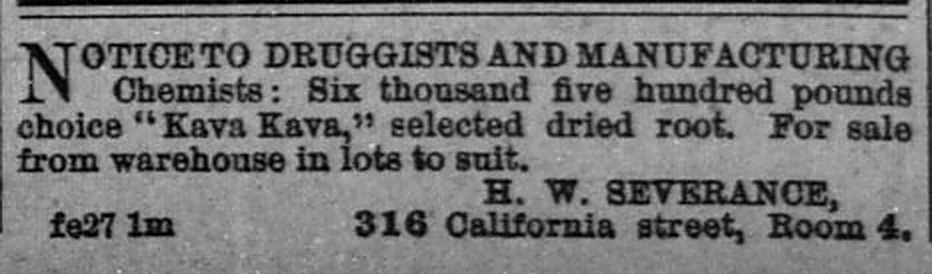
The Hawaiian Kingdom maintained a consulate at San Francisco from 1868, held by a consul who was simultaneously a commission merchant in Sandwich Islands produce, with the office documented at 405 Front Street, 316 California Street and 218 California Street. That consul dealt in kava at wholesale. H. W. Severance advertised 6,500 pounds of choice "Kava Kava" selected dried root for sale from a San Francisco warehouse "in lots to suit," addressed to druggists and manufacturing chemists, in the Daily Alta California through February and March 1884 — from the same California Street address the city directories give for the consulate.
'Awa was a licensed, fee-bearing, lawfully traded commodity under Hawaiian Kingdom statute from at least 10 January 1865, with fees of $100 to $500 a year by district, and a cash export crop grown for overseas markets. The Kingdom's own customs tables record exports of 20,372 lbs in 1886 — 20,132 lbs of it consigned to Pacific ports of the United States and 240 lbs to Europe — then 9,636 lbs in 1887 and 9,209 lbs in 1888, entered in the same ledger as sugar, rice, coffee and cattle. And it landed physically, in documented bulk: 76 sacks of kava kava at San Francisco on 14 March 1888, printed in the Examiner's daily importations column.
- 6,500 lbs — Offered wholesale from one San Francisco warehouse by the Kingdom's own consul, 1884
- 20,372 lbs — 'Awa exported in 1886 alone, 20,132 lbs of it to U.S. Pacific ports
- 76 sacks — Landed on one San Francisco wharf, 14 March 1888
- 18 exhibits — Primary documents reproduced as page images in the book
In print, in the pharmacy, and in the national catalogue
Kava in the nineteenth century was not an obscure import awaiting discovery. On 5 January 1887 the London Daily News carried a full-column advertisement headed "KAVA! KAVA! KAVA! WHAT IS IT?" under the subheadings "A NATIONAL DRINK," "A ROYAL BEVERAGE" and "A HEALTH STIMULANT," naming Piper methysticum, quoting a retail price of 36 shillings the case, and naming its proprietors. American readers met it as ordinary reportage in the same decade: a syndicated item in Pennsylvania's Daily Republican of 30 September 1882 described Pacific islanders who "drink an intoxicating liquor called kava-kava," used without explanation in general-circulation American print.
The apparatus of kava drinking was physically present in California, in public, in the middle of that period. The California Midwinter International Exposition ran in Golden Gate Park from 27 January to 4 July 1894, and a photograph by the fair's official photographer shows a Samoan tanoa fai'ava — the low, many-legged mixing bowl — and an ipu tau 'ava, the polished half-coconut cup. The book is careful about what that establishes: that the bowl and cup stood before the paying American public and were photographed is documented; that 'ava was prepared or drunk at the fair is not. The photograph belongs to a nineteenth-century commercial trade in ethnographic display rather than to Samoan protocol, and is reproduced for the object, the date and the place.
By the mid-1890s an imported kava preparation was being sold by mail to any American with a postal address, advertised in Washington in December 1895 and St. Louis in February 1897. That advertisement also asserts that the plant grows on the banks of the Ganges, which is false. It is reproduced as a record of two things at once: an imported preparation marketed as kava was offered nationwide in 1895, and its seller presented it through claims that cannot be accepted at face value. The claims are the artifact; the commerce is the evidence.
Nor was the plant confined to the patent-medicine trade. The first National Formulary appeared in 1888 and fluid extract of kava held official status in its fourth and fifth editions; the 1898 King's American Dispensatory carries a full monograph, "Piper Methysticum — Kava-Kava," stating that "the root is the part recommended for use in medicine." Listed in the same reference, in the same terms, were the ordinary botanicals of the household teapot: tea, coffee, Roman and German chamomile, peppermint and ginger.
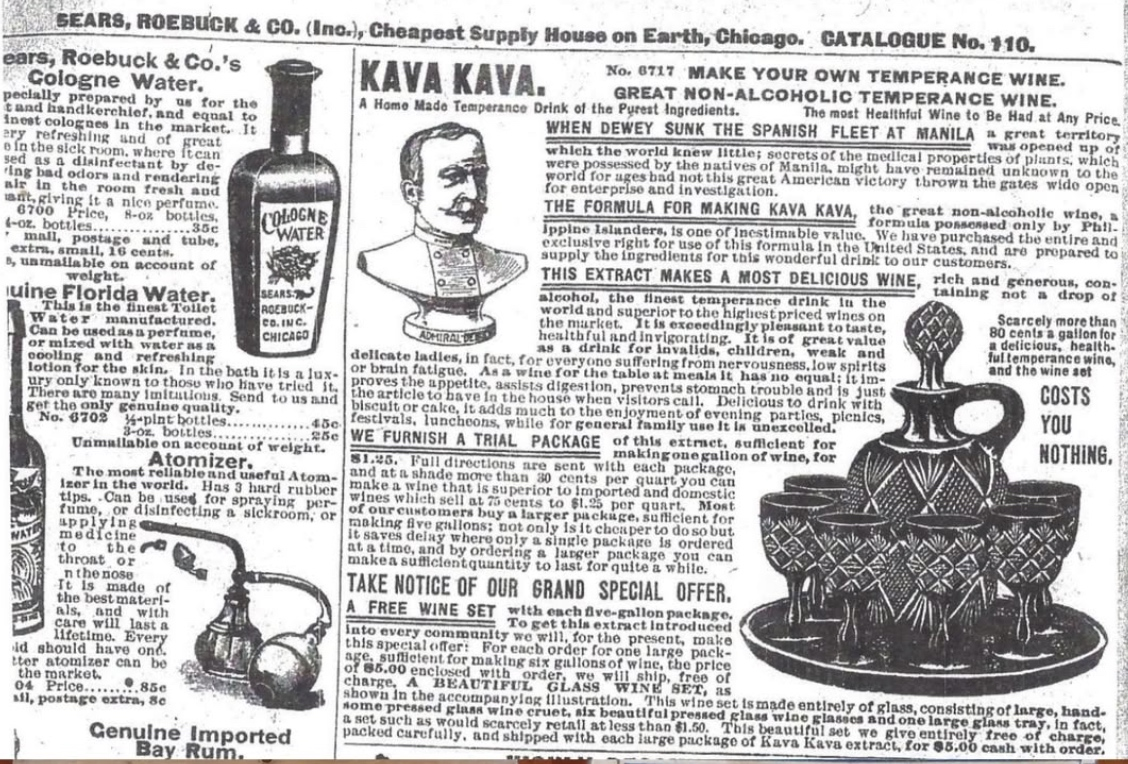
By 1900 the seller was the largest retailer in the United States. Sears, Roebuck & Co. offered kava in Catalogue No. 110 — the Consumers Guide for fall 1900 — as item No. 6717, under "KAVA KAVA. A Home Made Temperance Drink of the Purest Ingredients" and "MAKE YOUR OWN TEMPERANCE WINE," with a trial package at $1.25 sufficient for a gallon, five gallons at scarcely more than 80 cents a gallon, and a free pressed-glass wine set with a $5.00 order. No prescription, no ingredient panel, no age limit, six years before the Food and Drugs Act.
The evidentiary status of this page is unusual — That Sears sold kava as a temperance wine around 1900 is repeated in modern sources, including Hawai'i's own 2024 'awa determination, and those sources cite no primary document. No freely viewable scan exists: the Internet Archive's copy of the volume is restricted to library lending, and Sears Catalogues No. 107, No. 111 and No. 112 were each read in full text for this book and contain no kava entry. The exhibit is a photograph of the physical page, reproduced as the primary document behind a claim that had until now circulated without one.
By 1920 the California press was no longer describing kava drinking as something only Pacific Islanders did. On 6 November 1920 the Sausalito News ran a short item headed "Kava in a New Way": "Many Americans, however, having acquired a liking for it, drink it by the gallon. But the native way of preparing it is too slow for them, and they prefer to use a meat grinder." It is not an advertisement and has nothing to sell. It gives no count and no location, so it cannot establish the size of a California drinking population — but the meat grinder connects repeated use with a practical change in equipment. Six years later an Associated Press dispatch of 3 September 1926 reported "great quantities" of the 'awa plant shipped from the South Sea Islands "by way of San Francisco," a material "used in the islands for beverage purposes."
The century in between: churches, homes, and kalapu
The archival record thins after the 1920s, and the kava bars do not begin until 2010. Between those points lies most of a century in which the plant almost disappears from California's public documents while the population that drinks it grows from a few thousand people into the largest concentration of Pacific Islanders on the American mainland. This is the chapter the earlier editions did not have.
Four migrations, not one. Samoans came first and largely through the United States Navy — the Pago Pago station closed in 1951 — and through farm-labor recruitment, settling first at Oceanside beside Camp Pendleton and reaching 150 families in the San Francisco region by 1960. Chamorros came through the Navy, through Typhoon Karen in 1962 and through fruit-company recruitment, leaving California with the largest Chamorro population of any state. Tongans came through the churches and chain migration after 1965, and sustained the organized, named kava clubs called kalapu. Fijians came last and fastest, driven by the coups of 1987 and 2000, in an emigration roughly ninety percent Indo-Fijian.
The earliest hard California evidence of communal kava drinking is Samoan, and it is in a church. A 1984 University of California, San Francisco dissertation on an urban Samoan congregation founded in 1962 records that "the church often hosts important cultural events, for example kava ceremonies," and that a visiting party "is opened by the kava ceremon[y] and a formal welcoming speech given by the hosts." That is a dated, academically published record of kava drinking in urban California in the early 1980s — twenty-six years before the first California kava bar, and a decade before kava appeared in an American supplement aisle. The practice did not arrive with the retail trade. The retail trade arrived long after the practice.
The Tongan record is the strongest bridge across the century. Kalapu Tala-Kei-Ola for Tonga of California was incorporated in San Mateo on 2 May 1978 — the same year Kalapu Fofo'anga began in Grey Lynn, Auckland — and held federal tax exemption until 2010; three more incorporated between 2007 and 2008, and a dozen named Bay Area clubs are documented in Tongan-language video from 2008 onward. Most of the practice ran without a corporate name at all, tied instead to named buildings: the Lennox Tongan United Methodist Church in Los Angeles County, where a 2013 newspaper report describes men retiring "to a back room to chat over the ceremonial brew of kava," and Laurel United Methodist Church in Oakland, where a filmed blessing records the head of the circle by name. In May 2000 the Los Angeles Times reported a San Mateo County case arising from a six-hour church kava circle, and noted in passing that such circles "are common."
The Fijian migration explains the state's present geography. Sacramento County now holds the largest Fijian population of any county in the United States — 9,092 identifying as Fijian alone and 11,780 alone or in any combination in 2020 — with Hayward the second-largest Fijian city in the country and a substantial Central Valley concentration in Modesto and Stanislaus County. The book resists the convenient conclusion that an overwhelmingly Indo-Fijian migration did not bring kava: Fiji's own 2011 national risk-factor survey found 43.5 percent of Indo-Fijians had drunk kava in the previous thirty days, and 73.2 percent of Indo-Fijian men. No documented yaqona or sevusevu ceremony held in California, at any date, could be located in any archive consulted — a limit of the accessible record, and an open invitation to anyone holding a church minute book, a program or a photograph.
From the grocery counter to the kava bar
Buying kava and drinking kava on premises are two different trades with two different histories in this state, and the second is much younger than the first. The counter is the older and worse-documented half — cash across a counter to a clientele that did not need the product explained to it. The earliest dated evidence tied to named California stores is a community listing of August 2013: Boutique Samoa in Anaheim at twenty-seven dollars a pound for Fiji waka, Kumar's Island Market in San Jose, Kumar's Imports on Oakdale Road in Modesto at about twenty-five dollars a pound, and Oloa Samoa in Oceanside at fifteen dollars a pack. That date is a floor, not a beginning: the listing treats those shops as an unremarkable, pre-existing feature of the state's Pacific Islander commerce.
The bar is the younger and better-documented half, and the third edition sharpens the chronology that earlier accounts blurred.
- By October 2005 — Kava Lounge, 2812 Kettner Boulevard, San Diego. Operating, twenty-one and up, with kava drinks on the menu — but its listings across 2005–2009 are DJ nights and band bookings. A bar that served kava, not a kava bar. Closed 2020.
- 2010 — Mystic Water Kava Bar and Yoga Studio, 3811 Ray Street, North Park, San Diego. The first dedicated California kava bar; company-dated to 2010, its own website live in April 2011, opened by the proprietor of a Hollywood, Florida kava bar of September 2009. Closed 2016.
- 2012 — Root of Happiness, Rancho Cordova. Northern California's first kava bar, announced on its own website on 29 September 2012; continuously operating in Sacramento County since.
- August 2013 — Named import groceries in Anaheim, San Jose, Modesto and Oceanside selling kava root by the pound, described there as long established.
- July 2014 — Root of Happiness, Davis.
- February 2015 — MeloMelo, 1701 University Avenue, Berkeley. First East Bay kava bar; its founders came to the idea in a South Florida kava bar.
- 2015 — Kava Bar, 630 San Mateo Avenue, San Bruno. Fijian-owned, in the stretch of Fijian businesses the local press calls Fiji Town, announced on the cover of the US Fiji Times in April 2015.
- April 2016 — Kava Lounge, 901 Divisadero Street, San Francisco. Grand opening 16 April; the owner had arrived from South Florida.
A footnote worth keeping — In August 2011 an academic survey of kava's new commercial settings counted five kava bars in the continental United States — three in Florida, one in North Carolina, one in Oregon — and "at least one place in California that sells kava but does not call itself a kava bar." Mystic Water was calling itself a kava bar on its own website that same month. The scholarship did not know California's kava scene existed while it was happening.
A retail trade needs a wholesale trade behind it, and California's is more specific than "the West Coast." Hayward — called "the capital of the United States' Fijian community" by the East Bay press in 2005 — holds at least four kava businesses, including an importer issued an FDA Foreign Supplier Verification Program warning letter in February 2022 and a firm self-dated in that city since 1999. The Modesto corridor holds the other centre, and it sits more precisely in Salida, where a container-scale distributor appears on customs records receiving kava powder from Walu Bay, Suva, through the Port of Oakland in May 2014 and again in July 2025. Los Angeles and Long Beach handle larger volumes still, but the companies behind those containers are headquartered in Florida and supply the national kava-bar trade. Behind all of it is an agricultural export: Fiji shipped more than 328,000 kilograms of kava to the United States in 2019, about two-thirds of everything it sold to America that year, and its total kava exports passed FJ$54 million in 2024, involving some 18,500 households.
A California kava culture
California's kava-bar culture is a hybrid, drawing both from Pacific diaspora communities and from the commercial kava-bar culture of Port Vila by way of Florida. The Port Vila model was itself an adaptation: urban nakamals preparing kava in bulk, selling servings, admitting customers beyond a local kin group, and selling bottles to take home — known there as redimed. Commercial service and take-away kava were not California inventions. The Florida route is explicit in the founders' own accounts of the business begun in Boca Raton in 2002, and it enters California through particular people: Mystic Water's Hollywood origin, MeloMelo's founders, and the owner of San Francisco's Divisadero Street lounge. Alongside that route were California's Pacific households, churches, kalapu, import shops and Fijian-owned businesses. The commercial culture did not replace them, and it had no single point of origin.
The book describes the daily life of one operator's rooms from the inside — the greeting, the couch, the patio, the cup to go, the shell raised with a "bula" as an acknowledgment of company rather than a test of cultural knowledge — and it labels that description as what it is: Root of Happiness's practice, not a statewide code. The same applies to the posted house rules reproduced from the Davis location: eighteen and over, physical ID every visit, no alcohol or drug mixing, no outside kava or kratom, one drink at a time with ten to fifteen minutes between. House-service instructions, not a clinical safety standard.
The distinction the chapter insists on is between welcoming people into a commercial kava bar and claiming authority over someone else's ceremony. A purchase from a menu is not a ranked ceremony, and a gathering convened by a community host is not an ordinary night of business — yet Tongan groups at one address and faikava gatherings at another show that more than one form can occupy the same room. "American" describes a developing cultural setting, not an ancestry test; Pacific Islanders and their descendants are participants in American kava history, not people outside it. A distinct California practice does not erase Pacific origins, and recognizing those origins does not require every California gathering to reproduce the same ceremony.
In October 2015 that hybrid was observed and reported from the other end of the supply chain. A delegation from Fiji's Ministry of Agriculture, in California on a market-scoping mission, visited the Sacramento room; the Fiji Sun reported on 2 October 2015 that the Acting Permanent Secretary for Agriculture had "witnessed this very modernised set up of a Kava Bar" and that "it has redefined the kava bar as we know it in Fiji," adding that the ministry would "work with the price mechanism that will ensure that the farmers get their fair share of the price." The book separates the delegation's own observations from the widely repeated clientele figure in the same article, which the newspaper attributes explicitly to the operator and which therefore stands as an owner's estimate rather than a count.
Kava and the modern regulatory state
Regulation appears at several points in the story; in the seventh chapter it becomes the subject. Most of the commercial record above predates the modern federal food-and-drug system, and the later community and retail history developed alongside it. Set the two chronologies side by side.
The two chronologies, side by side. The regulatory machinery arrives last.
- 1812–42 — Regulatory milestone: Before California statehood; Fort Ross is a Russian-American Company colony on a coast whose political boundaries were changing. · Kava in the record by that date: Native Hawaiians counted in the Fort Ross census of 1821, alongside Russians, Yakuts, Aleuts, Tlingits, Miwok and Pomo.
- 1839–50 — Regulatory milestone: A period before California statehood in 1850. · Kava in the record by that date: Sutter arrives with Hawaiian workers under three-year contract, 1839; Hawaiians are 40 of 459 recorded San Francisco residents in June 1847 and "very expert boatmen" on the bay.
- 1865 — Regulatory milestone: Before the federal Food and Drugs Act of 1906. · Kava in the record by that date: Hawaiian Kingdom licenses 'awa sale by statute; fees of $100–$500 per year by district.
- 1870 — Regulatory milestone: California's first public-health body, the State Board of Health and Vital Statistics, begins operation 18 March 1870. · Kava in the record by that date: Hawaiian consulate already established at San Francisco under Severance, appointed 1868.
- 1884 — Regulatory milestone: Before the federal Food and Drugs Act of 1906. · Kava in the record by that date: The Kingdom's consul at San Francisco advertises 6,500 lbs of choice "Kava Kava" dried root from a San Francisco warehouse to druggists and manufacturing chemists.
- 1886–88 — Regulatory milestone: Before the federal Food and Drugs Act of 1906. · Kava in the record by that date: Kingdom customs tables record 20,372 lbs (1886), 9,636 lbs (1887) and 9,209 lbs (1888); the 1886 figure includes 20,132 lbs to U.S. Pacific ports; 76 sacks landed at San Francisco, 14 March 1888.
- 1888–98 — Regulatory milestone: First National Formulary published 1888. · Kava in the record by that date: Fluid extract of kava official in the National Formulary; full monograph in King's American Dispensatory, 1898, alongside coffee, tea, chamomile and ginger.
- 1895–99 — Regulatory milestone: Before the federal Food and Drugs Act of 1906. · Kava in the record by that date: An imported kava preparation sold by mail nationwide; 'awa described in the U.S. press as a licensed, lawful Hawaiian trade.
- 1900 — Regulatory milestone: No labeling law, no ingredient panel, no age limit anywhere in existence. · Kava in the record by that date: Sears, Roebuck & Co. offers kava nationwide by mail as item No. 6717, "Make Your Own Temperance Wine."
- 1906 — Regulatory milestone: Food and Drugs Act signed 30 June 1906. · Kava in the record by that date: Eighty-five years of documented Hawaiian presence in California and twenty-two years of documented wholesale 'awa dealing in San Francisco already behind it.
- 1920–26 — Regulatory milestone: The agency is not yet named "FDA" — that dates to 1930 — and the FDCA is still twelve years away. · Kava in the record by that date: Sausalito News: "many Americans … drink it by the gallon." Associated Press reports "great quantities" moving through San Francisco "for beverage purposes."
- 1951–84 — Regulatory milestone: No federal or state rule addresses kava. · Kava in the record by that date: Samoan, Chamorro and Tongan migrations establish California's Pacific communities; a 1984 University of California dissertation records kava ceremonies hosted by a Bay Area congregation founded in 1962.
- 1958 — Regulatory milestone: Food Additives Amendment creates the GRAS exemption; the statutory cutoff for common use in food is 1 January 1958. · Kava in the record by that date: The nineteenth- and early-twentieth-century commercial documents reproduced in the book all predate the cutoff.
- 1978 — Regulatory milestone: No kava-specific rule exists at any level of government. · Kava in the record by that date: Kalapu Tala-Kei-Ola for Tonga of California incorporated in San Mateo, 2 May 1978.
- 1994 — Regulatory milestone: DSHEA, approved 25 October 1994, defines a "new dietary ingredient" as one not marketed in the United States before 15 October 1994. · Kava in the record by that date: Kava was in documented U.S. commerce more than a century before that date.
- 2010–26 — Regulatory milestone: Hawai'i's 'awa determination, January 2024; the FDA's letter to Congress, July 2024; CDPH's standing guidance, last updated 11 August 2026. · Kava in the record by that date: Continuous California retail service since 2010; six Root of Happiness rooms and a statewide kava-bar trade operating under the guidance those documents supply.
Sources for each row appear as numbered footnotes in the book.
What California publishes, and what it rests on
CDPH's Food and Drug Branch maintains a standing guidance page, Consumer Facts-Kava, last updated 11 August 2026. Four passages have to be read together, and in practice they rarely are:
- "Kava and kava-based preparations may be regulated as food, dietary supplements, or drugs."
- "Under federal law, kava as a food additive is not considered generally recognized as safe or GRAS … Kava would generally not be regulated as a food additive if kava is steeped in only water to brew tea and consumed as a single-ingredient conventional food."
- "Kava used as a dietary ingredient in a dietary supplement, or kava marketed as a dietary supplement is not currently prohibited in the U.S., as long as all the related federal and state requirements have been met."
- "Reports of adverse effects from chronic and heavy consumption … present a public health concern. However, there are currently no regulatory limitations regarding the use of kava as a single-ingredient conventional food or dietary supplement."
The department is describing two different legal operations: added to something else, kava is an unapproved additive; steeped in water by itself and served as itself, it is — in the department's own words — "generally not … regulated as a food additive." The footnote California attaches to that carve-out is not a state document. It is the FDA's letter of 5 July 2024 to Representative Ed Case, identified in the guidance as footnote [5]. California is directing its readers to the federal correspondence.
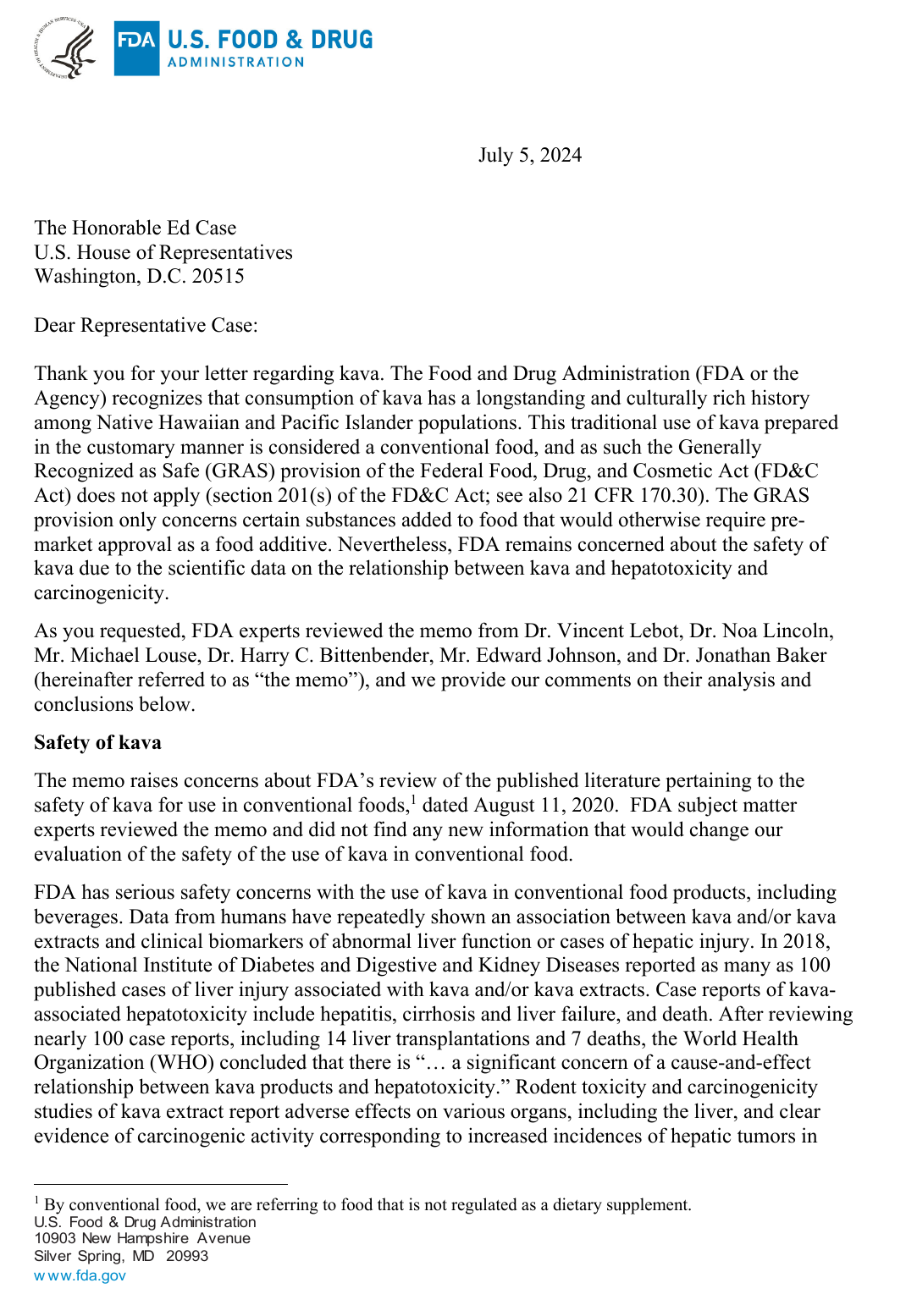
The operative language is: "This traditional use of kava prepared in the customary manner is considered a conventional food, and as such the Generally Recognized as Safe (GRAS) provision of the Federal Food, Drug, and Cosmetic Act (FD&C Act) does not apply." And immediately following: "The GRAS provision only concerns certain substances added to food that would otherwise require pre-market approval as a food additive."
Read the whole letter, not the headline — The same letter states the agency's continuing safety concerns about kava and hepatotoxicity, and its position that kava added as an ingredient to other foods is an unsafe food additive. It also recognizes the role of state, local, tribal and territorial authorities in regulating restaurants and retail food establishments. Both halves are in the document. Quoting either alone misrepresents it.
The common-use question, and where jurisdictions have landed differently
21 C.F.R. § 170.30(c)(1) provides that general recognition of safety through common use in food prior to 1 January 1958 "may be achieved without the quantity or quality of scientific procedures required for approval of a food additive," and § 170.3(f) defines common use in food as "a substantial history of consumption of a substance for food use by a significant number of consumers." That is a documentary standard, which is why manifests, licensing statutes, customs tables and dated advertisements are the right kind of evidence.
There are two pre-1958 routes, not one. Subsection (c)(2) covers use that occurred "exclusively or primarily outside of the United States" and demands published documentation corroborated by a second independent source. Hawai'i's Department of Health did not take that road: it held § 170.30(c)(2) "inapplicable as Hawai'i has been a territory of the United States since 1898" and proceeded under (c)(1), in a determination of 23 January 2024 expressly bounded to noble 'awa root prepared by aqueous extraction. California has been a state since 9 September 1850, and the 1884 wholesale offer on California Street, the 1888 manifest, the 1900 mail-order page and the 1920 and 1926 press reports are records of American commerce before 1958. What each establishes about the material, its preparation and its use remains a separate question from where it occurred.
The agency's own position distinguishes acknowledgment from sufficiency. FDA writes that "we acknowledge that the traditional use of kava in beverages extends before 1958," and, separately, that it is "not aware of a history prior to 1958 of kava in common use as an ingredient in food that provides sufficient experience … to overcome the documented safety concerns." The documents assembled in this book address the first sentence. Whether they amount to "sufficient experience" is for the agencies and their experts to decide.
The wider comparison is collected in the book's regulatory appendix, and it shows jurisdictions addressing different legal questions rather than reaching one national answer:
- New York City embargoed kava at two Manhattan cafés and closed them. The Second Circuit affirmed the denial of preliminary relief in December 2024, and in August 2025 the district court held on the merits that the plaintiffs had not proven that kava steeped in water and sold in a New York food-service establishment qualifies as a "food" rather than a "food additive."
- Michigan told its local health departments the opposite in January 2023 — that noble kava infused in water "is exempt from the definition of Food Additive … based on its GRAS status." That is the framing FDA called incorrect.
- Cocoa, Florida treated the question as land use and set a 500-foot buffer from schools, churches and playgrounds.
- Los Angeles County is reported to have updated its notice to retail businesses in February 2026 to permit water-steeped single-ingredient kava, tracking CDPH.
- Sacramento, Yolo, Placer and El Dorado — the four counties where this retail category actually grew up — have no published kava-specific guidance, letter or policy that could be located. That is a limit of the public record examined rather than proof that none exists.
One consequence of that patchwork appears in the book as an operating cost rather than a legal argument. The work of explaining kava to local authorities has frequently come at the operators' expense: kava bars paying for legal assistance so that localities could work through the law applying to the beverage. A locality encountering a new kava bar may be encountering the retail format for the first time — not the first appearance of kava in California.
What this establishes, and what it does not
This book does not establish that every preparation of kava is generally recognized as safe, and it does not attempt to resolve the toxicological concerns raised about particular forms, preparations and combinations — including the liver-injury reports behind the FDA's 2002 consumer advisory, which it records rather than argues around. Cultivar, plant part, preparation, other ingredients and conditions of use all remain relevant to evaluating a present-day product. Those are scientific questions, and this is a documentary history.
What it establishes is that kava did not recently arrive in American commerce as a newly discovered dietary ingredient, and that California's part in its American history is longer and more populated than the opening of a shop. Hawaiian communities were here before statehood. The trade was moving in commercial tonnage by the 1880s, was carried in American pharmaceutical references from the same period, was sold nationally for household preparation by 1900, and was described in the California press as a beverage Americans drank habitually by 1920. Churches, households and kalapu carried the practice through the century that left no manifests. The import counter preceded the kava bar, and the kava bar, when it came, was a hybrid of Pacific community practice and a commercial form adapted from Port Vila by way of Florida. Kava came ashore long before the states and agencies that make rules about it existed. Those rules may determine which shelf it belongs on today, depending on how it is prepared, packaged and marketed. They do not erase the record that was written before them.
Conflicts of interest — The author is commercially engaged in the kava trade and co-founded Root of Happiness, a California kava retailer whose venues appear in the record described above, and is a member of the American Kava Association, which publishes this book. He stands to benefit from a favourable regulatory reading of the history assembled here, and Chapters Five and Six draw in part on his own participant account, which is labelled as such throughout. The documents themselves are public records, reproduced in the book so that any reader can check them against the claims made from them; where a date, address or figure differs between sources, the discrepancy is stated in the text rather than resolved silently.
References
- Associated Press dispatch, "Awa Laboratory Probe Completed," The Evening Star (Washington, D.C.), September 3, 1926, p. 10.
- Advertisement of H. W. Severance, Daily Alta California, February–March 1884 ("Six thousand five hundred pounds choice 'Kava Kava,' selected dried root").
- "An Act to Amend Chapter 7, Article 2, of the Civil Code, 'On Awa,'" in Laws of His Majesty Kamehameha V., 1864–65 (Honolulu, 1865), p. 3, approved January 10, 1865.
- California Department of Public Health, Food and Drug Branch, "Consumer Facts-Kava," page last updated August 11, 2026; consulted September 2026.
- California Office of Historic Preservation, "Asian Americans and Pacific Islanders in California, 1850–1995," Multiple Property Documentation Form.
- California Secretary of State, business filings: Kalapu Tala-Kei-Ola for Tonga of California, Inc., entity 845241, filed May 2, 1978, San Mateo; Kalapu Fevanga (2007); Kalapu Heilala (2008); Paionia Kalapu (2008).
- Cultural Survival Quarterly, "Kava, Cash, and Custom in Vanuatu," on Port Vila's urban nakamals, bulk preparation, cash sales and redimed.
- Dietary Supplement Health and Education Act of 1994, Pub. L. 103-417, approved October 25, 1994, sec. 413(c); Food Additives Amendment of 1958, Pub. L. 85-929, 72 Stat. 1784.
- E. S. Craighill Handy and Mary Kawena Pukui, as summarized in Margaret Titcomb, "Kava in Hawaii," Journal of the Polynesian Society 57, no. 2 (June 1948).
- Fiji Ministry of Health, Fiji STEPS Survey Report 2011, kava consumption by ethnic group, ages 25–64.
- Food and Drug Administration, letter to the Honorable Ed Case, U.S. House of Representatives, July 5, 2024, three pages, signed Erin O'Quinn, Acting Associate Commissioner for Legislative Affairs.
- Food and Drug Administration, consumer advisory on kava-containing dietary supplements, March 25, 2002; Centers for Disease Control and Prevention, "Hepatic Toxicity Possibly Associated with Kava-Containing Products," MMWR 51, no. 47 (2002).
- Food and Drug Administration, warning letter to Best Fiji Kava, Inc., Foreign Supplier Verification Program, February 16, 2022.
- Frank Soulé, John H. Gihon and James Nisbet, The Annals of San Francisco (1855), population table for June 1847 and description of Hawaiian boatmen.
- Hawai'i Department of Health, "Generally Recognized as Safe (GRAS) Determination for 'Awa," January 23, 2024, signed Kenneth S. Fink, MD, Director of Health.
- Jeffrey Bowman, "What Does Nakamal At Home Mean?," April 30, 2022; American Botanical Council, HerbClip News, "Kava as a Social Event: Kava Bars," June 15, 2012.
- John Arthur and Co., "KAVA! KAVA! KAVA! WHAT IS IT?," Daily News (London), January 5, 1887, p. 4.
- Kavasutra 6th Street, Inc. v. Adams, No. 1:23-cv-06359 (S.D.N.Y.); Second Circuit summary order, December 19, 2024; merits ruling, August 2025.
- "Kava in a New Way," Sausalito News (Sausalito, California), November 6, 1920, p. 10.
- King's American Dispensatory (1898), "Piper Methysticum — Kava-Kava"; National Formulary (1888), fluid extract of kava.
- Los Angeles Times, May 7, 2000, on a San Mateo County church kava circle; Los Angeles Times, November 28, 2013, on the Lennox Tongan United Methodist congregation.
- Michigan Department of Agriculture and Rural Development, memorandum to all local health departments, "Michigan Retail Food Establishments Selling Kava," January 11, 2023; City of Cocoa, Florida, Ordinance No. 25-2023.
- Rachna Lal, "US$15 Million Kava Potential Identified," Fiji Sun (Suva), October 2, 2015.
- Richard Henry Dana, Jr., Two Years Before the Mast (New York: Harper & Brothers, 1840), journal entry for May 8, 1835.
- "Selections from Custom House Tables, 1886–1888 — Principal Domestic Exports," Hawaiian Annual; "Importations," The San Francisco Examiner, March 14, 1888.
- Sears, Roebuck & Co., Consumers Guide, Catalogue No. 110 (fall 1900), item No. 6717, "Make Your Own Temperance Wine."
- 21 C.F.R. § 170.30(c)(1)–(c)(2) and § 170.3(f) (general recognition of safety through experience based on common use in food).
- U.S. Census Bureau, 2020 Census detailed (DHC-A) tabulations for Samoan, Fijian, Tongan and Chamorro populations by state, county and place.
- Unpublished doctoral dissertation in medical anthropology, University of California, San Francisco, 1984, on hypertension in an urban Samoan community, pp. 208, 212 (church-hosted kava ceremonies).
- Marina Yakovleva, "The Sakha Story of Fort Ross," Fort Ross Conservancy, quoting the Fort Ross census of 1821.
Cite This
Blythe, T. A Documented History of Kava in California: From the Pacific to the Pacific Coast, 3rd ed.; American Kava Association LLC: Las Vegas, NV, USA, 2026. ISBN 9798176267204.
Supporting Data and Access
The third edition runs to ninety-three pages across eight chapters and reproduces eighteen documentary exhibits (A–R) as page images, each with a complete footnote giving its archive, publication and URL. It also carries a selected chronology, twenty-three numbered documentary findings in Appendix A, a comparative regulatory appendix covering New York City, Michigan, Cocoa (Florida) and Los Angeles County in Appendix B, and a note on sources and method. Several archives are named in the book as unread so that a reviewer can extend the record: the Hoover Institution's Hoji Shinbun Digital Collection; the Hawaiian Kingdom Foreign Office and Executive records for 1842–1900 at the Hawai'i State Archives; the California Digital Newspaper Collection, Sacramento Bee and Stockton Record, which could not be queried programmatically; and the United States International Trade Commission DataWeb series for kava under the relevant tariff line. Every negative statement in the book should be read as "not found in the accessible record."
The discussion published on this page is complete as an argument. It states the method, the numbers, the limitations and the conflicts of interest, and it is free to read, cite and disagree with. The records underneath it are held for the Association’s members.
Access to those records is open to stakeholders in the American kava growing industry — growers with at least one acre in production and a contract in place for the purchase of licensed planting material.
The reason is simply who this organization is. The American Kava Association is funded by its members and operates for their benefit, and its members are American kava farmers with land, capital and years committed to the crop. This work is self-funded: it was paid for out of working farms, to answer questions those farms were already facing. What the people who paid for it are owed is a working advantage in their own fields. So we publish the findings in full, limitations included, so the work can be judged on its merits — and we keep the underlying files inside the membership that produced them. That is a decision about who we are resourced to serve, not a judgement on anyone who asks.
Researchers and institutions interested in working with this material are welcome to propose a funded collaboration. That is the basis on which the Association can extend it, and we would rather say yes to a properly resourced study than no to a request.
Write to admin@americankavaassociation.org to enquire.