Overview
A review of how outsiders described kava's taste, smell and texture from the 1770s to the 1990s, set against the early European reception of coffee, chocolate and ginger from the digitized primary texts, and a proposed seven-family kava flavor wheel built to be tested rather than asserted. Chocolate is identified as the mechanistically informative precedent, because kava presents the same two-channel obstacle — bitterness plus astringency — in the same physical form, an aqueous suspension of insoluble plant solids. Includes the first located fat and elemental analysis of dried kava root, and a statement of what has never been measured in the strained beverage.
Abstract
Kava is prepared as an aqueous root beverage across Oceania and is now served commercially in the United States, Australia, New Zealand and parts of Europe, yet the modern literature on it is dominated by toxicology, pharmacology and regulation, with sensory characterization, lexicon development and consumer motivation largely absent. This paper reviews the primary historical record of kava sensory description from the Cook-era voyages through late twentieth-century ethnobotany and compares it with the early European reception of coffee, chocolate and ginger using digitized primary texts. Three findings emerge. The pairing of a repellent sensory description with an immediate efficacy claim is the standard rhetorical form of early modern beverage reporting rather than anything distinctive to kava. The interventions that made coffee and chocolate palatable were predominantly process interventions rather than sweetening — most of coffee's bitterness is roast-generated rather than caffeine-derived, and cacao's aversive profile is a two-channel bitterness-plus-astringency problem that was solved physically — which makes chocolate the technically instructive precedent, because kava presents the same dual obstacle in the same physical form. And ginger, which required no normalization narrative at all, functions as a negative control that isolates novelty combined with bitterness, rather than sensory intensity as such, as the variable requiring explanation. The paper proposes a seven-family kava flavor wheel with a parallel mouthfeel layer and a temporal-chemesthetic overlay, reviews what is and is not known about the composition of kava root material and of the strained beverage, and specifies a consumer sensory protocol for subsequent execution. That protocol has not been run and no panel results are reported.
Key Findings
- Early outsider descriptions of kava concentrate on preparation and texture rather than on taste. Of ten recurrent descriptor groups, four are tactile or chemesthetic, two visual, and only two unambiguously gustatory.
- The pairing of a repellent sensory description with an immediate efficacy claim is not distinctive to kava. It is documented for coffee in 1600, 1615, 1626 and 1636, and for chocolate in 1556, 1565 and 1590 — the standard rhetorical form of early modern beverage reporting.
- Girolamo Benzoni's 1565 account of cacao records a complete acquired-taste trajectory in a single paragraph: initial disgust, more than a year of refusal, adoption under constraint, continued acknowledgement of bitterness, and a favorable functional appraisal. It anticipates the flavor-consequence learning literature by four centuries.
- Bitterness in coffee is largely a process artifact. Caffeine accounts for roughly 15 percent of it; chlorogenic acid lactones and phenylindanes formed during roasting dominate. The historical obsession with roast degree, grind and brewing method was chemically well founded.
- Cacao's aversive profile is two-channel — bitterness plus astringency and mouth-coating — and the decisive fixes were physical: pressing in 1828, the moulded bar in 1847, milk chocolate, and conching in 1879. Kava's obstacle is of the same physical class, in the same physical form.
- Ginger required no normalization narrative. Its pungency is transduced by TRPV1 and TRPA1 channels on trigeminal afferents rather than by TAS2R taste receptors, and it was already naturalized in European use. It is a comparative negative control, not a third parallel case — and that contrast isolates novelty combined with bitterness, rather than sensory intensity, as the variable requiring explanation.
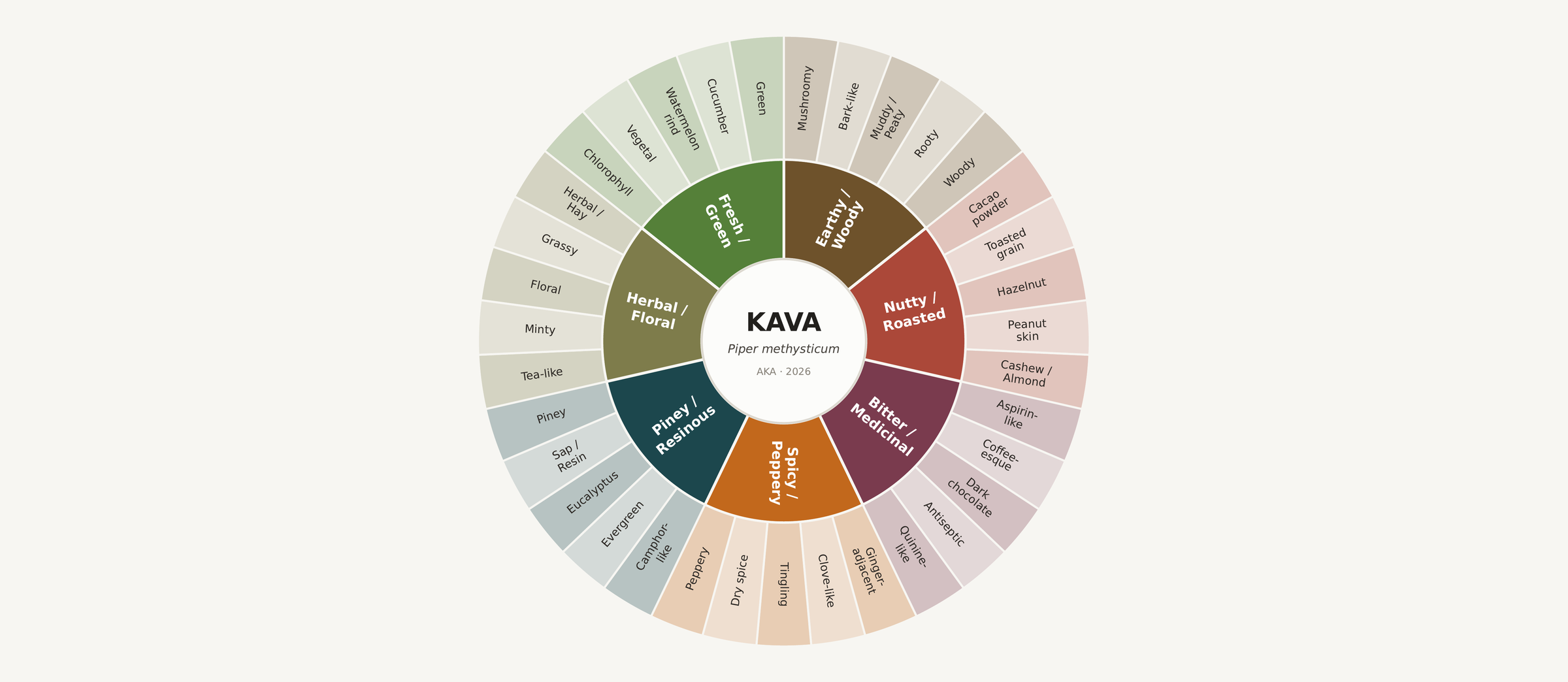
- Kava's sensory profile is organized here into seven flavor families — earthy/woody, nutty/roasted, bitter/medicinal, spicy/peppery, piney/resinous, herbal/floral and fresh/green — with mouthfeel and temporal-chemesthetic attributes treated as parallel modifiers rather than as additional families.
- Traditional aqueous kava is a suspension, not a solution. Mass balance places 74 to 86 percent of root kavalactone in the strained drink, but only about 9 to 16 percent of what is in the cup is truly dissolved. Particle size is therefore a flavor-delivery variable, not merely a texture variable.
- A 2018 association laboratory analysis of dried Vanuatu root supplies the first located fat determination for kava, 2.62 g per 100 g, with potassium 1,620 mg, calcium 324 mg, iron 4.80 mg and sodium 42.9 mg per 100 g, dietary fibre 24.3 percent, total sugars 3.00 percent and a calculated 351 kcal per 100 g.
- The profile every major regulator quotes — about 43 percent starch and 20 percent fibre — traces to a single 1992 monograph with no recoverable analytical method. No modern starch determination exists, and no proximate analysis of the strained beverage has ever been published.
- Brewed coffee and brewed black tea each deliver about 1 kcal per 100 g and negligible macronutrient content, while the strained kava beverage carries roughly twice the solids load of filter coffee per unit volume. Whatever grounds the food status of the comparator beverages, it is not nutrient delivery.
- The consumer sensory panel specified in the paper has not been conducted. No hedonic scores, descriptor frequencies or temperature preferences are reported, because none have been collected.
The literature treats kava as a drug. People drink it.
Almost everything published on Piper methysticum treats it as a pharmacological agent — kavalactone chemistry, hepatic safety, anxiolytic effect, regulatory status. Almost nothing treats it as what it is at the point of consumption: a beverage, served in a bowl, in company, to people who have opinions about how it tastes. Coffee, cacao, tea and wine each carry a food-science literature of trained panels, descriptive analysis, published lexicons and flavor wheels. Kava carries none of it.
This paper assembles the primary-source record of how outside observers described kava's taste, smell and texture between the 1770s and the end of the twentieth century; sets that record against the early European reception of coffee, chocolate and ginger using digitized primary texts rather than received summaries; and proposes a seven-family sensory framework, drawn as a flavor wheel, that gives producers, kava bars and researchers a shared vocabulary for what is in the cup. Every quotation is attributed to the edition actually consulted, because nearly every famous early beverage quotation in circulation reaches the reader through a later edition, a translation, optical character recognition of a scanned page, or an early twentieth-century trade history with a promotional interest.
What outsiders actually said, 1777 to 1996
Across two and a half centuries of outsider accounts the vocabulary is small and stable. It is also, and this is the first substantive finding, largely not about taste. Of ten recurrent descriptor groups, four are tactile or chemesthetic, two are visual, and only two are unambiguously gustatory. What the record preserves is a complaint about texture, appearance and oral sensation far more than about flavor in the narrow sense.
The second pattern is that the earliest and most-quoted passages are about preparation rather than about the drink. Georg Forster's 1777 line — kava is "made in the most disgustful manner that can be imagined" — is the single most-cited sentence in the kava sensory record, and it applies its adjectives to a process while describing the sensory content of the beverage not at all. La Billardière's party, in 1793, declined the offered bowl explicitly because they had watched it being prepared. The only first-hand sensory judgment anywhere in his passage, "acrid and stimulant," is of the raw root, chewed, not of the drink.
Table 1. The recurrent outsider descriptor set for kava, arranged by sensory channel, with the earliest located attestation of each term.
- Peppery, acrid, stimulant, biting — Sensory channel: Chemesthetic and gustatory · Earliest located attestation: La Billardière 1793, on the chewed raw root · Maps to: Spicy / peppery
- Bitter — Sensory channel: Gustatory (TAS2R) · Earliest located attestation: Mead 1928; earlier only as generalized unpleasantness · Maps to: Bitter / medicinal
- Astringent, drying, chalky — Sensory channel: Tactile / mouthfeel · Earliest located attestation: Mead 1928; Lebot & Cabalion 1988 ("chalky") · Maps to: Mouthfeel layer
- Numbing, tingling — Sensory channel: Chemesthetic · Earliest located attestation: Keesing 1941 ("lingering numbness") · Maps to: Mouthfeel and temporal overlay
- Earthy, muddy, muddy water — Sensory channel: Gustatory and olfactory · Earliest located attestation: Forster 1777 (appearance); Sahlins 1962 (taste) · Maps to: Earthy / woody
- Woody, cedar-pencil, resinous — Sensory channel: Olfactory / retro-nasal · Earliest located attestation: Ford 1967 · Maps to: Earthy / woody and piney / resinous
- Café-au-lait, milky, opaque — Sensory channel: Visual · Earliest located attestation: Forster 1777; Britannica 9th ed. 1882 · Maps to: Visual and particulate cues
- Burning effect requiring a water chaser — Sensory channel: Chemesthetic, temporal · Earliest located attestation: Ellis, on Miomioi, 1820s · Maps to: Temporal / chemesthetic overlay
- Initially sweet, then pungent — Sensory channel: Temporal, gustatory · Earliest located attestation: Britannica 9th ed. 1882 · Maps to: Temporal / chemesthetic overlay
- Slimy, thick, fibres subsiding — Sensory channel: Tactile and visual · Earliest located attestation: La Billardière 1793; Firth 1936 · Maps to: Mouthfeel layer
Every descriptor in this table was applied to material handled without any of the post-harvest controls that now govern commercial kava.
Two cautions belong with the table. Titcomb, working on Hawaiian ʻawa in 1948, observed that most Polynesian foods were suave and non-acid and that no drink other than a medicinal one carried any bitterness at all, and concluded that the local adjective translated as "bitter" was doing different work from the English word. And mandatory peeling, prompt drying, cultivar identity and particle-size control are all recent. Muddiness, mustiness and harshness are in large part descriptions of exactly the things modern handling was designed to remove, which makes applying that vocabulary to a peeled, promptly dried, single-cultivar noble root a category error.
The best sensory line of the nineteenth century came from the pharmacists, not the missionaries
Nineteenth-century missionary writing supplies the densest cluster of hostile description and the least usable evidence, because its adjectives were selected to support a conclusion. The most informative description of kava's flavor in that century comes instead from the materia medica tradition — the kava article in the ninth edition of the Encyclopædia Britannica, 1882 — because its purpose was description rather than persuasion. It reports a muddy liquid "resembling café au lait in appearance," with a taste "at first sweet and slightly aromatic, afterwards pungent and acrid," followed by numbness of the tongue and lips.
Three things make it the most valuable outsider sensory line of the century. It is the first description with temporal structure, reporting an opening impression followed by a different one rather than a single verdict. It separates appearance from taste from oral sensation. And every element of it survives into the modern framework below: a sweet opening, a pungent and acrid mid-palate, and a persistent numbing finish are exactly the temporal overlay that experienced drinkers still describe.
One detail from the same century is worth keeping. Churchill recorded Samoan drinkers adding the aromatic leaves and bark of other plants to the bowl to alter its character. That is the earliest documented instance of deliberate flavor modification of kava by its own drinkers, and it is evidence against the reading that Pacific drinkers were indifferent to sensory character.
Coffee's bitterness turned out to be a process artifact
The earliest English-language sensory judgment of coffee is also the most economical. William Biddulph, in the Levant around 1600, called it "more holesome than toothsome" — efficacy conceded, palatability denied, in six words. Sandys in 1615 has it "blacke as soote, and tasting not much unlike it." Bacon in 1626 describes a strong scent "but not Aromaticall." Blount in 1636 gives "a little bitterish taste." Pasqua Rosée's handbill of about 1652, the first coffee advertisement in England, is a list of conditions cured and contains no flavor claim at all.
Modern flavor chemistry supplies the correction that matters. Caffeine — the compound popular accounts blame — contributes only about 15 percent of coffee's bitterness. The dominant contributors are chlorogenic acid lactones and phenylindanes formed during roasting. Coffee's bitterness is therefore mostly something the process creates, not something the bean contains, and the historical obsession with roast degree, grind fineness, water temperature and brewing method was chemically well founded rather than superstitious. The trajectory of coffee's domestication follows the chemistry: roast control, grind control, filtration, and later pressure extraction. Sugar and milk were adjuncts, not the solution.
Chocolate is the case that tells you what to do
The chocolate record supplies the strongest single piece of evidence in this comparison, and it is not a fragment. Girolamo Benzoni, in 1565, describes his own reception of cacao from start to finish in one paragraph: it "seemed more a drink for pigs, than a drink for humanity"; he refused it for more than a year; he adopted it when wine ran out; he continued to find it bitter; and he ended by judging it satisfying and refreshing without intoxicating. Initial disgust, a documented duration of refusal, adoption under constraint, continued acknowledgement of the aversive attribute, and a favorable functional appraisal — a complete acquired-taste trajectory, four centuries before the flavor-consequence learning literature described the mechanism.
That pattern is the one observed among new kava drinkers now: continued acknowledgement of an unfamiliar flavor alongside a favorable appraisal of what the drink does in a social setting. And the mechanism is separable. Repeated exposure alone raises liking for initially disliked flavors. Flavor-consequence learning is stronger still, and was demonstrated for caffeine by Yeomans and colleagues in 1998. Pairing with an already-liked taste transfers liking even after the sweetness is withdrawn. Genetic variation in TAS2R bitter receptors shifts the starting point and the amount of learning required, but does not fix the endpoint.
Cacao's obstacle is two-channel, and that is why it is the instructive case. Bitterness comes from methylxanthines, bitter peptides and polyphenols; astringency is a separate, tactile percept produced by polyphenols precipitating salivary proteins. The interventions that made chocolate broadly palatable were correspondingly physical rather than gustatory: hydraulic pressing in 1828, which let fat content and mouthfeel be controlled independently of the solids carrying the bitterness; the moulded bar in 1847, which replaced a suspension in water with a fat-continuous solid; milk chocolate, whose proteins and fat bind polyphenols; and conching in 1879, which took particle size below the threshold of perceived grittiness while volatilizing aversive aromatics.
Kava presents the same dual obstacle — bitter and astringent together — in the same physical form, an aqueous suspension of insoluble plant particles. The chocolate history therefore predicts where the productive work lies, and it is not sweetening.
Ginger is the control, and it is the one that isolates the variable
Ginger is customarily listed as a third parallel case. The primary record does not support that, and the discrepancy is more useful than the parallel would have been: no early modern European text describing ginger as unpleasant was located. Gerard's Herball of 1597 treats it as a valued warming drug with no aversive sensory note at all. The comparison can be made inside a single work — cacao entered the Herball in Johnson's 1633 revision as "of an astringent and unpleasant taste," while ginger in the same volume attracts no such remark.
Ginger differs from coffee, cacao and kava on three axes at once. Its dominant sensation is pungency, transduced by TRPV1 and TRPA1 channels on trigeminal afferents rather than by TAS2R taste receptors, so it is closer to warmth than to taste and is not an innate rejection signal. It reached Europe overland long before the seventeenth century and was already naturalized in cookery and pharmacy, while coffee, cacao and kava arrived as complete novelties in unfamiliar preparations. And its beverage forms are late: ginger beer is mid-eighteenth century, carbonated ginger ale nineteenth.
Read as a control, ginger isolates the operative variable. Sensory intensity alone does not require a normalization narrative — ginger is intensely sensation-bearing and never needed one. What required normalization in the coffee and cacao cases was novelty combined with an innately aversive channel, which is precisely kava's position.
Five stages, and where kava actually sits
Coffee and cacao share a sequence. Placed against it, kava is well advanced at stages 1, 2 and 5, partially advanced at stage 3, and essentially absent at stage 4 — and the gap at stage 4 is the one that matters, because process interventions cannot be optimized against a sensory target that has never been stated.
Table 2. The five-stage pattern of beverage normalization observed for coffee and cacao, with kava placed against it.
- 1. Novel encounter described in repellent terms with efficacy conceded — Coffee: Biddulph c. 1600, "more holesome than toothsome"; Sandys 1615, "blacke as soote" · Chocolate: Anonymous Conqueror 1556, foam "must be given room to subside"; Benzoni 1565, "more a drink for pigs" · Kava: Forster 1777, "disgustful," "nauseous"; La Billardière 1793, "acrid and stimulant"
- 2. Medical framing substitutes for hedonic appeal — Coffee: Rosée handbill c. 1652 — a disease list, no flavor claim · Chocolate: Colmenero 1631 and 1652 — humoral and therapeutic argument · Kava: Anxiolytic and standardized-extract literature, 1990s onward
- 3. Process intervention rather than sweetening solves the sensory obstacle — Coffee: Roast, grind and filtration control; later pressure extraction · Chocolate: Pressing 1828; alkalization 1828 or 1846 (sources differ); bar 1847; milk 1879; conching 1879 · Kava: Post-harvest standardization recent and not yet harmonized — Vanuatu 2013 and Fiji 2017 differ on peeling; cultivar selection, prompt drying and particle-size control in practice but uncharacterized; no measured sensory effect published for any of them
- 4. Descriptive vocabulary and quality grading emerge — Coffee: SCA cupping protocol and flavor wheel · Chocolate: Cacao of Excellence and fine-flavor lexicons; earlier, adulteration analysis driving the Food and Drug Act 1860 · Kava: Not yet established in the receiving market, though Pacific producing societies grade kava and long have. This paper proposes a starting framework
- 5. Social ritual and category identity consolidate the beverage — Coffee: Coffee house, then café and third wave · Chocolate: Chocolate house, then confectionery and craft bar · Kava: Nakamal, then kava bar; category identity still contested
The kava column is an assessment of the present state of the field, not a prediction.
Cacao's aversive load was reduced before any recipe was written: fermentation and roasting are operations on the raw material, and both were inherited practice long before Europe took an interest. Kava's equivalent is about a decade old. The obligation to peel is not codified tradition but recent regulatory text — the Vanuatu kava quality manual of 2013 and the Fiji kava standard of 2017 — and the two producing nations that supply most of the world's kava do not yet agree on which fractions are peeled. Peel and bark are a distinct tissue with a distinct constituent profile, so whether they are present is a compositional variable, not a detail.
A seven-family flavor wheel for kava
Flavor wheels organize sensory attributes hierarchically to support profiling and comparison, as they do for coffee, cacao, tea and wine. No standardized kava wheel is in general use. The wheel below is proposed as a starting framework: seven primary families on the inner ring, each resolving into five granular descriptors on the outer ring, with mouthfeel and temporal-chemesthetic attributes treated as parallel modifiers rather than as additional segments.
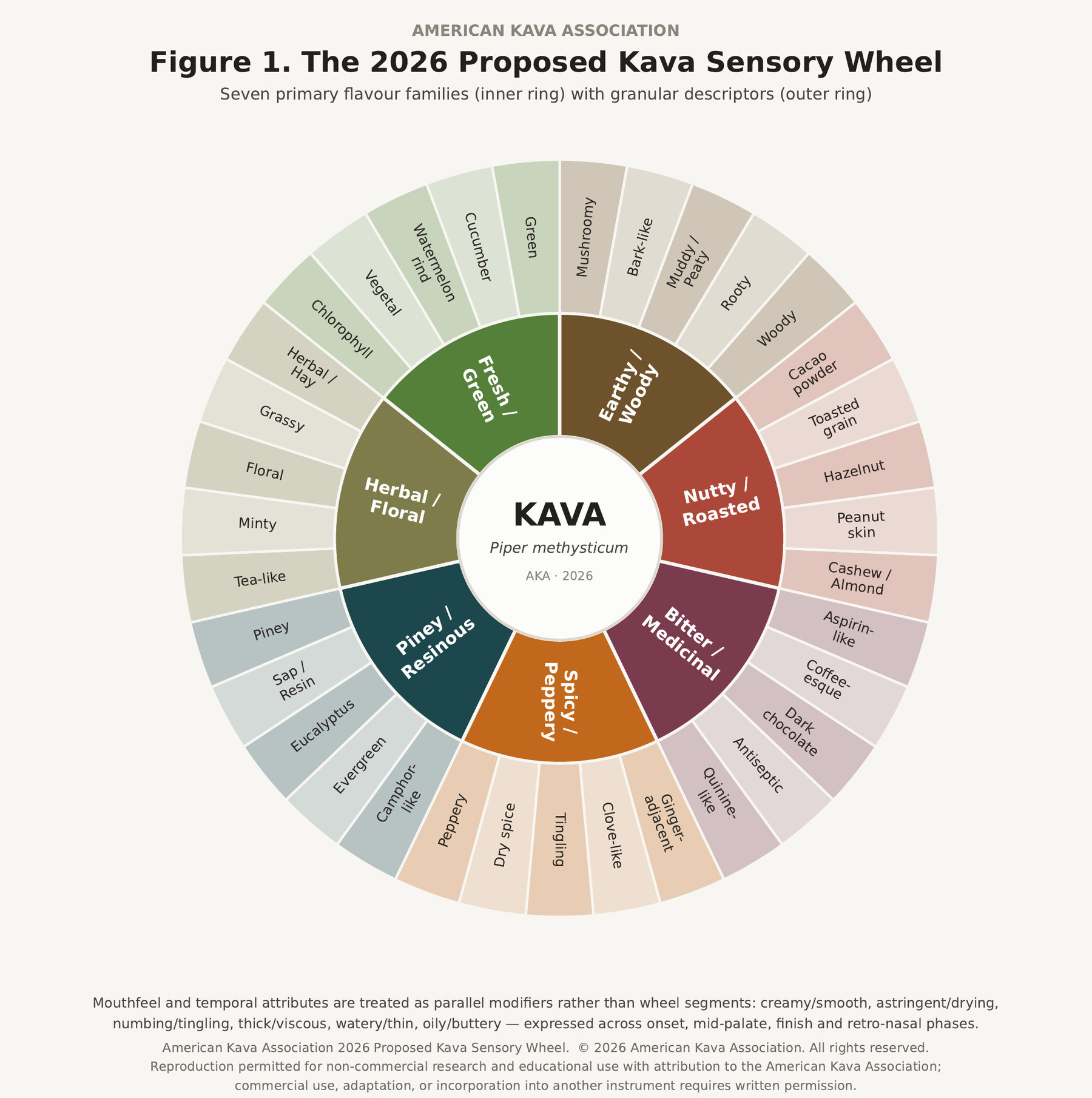
Three points define its status. It is a descriptive framework, not a validated instrument — no panel has yet confirmed that trained assessors partition kava attributes this way. It encodes no preference: no family is a defect and none is a target. And it is built to be falsified, which is what the open-ended response stage of the protocol in the paper is for.
Each family is organized around causes rather than impressions. Earthy / woody is the structural foundation and the least avoidable, arising from root tissue, lignin and cell-wall character — though its muddy and peaty end is a handling artifact, driven by soil carryover and slow or uneven drying, rather than an intrinsic property. Nutty / roasted is the bridging domain, Maillard-adjacent and lipid-associated, concentrated by drying and aging and amplified by warm-water extraction. Bitter / medicinal is the most cognitively charged: most often misread as a defect, it is also the clearest marker of potency, and poor emulsification exaggerates it by leaving kavalactones directly available to receptors. Spicy / peppery is the most tactile, rooted in the genus Piper and expressed through trigeminal stimulation. Piney / resinous is the most volatile and disproportionately influential at low concentration, expressed more strongly in lateral roots. Herbal / floral is the most culturally legible, driven by oxygenated volatiles that clean drying preserves and over-aging suppresses. Fresh / green is kava at its least processed, dominated by green volatiles and chlorophyll-adjacent compounds that drying converts into earthiness within days.
Two descriptors in that last family are the ones consumers most often volunteer on first encountering fresh material: cucumber, and watermelon rind. They are retained in the lexicon unmodified so that the informal reports can be tested rather than assumed.
Mouthfeel is not secondary, and neither is time
Kava is an aqueous or coconut-based suspension, and the suspension governs flavor release and persistence. Mouthfeel therefore sits parallel to the families rather than beneath them: creamy or smooth, astringent or drying, numbing or tingling, thick or viscous, watery or thin, oily or buttery. Astringency deserves separate treatment because it is a tactile percept produced by the precipitation of salivary proteins, not a taste — in balanced profiles it adds structure and lengthens the finish; in excess it reads as chalky and reduces drinkability.
A second parallel layer is temporal. Onset is a green and peppery lift with numbing. Mid-palate is creamy viscosity balancing nutty against bitter. The finish is a drying astringency fading to clean earthy resonance. Retro-nasal aroma commonly intensifies after the sip, moving from herbal and piney top notes toward deeper earthy and nutty bases. The signature numbing of tongue and lips persists in the range of 5 to 15 minutes, which is why any panel work has to specify an inter-sample interval of at least ten minutes — otherwise the previous sample is still in the mouth.
Service temperature is a lever rather than a detail. Chilled service at 4 to 10 °C amplifies fresh and piney lift and reduces perceived bitterness; ambient or slightly warm service at 25 to 38 °C brings forward nutty, roasted and earthy character and lengthens the finish. The evidence points to two coherent service profiles rather than one correct temperature.
Table 3. The proposed kava sensory lexicon: the descriptor set represented in the wheel, with the two parallel layers.
- Earthy / woody — Descriptors: Woodsy; rooty; muddy or peaty; bark-like; mushroomy
- Nutty / roasted — Descriptors: Cashew or almond; peanut or peanut skin; hazelnut; toasted grain; cacao or cocoa powder
- Bitter / medicinal — Descriptors: Quinine-like; antiseptic or medicinal; dark chocolate; coffee-esque; aspirin-like
- Spicy / peppery — Descriptors: Peppery; spicy; tingling; clove-like; ginger-adjacent
- Piney / resinous — Descriptors: Piney; sap or resin; eucalyptus; evergreen; camphor-like
- Herbal / floral — Descriptors: Herbal or hay; grassy; floral (rose, lavender); minty; tea-like
- Fresh / green — Descriptors: Green; cucumber; watermelon rind; vegetal; chlorophyll
- Mouthfeel (parallel layer) — Descriptors: Creamy or smooth; astringent or drying; numbing or tingling; thick or viscous; watery or thin; oily or buttery
- Temporal (parallel overlay) — Descriptors: Onset; mid-palate; finish; retro-nasal evolution
The lexicon is formatted for use as a check-all-that-apply list. It is a proposal, not a validated instrument.
The drink is a suspension, not a solution
The most consequential compositional fact about kava as a beverage is that most of what is in the cup is not dissolved. Direct mass-balance measurement places 74 to 86 percent of the root's kavalactone load in the strained drink, but only about 9 to 16 percent of what arrives in the cup is truly dissolved. Roughly nine-tenths of delivered kavalactone rides on suspended plant solids that pass the strainer.
That resolves an apparent contradiction in the literature, where reported transfer efficiencies span from under 3 percent to 85.5 percent. Those are not conflicting measurements of the same quantity: the low figures measure dissolved kavalactone, the high figures measure total delivered kavalactone including the particle-bound fraction.
Four consequences follow, and they are why a sensory paper carries a compositional section. Particle size is a flavor-delivery variable, not merely a texture variable — grind, shear and filtration cut-off determine where and how fast compounds are released, not just grittiness. Sedimentation changes the drink during a session, so the last mouthful is not the first; the traditional practice La Billardière recorded, of gathering the settled fibres and re-wringing them, addresses exactly that. Astringency and bitterness are partly co-located on the same particles, which is why they covary in practice and why interventions that reduce one usually reduce the other. And dose and flavor cannot be varied independently by dilution, which constrains the design space and makes physical intervention — the cacao route — the more promising one.
A soluble extract is therefore not a more convenient form of the traditional beverage. It removes the particulate channel outright, which is what the comparative history predicts will work, but it is a different product, because it discards the phase that carries most of what the traditional drink delivers.
What a 2018 laboratory analysis closes, and what is still open
One measured analysis of kava root does exist and has not previously been placed in the compositional literature: a nutritional analysis of dried Vanuatu root — 30 percent lateral root and 70 percent basal stump, sample PV-R092418 — commissioned and published by the association in 2018. It supplies the first located fat determination for kava, 2.62 g per 100 g, resolved into 0.60 g saturated, 0.11 g monounsaturated and 0.90 g polyunsaturated, with trans fatty acids and cholesterol not detected. It supplies an elemental panel: potassium 1,620 mg, calcium 324 mg, iron 4.80 mg and sodium 42.9 mg per 100 g. It supplies dietary fibre at 24.3 percent, total sugars at 3.00 percent resolved by HPLC into fructose, glucose, sucrose and maltose, protein at 2.98 percent by combustion analysis, ash at 4.60 percent, moisture at 8.99 percent, and a calculated 351 kcal per 100 g.
Against that, the profile every major regulator quotes — approximately 43 percent starch and 20 percent fibre — traces to a single 1992 monograph with no recoverable analytical method. No modern enzymatic starch determination has been published. No starch or fibre split by root fraction exists, although fraction is known to govern kavalactone content and is a stated driver of five of the seven flavor families. Magnesium and phosphorus have not been measured. No vitamin panel has been run. And no proximate analysis of the strained beverage exists anywhere — the only measured beverage-solids figure located in the literature is 3.01 to 3.15 g per 125 mL, for one cultivar in one laboratory.
Table 4. Kava beside brewed coffee and brewed black tea on a 240 mL serving basis. Coffee and tea values are USDA reference values scaled to 240 g; kava entries are scaled from the measured figures above.
- Solids in the serving — Kava, strained: 5.8–6.0 g measured, scaled from 3.01–3.15 g per 125 mL · Coffee, brewed: 2.8–3.2 g dissolved · Tea, black: Not determined here
- Energy — Kava, strained: About 25 kcal, upper bound on gross energy · Coffee, brewed: 2 kcal · Tea, black: 2 kcal
- Protein — Kava, strained: Not determined for the beverage; 2.98 g per 100 g of dried root · Coffee, brewed: 0.29 g · Tea, black: 0 g
- Dietary fibre — Kava, strained: Not determined for the beverage; 24.3 g per 100 g of dried root · Coffee, brewed: 0 g · Tea, black: 0 g
- Potassium — Kava, strained: Not determined for the beverage; 1,620 mg per 100 g of dried root · Coffee, brewed: 118 mg · Tea, black: 89 mg
- Calcium — Kava, strained: Not determined for the beverage; 324 mg per 100 g of dried root · Coffee, brewed: 5 mg · Tea, black: 0 mg
- Caffeine — Kava, strained: None · Coffee, brewed: 96 mg · Tea, black: 48 mg
- Physical state of the load — Kava, strained: Predominantly suspended plant tissue; about 90 percent of beverage kavalactone is particle-associated · Coffee, brewed: Dissolved · Tea, black: Dissolved
Included to make the scale of the kava data gap visible, not to support any nutritional claim.
Two things follow and should be kept apart. On a per-volume basis the strained kava beverage carries roughly twice the solids load of filter coffee, and the dried root it is made from is a characterized food material. Whatever grounds the accepted food status of coffee and tea, it is not nutrient delivery — each delivers about 1 kcal per 100 g and negligible macronutrient content. What would settle the open question is narrow and inexpensive: a proximate and elemental analysis of the strained beverage at a stated root charge, water volume, temperature and strainer cut-off, run alongside the marc so that the two close.
What this means for producers and kava bars
The comparative and compositional analysis converges on a small number of actionable points. They are implications of the reviewed evidence, not recommendations backed by trial data.
The productive interventions are physical. Particle-size distribution, particulate load, filtration cut-off and the presence of fat or protein are the levers the chocolate precedent and the suspension data both point to. Filtration cut-off should be treated as a formulation parameter: the difference between 150-micrometre and 70-micrometre straining is a difference in grit, in astringency delivery and in sedimentation behavior, not merely in clarity. Over-blending is a defined defect — micronization increases bitterness and astringency and releases fibre associated with nausea reports, while appearing to improve yield, so shear should be specified and limited rather than maximized. Sedimentation should be managed deliberately, since an unstabilized suspension delivers a changing composition across a session; traditional Hibiscus tiliaceus mucilage stabilization and modern agitation practice address the same problem. Menus that specify service temperature give consumers a meaningful choice rather than a default.
And bitterness should not be treated as a defect to be eliminated. It is the attribute experienced consumers associate with quality, and the comparative histories indicate that categories which eliminated their characteristic bitterness lost their category identity along with it.
The panel has not been run
This paper reports no sensory measurements. The framework above is a proposal derived from reported tasting notes, practitioner experience and lexicon convention, and it has not been validated by trained assessors or by consumer data. The consumer study specified in the paper — 100 adults stratified as kava-naïve, occasional and experienced, within-subject and blinded, two service temperatures from the same batch, check-all-that-apply against the 35 outer-ring descriptors plus distractors, with an open-ended stage before the list is shown — has not been conducted, and no result should be inferred from the presence of a method section.
The historical sources are not sensory data either. They were produced without controlled conditions, without cultivar or preparation records, and frequently with argumentative purpose; they evidence a reception pattern, not a flavor profile. Several key quotations reach the reader through later editions, translations or trade histories with promotional interests, and where the transmission path introduces doubt about wording, the paper states the doubt rather than smoothing it over. The commercial observations reflect United States kava-bar practice. Nothing in the paper addresses hepatic safety, dose, drug interaction or regulatory status.
What would close the gaps
Ordered by expected information gain against cost: a proximate and lipid analysis of kava root by fraction and cultivar, including a modern enzymatic starch determination and a full elemental panel; a proximate analysis of the strained beverage, which does not currently exist anywhere and which the FAO and WHO documentation itself identifies as an open question; a quantitative partition of kava bitterness across compound classes, on the model of the coffee work, to establish whether kavalactones actually dominate kava bitterness or whether, as in coffee, something else does; execution of the consumer protocol, including validation or falsification of the seven-family structure; and a particle-size intervention trial manipulating filtration cut-off and shear systematically, which is the direct test of the cacao-precedent prediction.
Beyond those: multi-cultivar descriptive analysis with a trained panel; cross-cultural consumer panels separating learned liking from cultural framing; a longitudinal exposure study, which is the only design that can measure the learned-liking trajectory directly; characterization of Hibiscus tiliaceus mucilage as a suspension stabilizer; composition of peel and bark against peeled root from the same lot; and volatile characterization of fresh against dried material of the same cultivar by headspace GC-MS, which would establish what the fresh/green family consists of chemically.
Kava is consumed in beverage form, in communal settings, by people who discuss its flavor. The historical record does not support the view that it is uniquely unpalatable — it shows that outsider descriptions of kava follow the standard rhetorical form of early modern beverage reporting. What kava lacks is the descriptive stage. Coffee and cacao both acquired a shared vocabulary and a grading framework before their process improvement became systematic, because a process cannot be optimized against an unstated sensory target. That is the stage this framework is offered to start.
References
- Acosta, J. de. (1880). The natural and moral history of the Indies (E. Grimston, Trans.; C. R. Markham, Ed.; Vol. 1, Books I–IV). Hakluyt Society. (Translation originally published 1604; Spanish original 1590). Page facsimile retrieved from https://archive.org/details/naturalmoralhist60acosrich/page/n306
- American Kava Association. (n.d.). Technical White Paper No. 3: Effect of extraction pH on kavalactone recovery. Retrieved from https://www.americankavaassociation.org/study/extraction-ph-kavalactone
- American Kava Association. (n.d.). Technical White Paper No. 5: Kavalactone transfer efficiency in shaker-bottle extraction. Retrieved from https://www.americankavaassociation.org/study/alu-shaker-extraction
- Anonymous Conqueror. (1556). Relatione di alcune cose della Nuova Spagna. Venice. Quoted in Coe, S. D., & Coe, M. D. (2013), p. 84.
- Bacon, F. (1626). Sylva sylvarum: Or a naturall historie. William Lee.
- Benzoni, G. (1857). History of the New World (W. H. Smyth, Trans.). Hakluyt Society. (Original work published 1565). Transcription retrieved from https://dcc.newberry.org/?p=14389
- Bingham, H. (1847). A residence of twenty-one years in the Sandwich Islands. Hezekiah Huntington.
- Blount, H. (1636). A voyage into the Levant. Andrew Crooke.
- Blythe, T., & Lowin, T. (2018). Kava nutritional facts. American Kava Association, Las Vegas, NV. Commissioned laboratory analysis of dried Vanuatu kava root, sample identification PV-R092418, laboratory sample number 54802, received 5 November 2018 and reported 21 November 2018; published online 28 November 2018. Report on file with the association.
- Bott Spillius, E. (1982). Power and ritual: The kava ceremony in Tonga. In N. Gunson (Ed.), Studies in Pacific history. Australian National University.
- Brunton, R. (1989). The abandoned narcotic: Kava and cultural instability in Melanesia. Cambridge University Press.
- Coe, S. D., & Coe, M. D. (2013). The true history of chocolate (3rd ed.). Thames & Hudson.
- Colmenero de Ledesma, A. (1652). Chocolate: Or, an Indian drinke (J. Wadsworth, Trans.). J. G. Retrieved from https://www.gutenberg.org/files/21271/21271-h/21271-h.htm
- Deihl, J. R. (1932). Kava and kava-drinking. Primitive Man, 5(4), 61–68. https://doi.org/10.2307/3316234
- Drewnowski, A., & Gomez-Carneros, C. (2000). Bitter taste, phytonutrients, and the consumer: A review. American Journal of Clinical Nutrition, 72(6), 1424–1435. https://doi.org/10.1093/ajcn/72.6.1424
- Ellis, W. (1829). Polynesian researches during a residence of nearly six years in the South Sea Islands (Vols. 1–2). Fisher, Son & Jackson.
- European Medicines Agency. (n.d.). Assessment report on Piper methysticum G. Forst., rhizoma. Committee on Herbal Medicinal Products.
- Fernández de Oviedo, G. (1959). Historia general y natural de las Indias (Vol. 1). Ediciones Atlas. (Original work published 1535). Quoted in Coe, S. D., & Coe, M. D. (2013), pp. 110, 112.
- Firth, R. (1936). We, the Tikopia: A sociological study of kinship in primitive Polynesia. George Allen & Unwin.
- Food and Agriculture Organization of the United Nations & World Health Organization. (2016). Discussion paper on the development of a regional standard for kava products used as a beverage when mixed with water. Retrieved from http://www.fao.org/3/a-i5770e.pdf
- Food Standards Australia New Zealand. (n.d.). Proposal P1057 supporting document 1: Kava — risk and technical assessment. Retrieved from https://www.foodstandards.gov.au/sites/default/files/food-standards-code/proposals/Documents/P1057%20SD1.pdf
- Ford, C. S. (1967). Ethnographical aspects of kava. In D. H. Efron, B. Holmstedt, & N. S. Kline (Eds.), Ethnopharmacologic search for psychoactive drugs (pp. 162–173). U.S. Department of Health, Education, and Welfare.
- Forster, G. (1777). A voyage round the world in His Britannic Majesty’s sloop, Resolution. B. White.
- Forster, J. R. (1778). Observations made during a voyage round the world. G. Robinson.
- Frank, O., Blumberg, S., Kunert, C., Zehentbauer, G., & Hofmann, T. (2007). Structure determination and sensory analysis of bitter-tasting 4-vinylcatechol oligomers and their identification in roasted coffee by means of LC-MS/MS. Journal of Agricultural and Food Chemistry, 55(5), 1945–1954. https://doi.org/10.1021/jf0632280
- Gerard, J. (1597). The herball, or generall historie of plantes. John Norton.
- Gerard, J. (1633). The herball or generall historie of plantes (T. Johnson, Rev. ed.). Adam Islip, Joice Norton and Richard Whitakers.
- Hope, G., & Storey, D. (2010). Kava and chicha: A comparison of masticated beverage traditions. Griffith University. Retrieved from http://hdl.handle.net/10072/43895
- International Agency for Research on Cancer. (2016). Kava extract. In Some drugs and herbal products (IARC Monographs, Vol. 108). Retrieved from https://www.ncbi.nlm.nih.gov/books/NBK350450/
- Kava. (1882). In Encyclopædia Britannica (9th ed., Vol. XIV, p. 18). Adam & Charles Black. Transcription retrieved from https://en.wikisource.org/wiki/Encyclop%C3%A6dia_Britannica,_Ninth_Edition/Kava
- Kava. (1911). In H. Chisholm (Ed.), Encyclopædia Britannica (11th ed., Vol. 15, p. 700). Cambridge University Press. Transcription retrieved from https://en.wikisource.org/wiki/1911_Encyclop%C3%A6dia_Britannica/Kava
- Keesing, F. M. (1941). The South Seas in the modern world. John Day Company.
- Kilham, C. S. (1996). Kava: Medicine hunting in paradise. Healing Arts Press.
- La Billardière, J. J. H. de. (1800). Voyage in search of La Pérouse (Vol. 2). John Stockdale. (Original work published 1798). Retrieved from https://en.wikisource.org/wiki/Voyage_in_Search_of_La_P%C3%A9rouse/Volume_2/Chapter_12
- Lebot, V., & Cabalion, P. (1988). Kavas of Vanuatu: Cultivars of Piper methysticum Forst. (Technical Paper No. 195). South Pacific Commission. Retrieved from https://horizon.documentation.ird.fr/exl-doc/pleins_textes/divers14-07/26842.pdf
- Lebot, V., Merlin, M., & Lindstrom, L. (1992). Kava: The Pacific drug. Yale University Press.
- Lebot, V., Merlin, M., & Lindstrom, L. (1997). Kava: The Pacific elixir: The definitive guide to its ethnobotany, history, and chemistry. Healing Arts Press. (Retitled reprint of Lebot, Merlin & Lindstrom, 1992).
- Marradón, B. (1618). Diálogo del uso del tabaco y de los polvos de sahumerio y chocolate. Seville. Quoted in Coe, S. D., & Coe, M. D. (2013), p. 134.
- Masi, C., Dinnella, C., Monteleone, E., & Prescott, J. (2015). The impact of individual variations in taste sensitivity on coffee perceptions and preferences. Physiology & Behavior, 138, 219–226. https://doi.org/10.1016/j.physbeh.2014.10.031
- Mayhew, H. (1851). London labour and the London poor. Retrieved from https://www.gutenberg.org/files/55998/55998-h/55998-h.htm
- Mead, M. (1928). Coming of age in Samoa: A psychological study of primitive youth for western civilisation. William Morrow & Company.
- Pacific Community. (2017). The Fiji kava standard 2017: Piper methysticum Forst. f. Suva, Fiji: Pacific Community. Retrieved from https://www.agriculture.gov.fj/documents/booklets/kava.pdf
- Pasinszki, T., Devi, R., & Krebsz, M. (2025). Nutritional and kavalactone composition of Piper methysticum from Fiji. Horticulturae, 11(12), 1456. https://doi.org/10.3390/horticulturae11121456
- PHAMA (Pacific Horticultural and Agricultural Market Access Program). (2013). Kava quality manual: For the export of kava from Vanuatu. Commonwealth of Australia. Retrieved from https://phamaplus.com.au/wp-content/uploads/2023/11/KAVAMAN-WEB-A4-ENGLISH-01-27May13-1.pdf
- Priestley, J. (1772). Directions for impregnating water with fixed air. J. Johnson.
- PROSEA. (n.d.). Piper methysticum Forst. f. Plant Resources of South-East Asia. Retrieved from https://prosea.prota4u.org/view.aspx?id=614
- Robinson, E. F. (1893). The early history of coffee houses in England. Kegan Paul, Trench, Trübner. Retrieved from https://archive.org/details/earlyhistoryofco00robi
- Sahlins, M. D. (1962). Moala: Culture and nature on a Fijian island. University of Michigan Press.
- Sandys, G. (1673). A relation of a journey begun an. Dom. 1610 (7th ed.). (Original work published 1615).
- Stein, L. J., Nagai, H., Nakagawa, M., & Beauchamp, G. K. (2003). Effects of repeated exposure and health-related information on hedonic evaluation and acceptance of a bitter beverage. Appetite, 40(2), 119–129. https://doi.org/10.1016/S0195-6663(02)00173-3
- Teschke, R., & Lebot, V. (2011). Proposal for a kava quality standardization code. Food and Chemical Toxicology, 49(10), 2503–2516. https://doi.org/10.1016/j.fct.2011.06.075
- The women’s petition against coffee. (1674). Retrieved from https://en.wikisource.org/wiki/The_Women%27s_Petition_Against_Coffee
- Titcomb, M. (1948). Kava in Hawaii. Journal of the Polynesian Society, 57(2), 105–171.
- U.S. Department of Agriculture, Agricultural Research Service. (2019). FoodData Central: Beverages, coffee, brewed, prepared with tap water (FDC ID 171890). Retrieved from https://fdc.nal.usda.gov/food-details/171890/nutrients
- U.S. Department of Agriculture, Agricultural Research Service. (2019). FoodData Central: Beverages, tea, black, brewed, prepared with tap water (FDC ID 173227). Retrieved from https://fdc.nal.usda.gov/food-details/173227/nutrients
- U.S. Food and Drug Administration. (2023). Kava kava (Piper methysticum). Retrieved from https://www.fda.gov/media/169556/download
- Ukers, W. H. (1922). All about coffee. Tea and Coffee Trade Journal Company. Retrieved from https://www.gutenberg.org/ebooks/28500
- Waterhouse, J. (1866). The king and people of Fiji. Wesleyan Conference Office.
- Whymper, R. (1921). Cocoa and chocolate: Their chemistry and manufacture (2nd ed.). J. & A. Churchill. Retrieved from https://archive.org/stream/dli.bengal.10689.1394/10689.1394_djvu.txt
- Williams, J. (1837). A narrative of missionary enterprises in the South Sea Islands. J. Snow.
- Yeomans, M. R., Spetch, H., & Rogers, P. J. (1998). Conditioned flavour preference negatively reinforced by caffeine in human volunteers. Psychopharmacology, 137(4), 401–409. PMID 9676901.
- Yin, Y., Dong, Y., Vu, S., Yang, F., Yarov-Yarovoy, V., Tian, Y., & Zheng, J. (2019). Structural mechanisms underlying activation of TRPV1 channels by pungent compounds in gingers. British Journal of Pharmacology, 176(17), 3364–3377. https://doi.org/10.1111/bph.14766
- Zellner, D. A., Rozin, P., Aron, M., & Kulish, C. (1983). Conditioned enhancement of human’s liking for flavor by pairing with sweetness. Learning and Motivation, 14(3), 338–350.
Cite This
Blythe, T.; LaRose, D.; Bowman, J. The Organoleptic Spectrum of Kava: From Aversion to Appreciation in Comparative Beverage History. American Kava Association Technical White Paper No. 9, version 1.0; American Kava Association: Las Vegas, NV, USA, 2026.
Supporting Data and Access
This paper reports no new primary data. Every historical quotation is attributed to the edition consulted, with a retrieval location given in the reference list where a digitized text was used. The 2018 laboratory report reproduced in the composition section is available from the corresponding author on reasonable request.
Write to admin@americankavaassociation.org to enquire.