Overview
Twenty-eight HPLC assays from one independent laboratory, 2018–2026, follow the Papuan cultivar Isa from the Madang coast through Hawai‘i to Kali ISA, the line now grown in California and Florida. Cultivated Madang kava is dihydrokavain-led and strong, at 14–16% kavalactones in lateral roots. Seven root and raw-material assays of six Kali ISA lots coded 254631, sat as close to Madang-grown roots as to each other, and carried flavokavains at a mean 2.5% of kavalactones, with six of seven lots meeting both Harmonized flavokavain limits. Not noble by code and far below two-day kava on flavokavains, the line fits neither class.
Abstract
Key Findings
- Madang kava is strong and dihydrokavain-led. Madang Short and Madang Tall lateral roots returned 16.0% and 14.1% kavalactones (245631), about four times the earlier survey's root mean, with flavokavains at 4.0–4.8% of kavalactones.
- Six Isa plants, one profile. Peeled chips from six Madang Isa plants all coded 256431 across a 5.5-fold range in potency, with flavokavains steady at 2.6–3.3% of kavalactones.
- Two materials stand apart. In wild-collected Rai Coast Pink and the Marind cultivar Palima, kavain came last in all five readings; Rai Coast Pink failed both Harmonized flavokavain limits.
- The Hawaiian record does not make Isa two-day. Published Hawaiian records give Isa seven codes, three within the 2015 ACP-EU project that listed it as two-day; that project's Isa samples carried flavokavains at 2.9–4.4% of kavalactones against 11.3–35.5% for every other two-day sample.
- Place moves the lower positions. Across 184 named noble roots on six Fijian islands, location explained about a third of the variance in methysticin and yangonin relative to kavain.
- Kali ISA kept Madang composition. Seven root and raw-material assays of six lots coded 254631 (ties within 10%) and lay 2.1–9.4 points from Madang lateral roots, no further than their own 1.7–9.4-point spread.
- Low flavokavains. Kali ISA flavokavains averaged 2.5% of kavalactones in roots, 0.61 of the Madang root mean, and matched Madang Isa in peeled chips (2.97% and 2.95%); six of seven lots met both Harmonized limits.
- Neither class. Kavain ran 6.22–14.16 times flavokavain B, between two-day and noble reference roots; 254631 falls outside the Harmonized noble criterion, yet flavokavains sit far below two-day kava.
The short version
The question
Where does Kali ISA come from, and has its chemistry held on the journey from the Madang coast of Papua New Guinea, through Hawai‘i, to farms in California and Florida?
Why it matters
Papuan kava is the least-studied kava in the Pacific, and Isa, the Madang cultivar behind Kali ISA, has been filed with Vanuatu's two-day kavas on thin evidence. Growers, bars and standards bodies need to know what the line actually is before deciding how to label it.
What was done
One independent laboratory ran 28 HPLC assays between 2018 and 2026: Madang Short, Madang Tall, Koniak, six Isa plants, Iwi, wild-collected Rai Coast Pink, two Marind cultivars from Merauke, and ten assays of Kali ISA from six lots. Every value was set against the published Papuan, Hawaiian and Fijian records and against the Harmonized Multinational Kava Standards (2025).
Where, when and who
Papuan material from Madang Province and Merauke in Indonesian Papua; Kali ISA from Sarasota and Boca Raton, Florida, and the Association's Sacramento greenhouse. Assays by Flora Research Laboratories, Grants Pass, Oregon. Author: Tyler Blythe.
What it found
Cultivated Madang kava is led by dihydrokavain and is strong, at 14–16% kavalactones in lateral roots. Kali ISA returned the same 254631 profile in all seven root and raw-material assays and sits as close to Madang-grown roots as its own lots sit to each other. Its flavokavains averaged 2.5% of kavalactones, inside the Harmonized limit and nowhere near two-day kava, and six of seven lots met both flavokavain limits.
What it means for the trade
Kali ISA is a documented, stable line with its own chemistry: not noble by code, not two-day by flavokavains. Lot records, separating lateral root from stump, and keeping stems and peelings out of the cup keep it in the low-flavokavain range the paper reports.
What it means for kava drinkers
Isa-type kava has been drunk for generations in Papua New Guinea and Hawai‘i and is now widely drunk in Fiji. The mainland line carries the same composition, with flavokavains well below the two-day range.
What comes next
A side-by-side planting of Kali ISA and unselected Isa, genotyping of the line, a controlled tolerability study, and a companion paper on how Isa-type kava should be classified.
Version of record
The full article — methods, results, tables, figures and references — is published in The Journal of American Kava. The accepted manuscript, every laboratory certificate and the derived-value workbook are on Zenodo.
Discussion
The Association's fuller account of the article for growers, bars and the trade: the background, the method, the results and what they mean in practice.
Analytical basis — Twenty-eight HPLC assays, all from Flora Research Laboratories in Grants Pass, Oregon, run between 2018 and 2026. Seventeen used the laboratory's current validated method for the six kavalactones and flavokavains A, B and C; eleven used its earlier methods. Ten of the 28 are Kali ISA, from six lots grown at three sites in two states; the rest cover nine kinds of Papuan material. Comparator assays of Kali Hiwa, Fijian Waka, Hawai‘i-grown Isa and the Hawaiian cultivar Wa‘a Wa‘a were run by the same laboratory, and the mother stock of the line was confirmed as Piper methysticum by HPTLC against two authenticated root references. Every certificate is reproduced in the supplementary data, and every code and ratio is a formula in the derived-value workbook.
The kava nobody had measured properly
New Guinea is the largest island in kava's range and holds kava found nowhere else, yet its chemistry rests on two thin surveys. A 1987 expedition took five root samples of cultivated north-coast kava, and the National Agricultural Research Institute later assayed 47 samples of eight named cultivars without measuring flavokavains at all. That survey's root mean was 3.82% kavalactones, a figure that has followed Papuan kava around ever since, and it gave Madang Short four different codes at three sites, three of them kavain-led.
Genetics says the Papuan domesticates are their own lineage. In both modern marker studies Isa and Iwi fell outside every Pacific cluster, separate from the noble, two-day and wild groups sampled in Vanuatu and Polynesia. Isa has nonetheless been grouped with Vanuatu's two-day cultivars on the strength of its kavalactone order and spectra, even though no Papuan cultivar appears on any Vanuatu variety list. The paper follows that one cultivar from Madang to the American mainland and asks what each stop actually shows.
What Papuan kava turned out to be
Cultivated Madang kava is strong and dihydrokavain-led. Madang Short and Madang Tall lateral roots, from plants at least five years old, returned 16.0% and 14.1% kavalactones, roughly four times the old survey's root mean, with the 245631 profile; their peeled chips coded 254631, as did a standard commercial Koniak lot of roots and chips. Flavokavains ran at 3.5–4.8% of kavalactones: inside the Harmonized ratio limit, closer to noble than to two-day values. Because the roots are so potent, though, they and four of six Isa chip plants exceeded the separate absolute ceiling of 0.4% w/w.
Six Isa plants, one profile. Peeled chips from six individual Madang Isa plants all coded 256431 while potency ran from 4.18% to 23.1%, and their flavokavain share stayed in a narrow 2.6–3.3% band. A single cultivar can swing more than fivefold in strength from plant to plant and still hold its composition.
Two materials stand apart. Wild-collected Rai Coast Pink, used on the Rai Coast for toothache, fever and initiation rather than as a drink, and Palima, a red-stemmed Marind wati cultivar from Merauke, were the only materials in which kavain came last and desmethoxyyangonin outranked it, in all five of their readings. Rai Coast Pink also carried the highest flavokavain share in the study and failed both Harmonized limits. Munana, grown in the same Merauke gardens as Palima, did not share the pattern. The author's position is that wild kava belongs to its customary ritual use and should never be blended into beverage kava, and the paper extends that caution to Palima on its kavalactone order alone.
A trade that has come back. Kava drinking on the Madang coast was first written down by Miklouho-Maclay at Astrolabe Bay in 1871–1872, as a prized feast drink grown beside the huts. Today the coast exports again: Fiji bought 21 tonnes of Papuan kava in 2017 and 529.1 tonnes in 2025, worth FJD 18.7 million and close to two-thirds of its kava imports by volume. In the author's trade experience that kava is Isa-type Madang Short and Madang Tall, drunk on its own and blended into Fijian kava.
The Hawaiian record, and why a code is not a class
Isa and Iwi reached Hawai‘i from Madang in the mid-1980s, brought in to widen the narrow genetic base of Hawaiian ‘awa. Isa became a grower favorite for vigor, disease resistance, yield and strength, was exported for kava products in the 1990s, and was poured in Hawaiian ‘awa bars as the stronger choice. The first genetic study of Hawaiian cultivars found it the most distant accession of all, with its own morphotype.
Across the published Hawaiian records, Isa carries seven different codes, every one led by dihydrokavain, with the positions below the lead moving about. The 2015 ACP-EU project that advised the regional Codex standard listed Isa as two-day kava, yet its own four Hawaiian Isa samples returned three codes, and the three it tested for flavokavains came in at 2.9–4.4% of kavalactones on A + B. Every other two-day sample in that project ran 11.3–35.5%. The paper's argument is simple: if those records are accurate enough to advise a standard, Isa did not keep one code in Hawai‘i, and a code a cultivar does not keep cannot place it in a class. If they are not accurate, they cannot support the two-day listing either.
The best evidence on whether place moves a code comes from Fiji, where one laboratory measured named noble cultivars, roots only, on six islands. Across 184 profiles, location explained about a third of the variation in methysticin and yangonin relative to kavain, well ahead of cultivar, and it held up with drying method and plant age added. Kavain stayed first in every noble root; what moved were the positions beneath it. That is an association rather than proof, and the earlier designed trial by Siméoni and Lebot found codes stable across sites, but it shows why one lab, one method and one plant part matter before reading anything into a shifted digit.
Wa‘a Wa‘a beside Isa
New in version 2.0 is a Hawaiian cultivar that looks like Isa on paper. A Wa‘a Wa‘a sample from Puna, assayed in 2020, coded 256431 at 12.3% kavalactones, the code of the Madang Isa chips, with flavokavains at 2.1% of kavalactones; a Hawai‘i-grown Isa from Pa‘auilo coded 254631 at 4.05%. Both met the two flavokavain limits, and by composition the two overlap with each other and with Kali ISA.
The plants themselves tell them apart. Of the sixteen morphotypes in the 1999 Hawaiian study, Isa was the only one scored as pubescent; its stems stay green into maturity and carry raised dark lenticels with a white center. Mature Wa‘a Wa‘a stems take on thick, pale grey-white bark, and their young stems lack the white-centered lenticels. Read with its collection record and with dihydrokavain-led roots recorded on Oahu in 1987, Wa‘a Wa‘a may well be a native Hawaiian kava with an Isa-like profile rather than an introduction; neither plant has been genotyped. The practical lesson is the one the whole paper keeps returning to: a dihydrokavain-led code in a Hawaiian sample does not identify Isa, and does not identify a two-day kava.
Kali ISA: from a Hāmākua farm to the mainland
The author began studying cultivation in Hawai‘i in 2008 and, working with Zach Gibson at Pu‘u‘ala Kava Farm on the Hāmākua Coast, chose the sub-type of Isa Gibson was growing and acquired planting material from that farm in 2013.
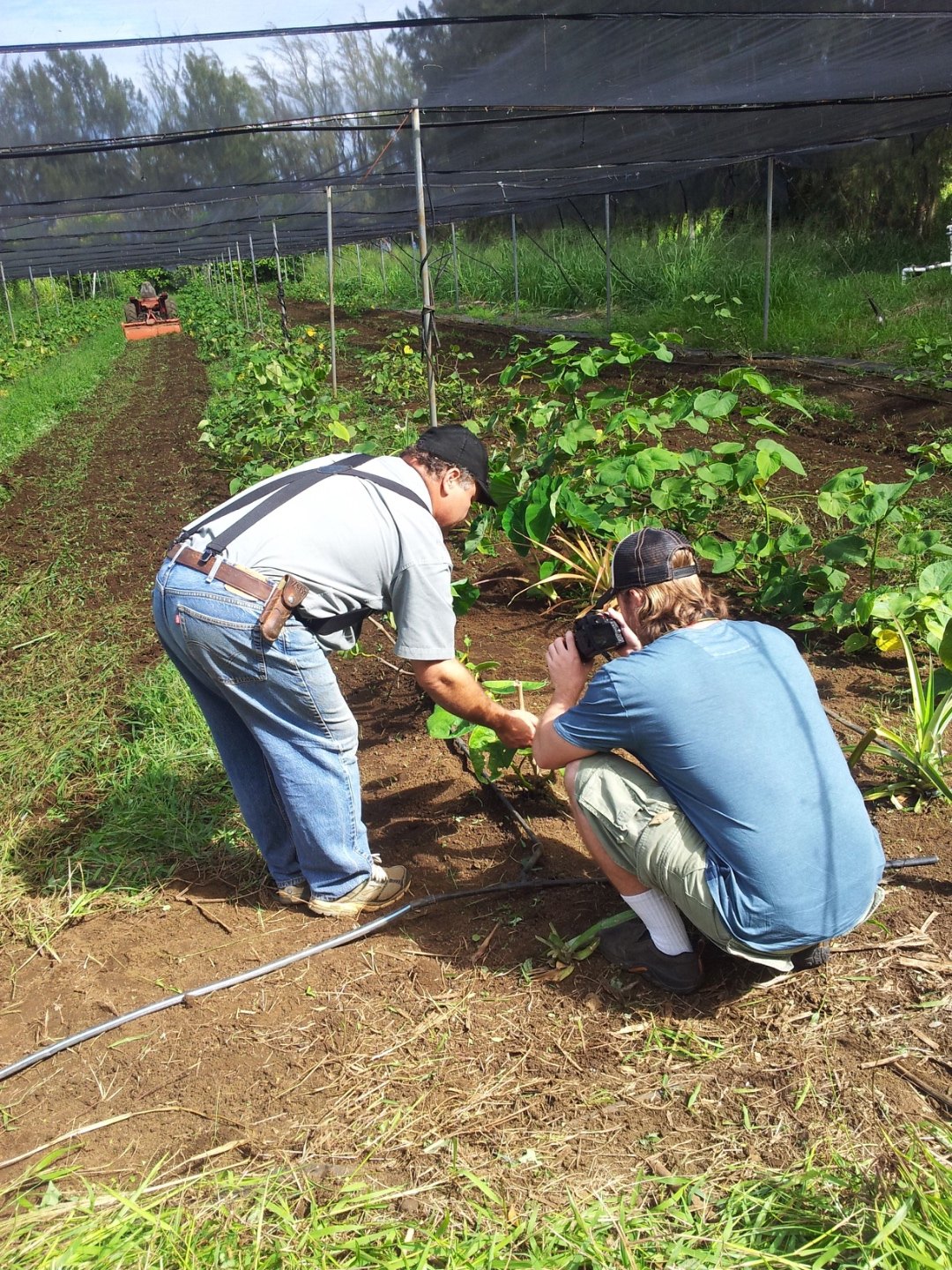
The Isa planting at Pu‘u‘ala Kava Farm from which the Kali ISA line descends.
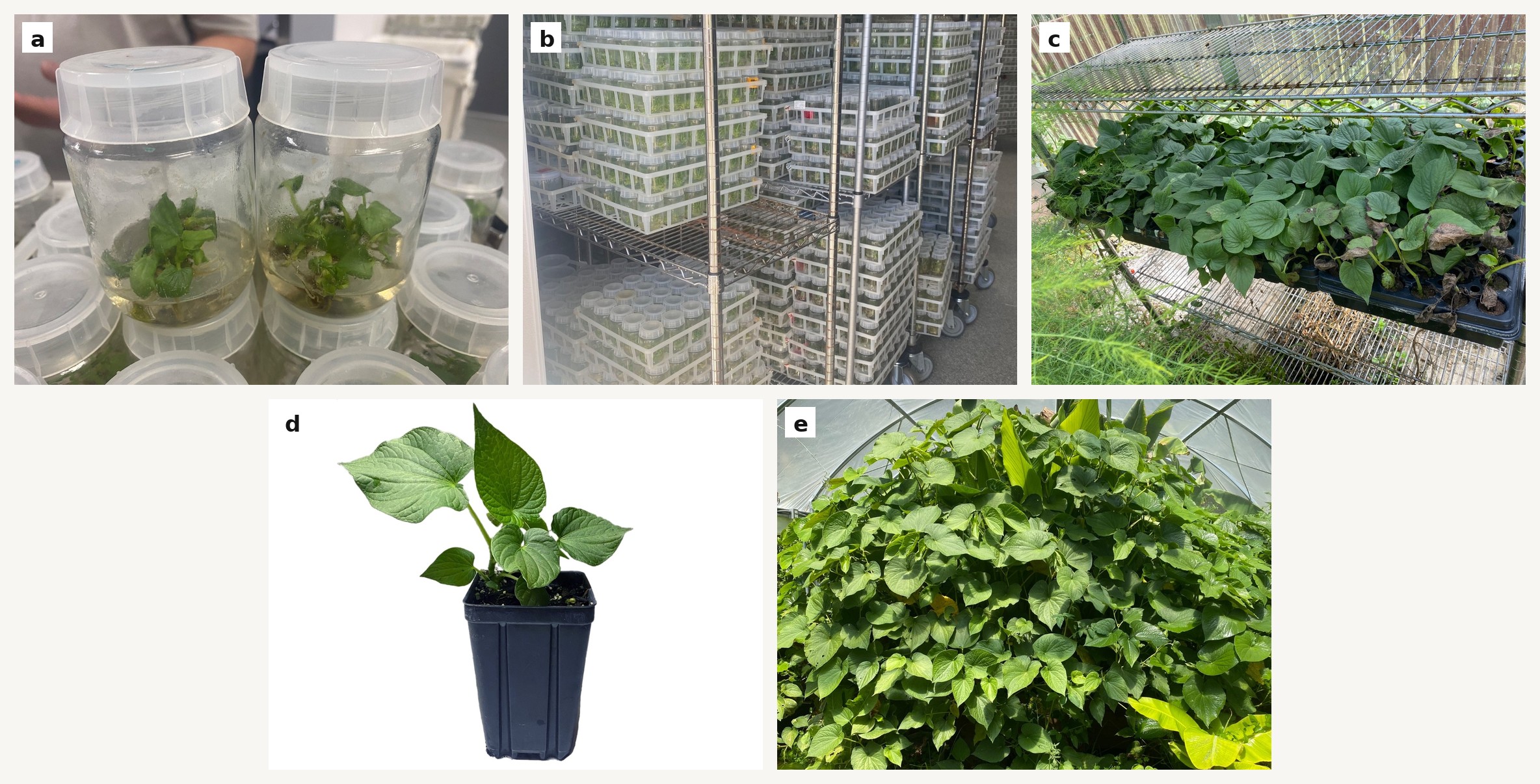
Selection began in California in 2015 on one criterion, tolerance of cold and heat, with no attention to strength or chemotype. The hardiest individuals went into tissue culture; the first plants grown out in 2017 kept their cold tolerance, and the author's records count 46 rounds of re-culturing by October 2026. Because the line is a clone carried through tissue culture, the paper makes no claim of a changed genotype; selection here means choosing which propagules to carry forward.
Plants of the line in Sarasota, Florida, grown in unamended sandy soil with concrete rubble and full sun, came through a week-long cold event reaching 29 °F, and by the author's account Sarasota plantings have wintered outdoors without protection since 2022. The line is now grown in the Sacramento greenhouse and on commercial farms in Florida.
What the mainland assays show
Ten assays of Kali ISA beverage material were run between October 2023 and July 2026: seven of lateral roots and raw material from six lots, and three of peeled chips.
| Lot | Grown | Part | Total KL (%) | Code | FK as % of KL | Kavain ÷ FKB | Both limits |
|---|---|---|---|---|---|---|---|
| Sarasota, Oct 2023 | Florida, in ground | Lateral roots | 19.9 | 254631 | 3.50 | 6.22 | No (0.697% w/w) |
| Boca Raton, Oct 2023 | Florida, 25-gal pot | Roots and chips | 8.95 | 254631 | 3.58 | 6.69 | Yes |
| Harvest Jan 2024 | Sacramento | Lateral roots | 7.00 | 254631 | 2.43 | 8.98 | Yes |
| Harvest May 2024 | Sacramento | Lateral roots | 8.10 | 254631 | 1.70 | 12.86 | Yes |
| Harvest Jul 2024 | Sacramento | Lateral roots | 6.38 | 254631 | 2.21 | 10.29 | Yes |
| Lot KI-R, Sep 2025 (mean of two bags) | Sacramento | Raw material | 14.2 | 254631 | 2.13 | 14.16 | Yes |
| Peeled chips, 2024 (3 assays) | Sacramento | Chips | 2.34–3.35 | 254631; 256431 (2) | 2.54–3.74 | 5.56–9.60 | Yes (3 of 3) |
From Table 6 of the journal article. Lot KI-R was assayed twice, from two bags nine months apart (FK 1.78% and 2.48% of KL); the lot value is their mean. Harmonized limits: flavokavains A + B + C below 0.4% of dried weight and below 5% of total kavalactones.
One profile across sites and seasons. Every root and raw-material assay was dihydrokavain-led and coded 254631. In three of them two kavalactones sat within 1% of each other, inside the method's own repeatability, so with near-ties bracketed the seven read 254631 four times and a tied variant three times. Potency moved about threefold with growing conditions, from 6.38% in greenhouse lateral roots to 19.9% in field-grown Sarasota roots; the 18-month mother stock ran 14.2–14.3%.
Composition is the better yardstick. Comparing each kavalactone's share of the six, rather than just the rank order, the seven Kali ISA assays sit as close to Madang-grown lateral roots as they do to each other, and close to Iwi. Kavain-led Kali Hiwa from the same greenhouse, Fijian Waka, Palima and Rai Coast Pink are all far away.
| Material | Distance from Kali ISA roots (percentage points, mean) |
|---|---|
| Kali ISA roots and raw material, among themselves | 1.7–9.4 (5.4) |
| Madang Short and Madang Tall, lateral roots | 2.1–9.4 (5.4) |
| Iwi, roots | 3.5–6.9 (4.9) |
| Isa peeled chips, six Madang plants | 4.1–15.6 (10.9) |
| Kali Hiwa, same greenhouse | 18.3–26.5 (22.8) |
| Fijian Waka, lateral roots | 18.2–25.1 (22.2) |
| Palima (Merauke), lateral roots | 20.9–23.8 (22.0) |
| Rai Coast Pink, lateral roots | 39.1–43.4 (41.1) |
From Table 7 of the journal article. Each kavalactone is taken as a share of the six; distance is the straight-line (Euclidean) gap between two profiles. Smaller means more alike.
Flavokavains in context
Kali ISA roots and raw material carried flavokavains at 1.70–3.58% of kavalactones, a mean of 2.5%, which is 0.61 of the Madang root mean. The Madang plants were at least five years old and the Kali ISA lots 18–28 months, so the like-for-like test is peeled chips of Isa from each place, run by the same laboratory: 2.97% for Kali ISA and 2.95% for the six Madang plants. In chips, the line and its Papuan parent are the same.
| Material | Range (%) | Mean or median (%) |
|---|---|---|
| Kali ISA, roots and raw material (7) | 1.70–3.58 | 2.5 |
| Madang lateral roots and the Koniak lot (3) | 3.65–4.84 | 4.2 |
| Kali ISA, peeled chips (3) | 2.54–3.74 | 2.97 |
| Isa peeled chips, six Madang plants (6) | 2.59–3.25 | 2.95 |
| Noble roots, 2015 ACP-EU project (46) | 0.50–2.70 | 1.10 |
| Noble roots, four Fijian islands (32) | 0.67–1.80 | 1.00 |
| Two-day roots, 2015 ACP-EU project (5) | 11.3–35.5 | 12.3 |
| Harmonized limit | below 5 | — |
From Table 8 of the journal article. The 2015 values count flavokavains A and B only; the others count A, B and C.
Six of the seven root and raw-material lots met both Harmonized limits. The exception was the Sarasota lot: at 3.5% it passed the ratio limit easily, but at 19.9% kavalactones, the strongest lot recorded for the line, its 0.697% w/w total failed the absolute ceiling. Material of that composition stays under 0.4% w/w at any potency up to 11.4%.
On a second yardstick, kavain divided by flavokavain B, Kali ISA ran 6.22–14.16 by lot: above the two-day median of 2.24, below the noble roots of the 2015 project (15.7–83.3). Part of the reason is structural. Kavain sits third in this chemotype, making up 15.6–18.1% of the kavalactones against a noble median of 27.1%, so a kavain-based ratio reads low for any dihydrokavain-led kava; kavain-led Kali Hiwa grown alongside it read 32.60–46.75. Why the two yardsticks disagree is the subject of the companion paper.
Handling keeps the numbers low. Stems of the 2024 harvests, assayed alongside but not counted in the study, carried the most flavokavain B relative to kavain of any Kali ISA material. Lifting lateral roots separately from stump and stem, peeling the chips, and keeping stems and peelings out of beverage material keeps the richest flavokavain-B tissue out of the cup.
Where Kali ISA sits
The paper keeps four questions apart. Composition was measured: dihydrokavain-led, 254631, consistent with Madang cultivated kava. Flavokavain compliance was measured: six of seven lots met both Harmonized limits. Classification under the Harmonized standard turns on code, and 254631 does not meet its noble criterion, which admits codes opening 42 or 24; nor does the line's kavain-to-flavokavain-B ratio reach the 2015 noble range. Yet its flavokavains sit an order of magnitude below two-day kava, and genetically it descends from an accession distinct from noble, two-day and wild groups alike. By the measures used here, Kali ISA fits neither box. Tolerability was not measured.
On the last point the paper reports the author's trade experience, from fifteen years of serving Madang Isa and Kali ISA at kava bars, plainly as experience: Isa-type kava has been drunk on the Madang coast since the first records, poured in Hawaiian ‘awa bars, and drunk and blended in Fiji today, without the hangover reputation of two-day kava, and Kali ISA prepared from lateral root and peeled chip drinks milder than Papuan-grown Isa-type kava.
What it means for growers, buyers and bars
- Name the line and keep the records. A dihydrokavain-led code on a certificate does not identify Isa or a two-day kava; cultivar, provenance, plant part, plant age and harvest date are what make one lot comparable with another.
- Separate the fractions. Lateral roots and peeled chips are the beverage material. Stems and peelings carry the most flavokavain B and stay out.
- Watch potency against the absolute ceiling. A strong lot can fail 0.4% w/w on strength alone while its ratio stays low; test both limits on every lot.
- Never blend wild kava in. Diluting wild or ritual material into a low-flavokavain lot to bring a blend inside the limits defeats the purpose of the limits, and the Harmonized standard already keeps non-noble material out of noble processing.
- Respect Marind wati. The Merauke material was collected for research only, under a verbal agreement with the community, and the Association continues to discourage any commercial use of it.
What the next studies need to settle
- Selection or age? The lower root flavokavain share of Kali ISA cannot yet be put down to selection, plant age, place or handling. A planting of Kali ISA and unselected Isa side by side, several plants of each, harvested and handled together, would separate them.
- Genetic authentication. No sample in the study was genotyped. Cultivar identity rests on the growers' identification, backed for the Madang material by photographs the author identified, and the HPTLC test confirms species for the mother stock, not cultivar.
- More plants per cultivar. Each Papuan variety is one lot per plant part, the 2024 harvest series is one plant per date, and the two Hawaiian comparators are single samples.
- Within-lot variation. Two bags of lot KI-R assayed nine months apart differed by 43% in flavokavain B while code and potency held; heterogeneity, storage and analytical variation were not separated.
- Like-for-like methods. The historical Papuan and Hawaiian records and the published reference values come from other laboratories and methods, and the current certificates state no dry-weight basis.
- Tolerability. A controlled study of how Isa-type kava is tolerated would settle what trade experience can only suggest. The companion paper takes up classification.
Disclosures and conflicts of interest
The author co-founded Root of Happiness and Kali Kava and has a direct commercial interest in Kali ISA. He also founded the American Kava Association, which publishes this page and The Journal of American Kava and has adopted the Harmonized standard the samples are tested against, and an ISA Grade category that shares the line's name; that category is examined in a companion paper and not applied here. He is a founding member of the Kava Coalition, which published the Harmonized standard, and co-owns KavaLytics, an analytical company. Root of Happiness paid for the laboratory work, except the Boca Raton lot, which Nakava, LLC submitted.
The manuscript was handled by Travis Lowin as editor, who is also the author's business partner in Root of Happiness; it was accepted after Computational Manuscript Review of version 1.6 and revision by the author. Against those interests: every number comes from an independent laboratory that had no role in the design or interpretation, and every certificate is published. The finding most exposed to the author's interest, Kali ISA's lower root flavokavain share, rests on single lots of older Madang plants, and the like-for-like chip comparison shows no difference. John Sanday of Melanesian Trustee Services Limited contributed the Merauke material and the field interviews, declined payment, and had no role in the analysis. An AI assistant was used to extract certificate values, compute codes and ratios, and draft and revise the manuscript; the author reviewed every change.
References
Cite This
Blythe, T. From Madang to the mainland: Papuan kava chemotypes, the Hawaiian Isa record, and the development of Kali ISA. J. Am. Kava 2026, 2, 026. https://journalofamericankava.org/articles/madang-to-mainland