Overview
Kava is propagated from nodal stem cuttings, and the petiole base carries no node and no axillary bud. At the Kali Kava research greenhouse, shed leaves lying on an algal mat were nevertheless found rooting at that surface — untreated, unwounded, unplanted — and leaves excised at the breakpoint, gel-dipped and held in an aeroponic mist chamber did the same. This is a record of what was seen, not a study: nothing was allocated, tagged, timed or counted, and no rate appears anywhere in it. What the two settings share is a wet, aerated, shaded, undisturbed wound surface against a biologically active substrate — conditions cheap enough that the controlled trial set out here is worth running.
Abstract
Kava (Piper methysticum) is propagated commercially from nodal stem material, and the species is generally treated as recalcitrant to regeneration from non-nodal tissue. This report records two independent settings at the Kali Kava research greenhouse in which kava leaves have nevertheless produced adventitious roots at the leaf–stem breakpoint — the abscission surface where the petiole separates from the stem — without any propagation intervention. In the first, leaves shed onto a mat of filamentous algae that had established on wetted greenhouse surfaces were subsequently found bearing roots emerging from the breakpoint, the petiole still turgid and the lamina still green, and carrying root systems substantial enough to support a plant. In the second, leaves were excised at the breakpoint, dipped in IBA rooting gel, seated in neoprene collars and held in an aeroponic mist chamber, where they rooted at the same surface. Neither observation arose from an experiment. The chamber work was set up but never run as a trial: no treatment was allocated, no control arm existed, no scoring interval was defined, nothing was counted and no root measurement was taken. The record consists of direct observation by the authors and nursery staff during routine operations, supported by photographs. Taken together the two settings show the phenomenon occurring both unassisted and under deliberate propagation conditions, and they converge on a common physical condition: a continuously wet, freely aerated, shaded abscission surface in contact with a biologically active substrate. The Association is reporting the phenomenon now, in advance of measurement, because it bears directly on the feasibility of leaf-based propagation in a crop whose planting material supply is structurally constrained, and because the conditions under which it occurs appear to be reproducible at negligible cost. A controlled trial to establish whether the phenomenon can be induced deliberately, at what frequency, and under what conditions is set out here and will be carried out and published separately.
Key Findings
- Kava leaves have formed adventitious roots at the leaf–stem breakpoint — the abscission surface where the petiole separates from the stem, which carries no node and no axillary bud.
- It happened without any propagation intent. Leaves shed onto a mat of filamentous algae on wetted greenhouse surfaces rooted untreated, unwounded and unplanted, carrying branching fibrous root masses large enough to support a potted plant.
- It also happened under deliberate conditions. Leaves excised at the breakpoint, dipped in IBA rooting gel and held in an aeroponic mist chamber rooted at the same surface — though that setup confounds auxin, nutrient, bacterial inoculant and artificial light, and nothing isolates any one of them.
- The two settings share a physical regime rather than any equipment: continuous free water at the wound surface without immersion, free gas exchange, shade on the breakpoint, a biologically active contact surface, and a wound left undisturbed.
- Root formation does not require the leaf blade to stay healthy. Rooted chamber leaves continued to develop roots while their laminae yellowed and perforated.
- Nothing here was counted. No leaf was tagged, dated or scored; there is no rooting frequency, root length, root number or survival figure for either setting, and any number attributed to this phenomenon on the basis of this report would be fabricated.
- Regeneration was not demonstrated. Roots were observed; shoot emergence, establishment and growth to a viable plant were not. A rooted leaf in decline is not yet a plant.
- A controlled factorial trial — substrate × auxin × leaf origin, followed through to establishment — is set out in this report and will be published in the technical white paper series whatever it finds.
Litter that rooted
Kava leaves fall. In a working greenhouse they land on benching and on the floor, they lie there until somebody sweeps them up, and nothing is expected of them. At the Kali Kava research greenhouse in Sacramento, staff clearing shed leaves off wetted surfaces began finding leaves that had grown roots.
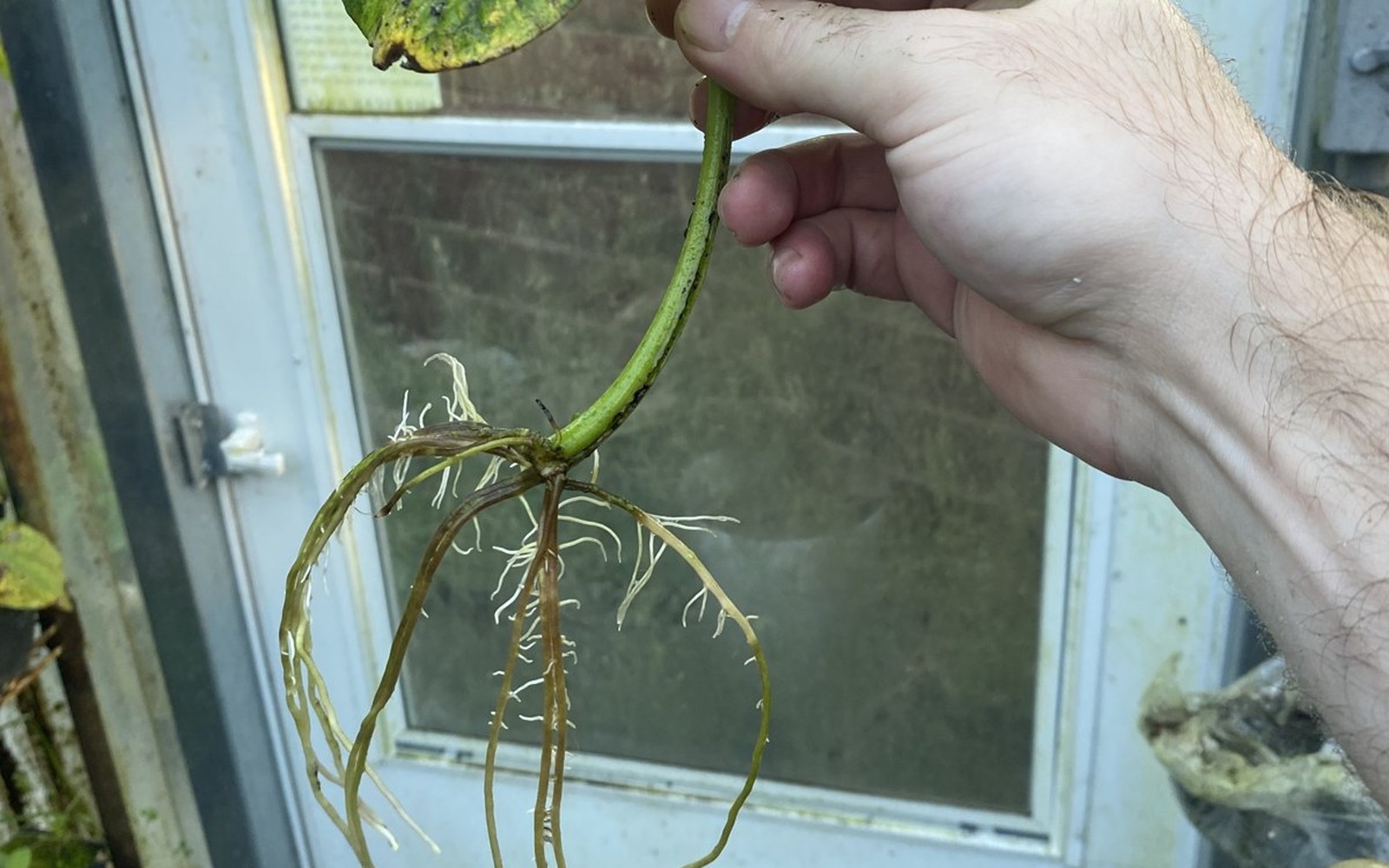
Not a token root or two. Branching fibrous root masses, white and turgid, big enough to support a potted plant — emerging from the leaf–stem breakpoint, the abscission surface where the petiole separates cleanly from the stem. The petioles were still firm. The laminae were still green. Nobody had treated these leaves with hormone, wounded them, trimmed them or placed them anywhere on purpose. They were not propagules. They were litter.
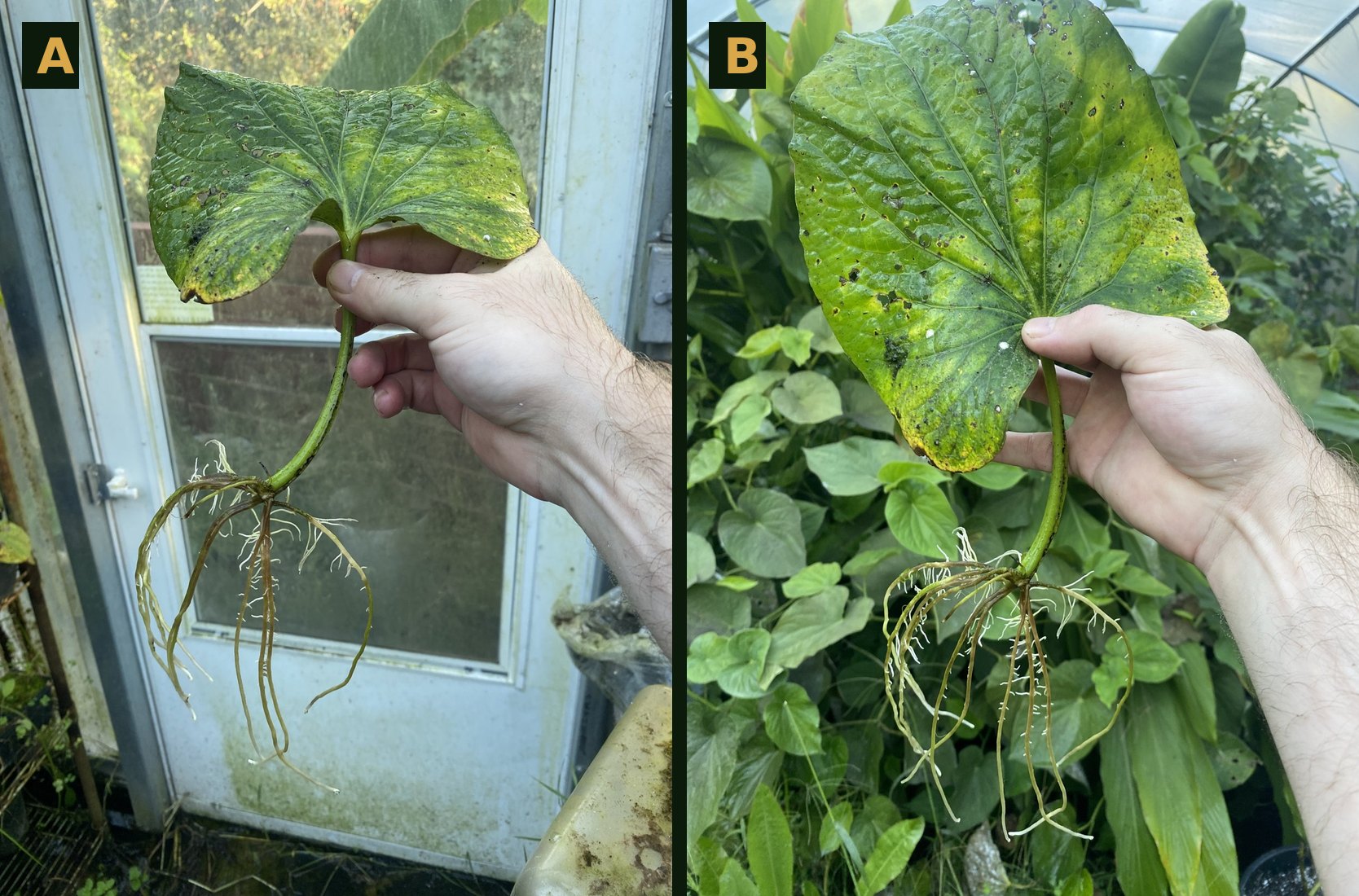
The same surface roots under deliberate conditions too. Leaves excised at the breakpoint, dipped in IBA rooting gel and held in an aeroponic mist chamber at the same facility also produced roots at the petiole base. That chamber work was set up to be evaluated formally and never was: no treatment was allocated, no control arm existed, no scoring interval was fixed, nothing was counted.
What this document is — A field observation report, not a study. No experiment was performed, no sampling frame was defined, nothing was counted, and no rooting percentage, root length, root number or survival figure appears anywhere in it. The Association’s practice is to publish measurement rather than impression; this is a deliberate and clearly labelled departure from that practice, made because the observation runs against a standing assumption about kava, because the conditions producing it are cheap enough for any grower to reproduce, and because an early record lets other growers look for the same thing while the controlled work is under way.
Why a leaf matters in a crop propagated from stems
Kava is sterile and obligately clonal. Every plant entering production is generated vegetatively, in practice from woody nodal stem segments cut at harvest — which ties the supply of planting material to the harvest cycle and caps multiplication at the standing biomass of mature plants. The chronic planting-material shortages across Pacific producing nations, and now across the expanding United States sector, follow directly from that constraint.
Non-nodal propagation would relax it, and the arithmetic is not subtle. A mature kava plant yields a handful of usable nodal cuttings. It carries dozens of healthy leaves that can be removed without compromising its structure or growth. Any route from leaf tissue to a rooted plant changes the multiplication rate of the crop substantially.
Leaf-based protocols already exist in related Piperaceae. Piper hispidum leaf cuttings root under mist; P. carniconnectivum gives comparable results with auxin treatment; and P. longum has been propagated clonally from trimmed leaf cuttings with no nodal segment at all. P. methysticum has been treated as the exception, with the practical literature directing growers to nodal material and the in vitro literature offering micropropagation as the alternative.
There is, though, a long-standing note in the monograph literature that kava roots readily wherever tissue meets a moist surface: Lebot and Cabalion record that marcotting is straightforward in kava and that runner nodes in ground contact root spontaneously. The Association’s own propagation work has extended that to unwounded nodes enclosed in inoculated sphagnum on standing stock plants, and to soft-stem cuttings under aeroponic mist. All of that concerns nodal or stem tissue. What is reported here concerns the petiole base, which carries no node and no axillary bud.
The mechanistic expectation is not unreasonable. Adventitious roots in cuttings arise from pericyclic, cambial or competent parenchymal cells that dedifferentiate and organize root primordia under auxin control. Competent cells of that kind are present at the petiole base, and the abscission zone is by definition a site of regulated cell-wall remodelling and active hormone signalling. What these observations suggest is that in kava, that competence does not require exogenous auxin to be expressed — provided the physical environment at the abscission surface is right.
Observation 1 — abscised leaves on a greenhouse algal mat
The Sacramento greenhouse holds containerized kava stock under routine overhead and hand irrigation. Persistent moisture on shaded bench surfaces and on the floor beneath the benching supports a green filamentous algal film, which thickens over time into a soft, continuously damp mat of the kind familiar in any irrigated glasshouse. The mat is an incidental feature of the house rather than a prepared substrate: it was never inoculated or maintained, and it receives no nutrient input beyond irrigation runoff and whatever leaches from the containers above it.
Kava sheds mature leaves continuously as the canopy turns over, and those leaves routinely fall onto these surfaces. The abscission is natural — the leaf separates cleanly at the petiole–stem junction rather than tearing, leaving the characteristic breakpoint surface intact.
Leaves lying on the mat have been found, on clearing, bearing adventitious roots emerging from that surface. The roots were white, fine, unbranched to lightly branched, and originated at the abscission surface itself rather than along the length of the petiole. The petiole above stayed turgid and the lamina retained chlorophyll — in contrast with adjacent shed leaves on dry benching or bare floor, which senesced and desiccated in the usual way without forming any roots at all.
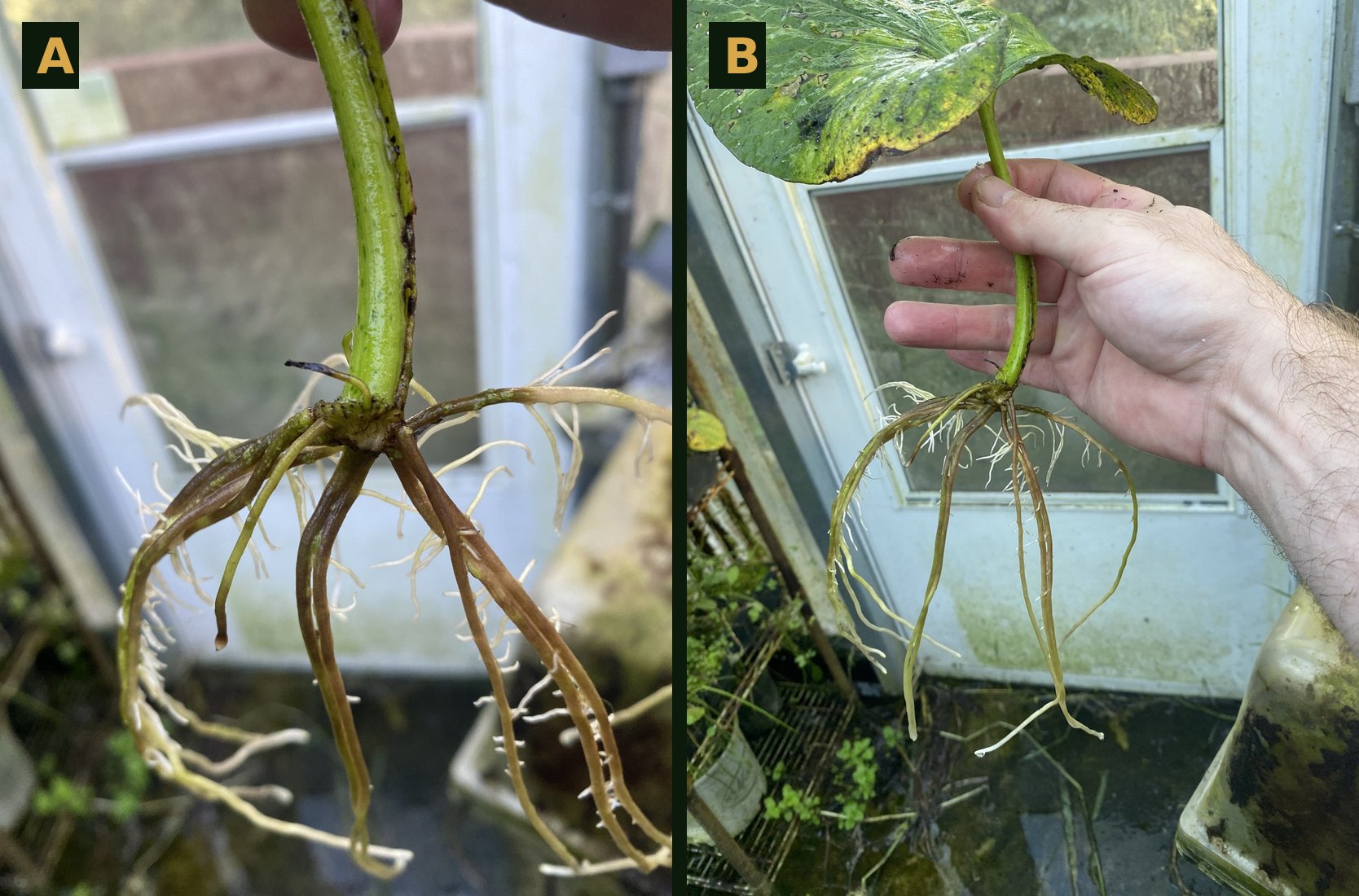
Orientation was not controlled, and it was not recorded whether rooting depended on the breakpoint lying in direct contact with the algal surface rather than resting above it, although in the cases observed the breakpoint was in contact with the mat.
What is not known about these leaves is most of what matters. None was tagged, dated, counted or followed. The interval between abscission and the appearance of roots is unknown. The proportion of shed leaves on the mat that rooted is unknown, and should not be estimated from this report. No leaf from this setting was carried forward to shoot emergence, so whether a leaf rooted on an algal mat goes on to become a plant is untested, and it is the central question for the trial described below.
Why the mat is of interest
The algal mat supplies, incidentally, what a propagation substrate is engineered to supply: continuous free water at the cut surface without immersion; a soft conforming contact that holds the breakpoint against moisture; shading of the abscission zone from direct light; and a living surface layer rather than an inert one.
That last feature may or may not be doing work. Microalgal and macroalgal biomass and extracts are documented sources of auxin- and cytokinin-like activity, and are sold commercially as rooting and establishment biostimulants. Whether the mat here contributes biochemically or merely supplies the physical conditions is exactly the kind of question an observation cannot answer and a factorial trial can.
Observation 2 — prepared leaves in an aeroponic mist chamber
The same facility operates aeroponic mist chambers of the type described in the Association’s soft-stem propagation work: an enclosed reservoir with a collared lid, misting heads delivering continuous fine spray to the root zone, a circulation fan for reservoir oxygenation and thermal control, a humidity dome above the lid, and red/blue LED lighting above the dome. The reservoir carries a dilute nutrient solution and a Bacillus root inoculant as standard practice, so material in the mist zone is not sitting in plain water.
Unlike the greenhouse material, this material was prepared. Mature, non-senescing leaves were taken from greenhouse stock and excised at the petiole–stem breakpoint with the full petiole retained. The basal end was dipped in Clonex Rooting Gel (0.31% w/w indole-3-butyric acid), seated through a neoprene collar, and placed in the chamber lid with the treated end in the mist zone and the lamina above the collar.
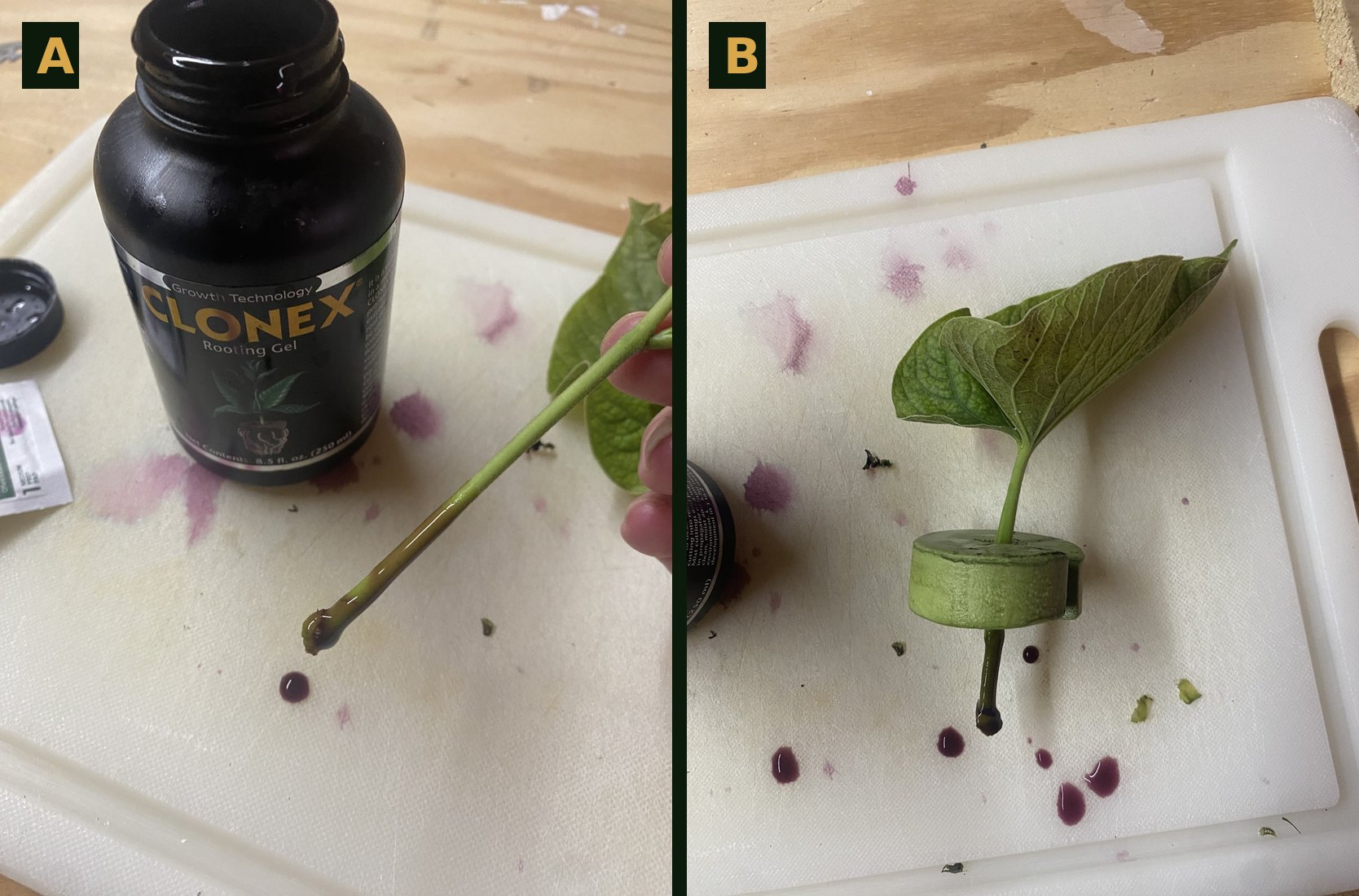
This is the arrangement the Association had intended to evaluate formally, and it was not evaluated. No treatment was allocated, no untreated or gel-free arm was run, no scoring interval was fixed, no unit was tagged or dated, and no count, rooting frequency, root number or root length was recorded at any point. The chamber work therefore yields the same class of evidence as the greenhouse observation — that the response occurs — and no more.
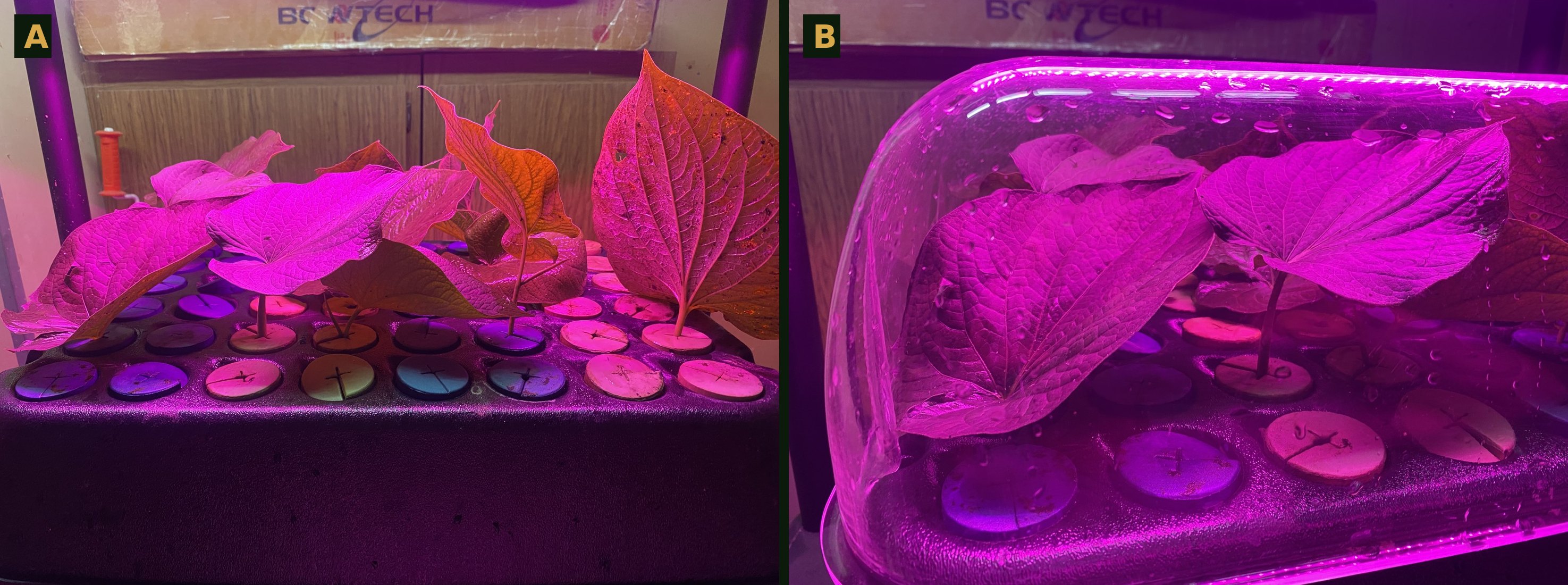
Leaves held in the chamber produced adventitious roots at the leaf–stem breakpoint. As in the greenhouse material, emergence was localized to the abscission surface rather than distributed along the petiole, and the petiole stayed turgid through the rooting zone. The lamina behaved less uniformly. Leaves in the chamber generally held colour and turgor above the collar, but rooted specimens examined later had laminae that were yellowing and perforating while the root system continued to develop.
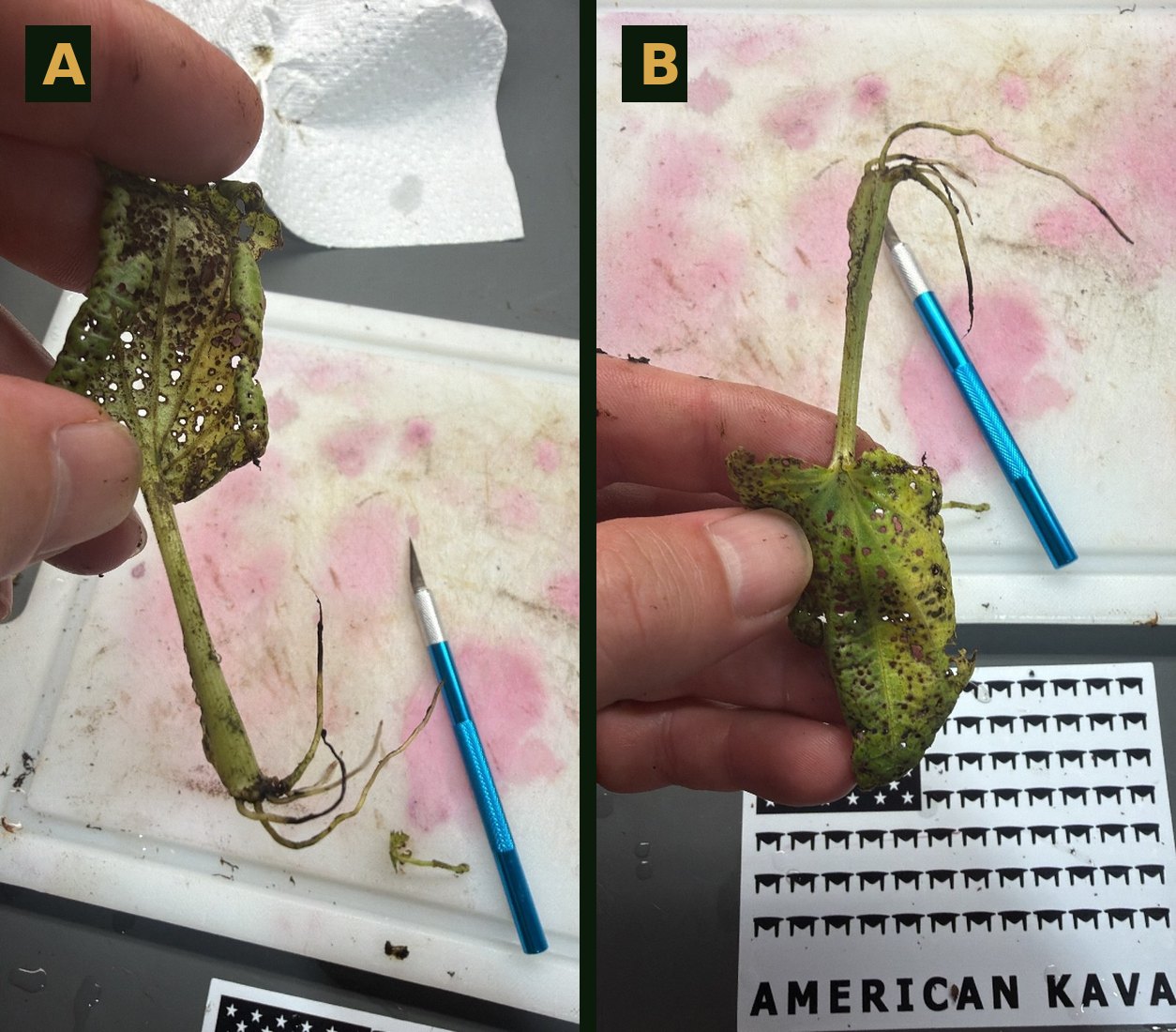
The leaf blade is a poor guide to what is happening at its base — Root formation at the breakpoint evidently does not require the lamina to stay in good condition. Whether a declining lamina limits what the propagule can go on to do is untested here — and a rooted leaf in decline is not yet a plant.
The confounds specific to this setting must be stated plainly, because they bear on any comparison between the two observations. Auxin was applied deliberately. The reservoir supplied nutrient and a bacterial inoculant. The light regime was artificial and continuous rather than ambient. Nothing here isolates the contribution of any one of them. The greenhouse algal-mat observation carries none of them, which is precisely why the two are more informative together than either would be alone: one shows the response arising with no input whatsoever, the other shows it arising when the conventional inputs are supplied.
What the two settings share
The algal mat and the mist chamber have nothing in common as equipment. What they share is a physical regime at the abscission surface.
- Continuous free water without immersion. In both settings the breakpoint stays wet indefinitely while remaining in contact with air. Neither setting allows the surface to dry between wettings, and neither submerges it.
- Free gas exchange. The mist chamber aerates actively; the algal mat is a thin, open, photosynthetically active film at the air interface rather than a saturated anaerobic layer.
- Shading of the wound surface. The breakpoint sits in shade in both cases — beneath the lamina and against the mat in one, inside an enclosed chamber in the other — while the lamina itself keeps enough light to stay green.
- A biologically active contact surface. Algal film in one setting; an inoculated, nutrient-bearing mist and reservoir in the other. Neither surface is sterile or inert.
- A wound surface left undisturbed. Once the leaf separates at the breakpoint, nothing further is done to that surface — it is not re-cut, re-seated or allowed to dry.
What separates the two settings is the one comparison worth drawing from them: Observation 1 had no auxin, no nutrient, no inoculant and no controlled light, and rooted anyway. Those five shared conditions are cheap to reproduce deliberately, and the difference between the settings is what the planned trial is built to resolve.
An interpretation, offered as a hypothesis
Kava’s reputed recalcitrance to non-nodal propagation may reflect the conditions under which non-nodal tissue has typically been asked to root, rather than an absence of regenerative competence at the petiole base. If competent cells at the abscission zone retain the capacity to organize root primordia, and if the limiting factor is holding a wet, aerated, undisturbed wound surface for long enough, then what was seen here is what the species does when those conditions happen to be met — and the engineering question becomes how to meet them reliably rather than how to overcome a tissue limitation.
Two further possibilities are worth stating so that the trial can discriminate among them. The mat may act biochemically rather than only physically, through algal growth-regulator activity at the contact surface; a sterile inert mat with equivalent moisture behaviour would separate the two. And endogenous auxin arriving at the abscission zone by basipetal transport before separation, together with the hormonal activity intrinsic to abscission, may be sufficient on its own — in which case exogenous auxin would add little and the naturally abscised leaf might outperform the deliberately excised one. That is the reverse of the usual expectation, and it is directly testable.
Nothing in these observations distinguishes among these accounts, and none of them is the Association’s position until the trial reports.
The standing of these observations
What follows states, without hedging, what this document cannot support.
- No experiment was performed. There was no design, no sampling frame, no treatment allocation, no control arm and no defined endpoint. Neither setting was established for propagation or managed as a trial.
- Nothing was quantified. No leaf was counted, tagged or dated; no rooting frequency, root number, root length, time to emergence or survival figure exists for either setting. Any number attributed to this phenomenon on the basis of this report would be fabricated.
- The record is biased toward positives. In the greenhouse, rooted leaves were noticed during routine work, which selects for the conspicuous; leaves that did not root attracted no attention and were cleared. In the chamber, nothing was scored at all. Neither setting says anything about how often the response occurs.
- Variety and provenance were not tracked. Observations were not recorded by variety. The greenhouse holds American kava varieties of tissue-culture origin, and nothing here should be generalized to kava broadly or to Pacific germplasm.
- Conditions were not logged. Temperature, humidity, light and substrate moisture at the breakpoint were not measured in either setting, and the chamber observation confounds auxin, nutrient, bacterial inoculant and artificial light.
- Regeneration was not demonstrated. Root formation at the breakpoint was observed. Shoot emergence, establishment in substrate and growth to a viable plant were not. Root formation alone does not constitute a propagation method.
The defensible claim is therefore a narrow one: adventitious root formation at the leaf–stem breakpoint of kava occurs without deliberate intervention in at least two distinct moist, aerated environments at one facility. Everything beyond that — frequency, reproducibility, variety dependence, the contribution of the algal mat, and whether a rooted leaf becomes a plant — is open.
The trial that follows
The Association intends to run a controlled trial of this phenomenon and to publish it in the technical white paper series. The design is stated here so that this report is read as the prelude to measurement that it is. None of it has been executed.
The objectives are to establish whether rooting at the breakpoint can be induced deliberately and reproducibly and at what frequency; whether the algal mat contributes anything beyond the physical conditions it provides, tested against substrates matched for moisture behaviour but biologically inert; whether exogenous auxin improves on the unassisted outcome, and whether naturally abscised leaves differ from deliberately excised ones; and whether rooted leaves carry through to shoot emergence, potting and establishment, so that the endpoint is a plant rather than a root.
The design in outline is a factorial trial crossing substrate (living algal mat; sterilized algal mat; aeroponic mist; peat-based control), auxin (applied / not applied) and leaf origin (naturally abscised / excised at the breakpoint), run across the American varieties held in the collection, with treatment groups of equal size set by a power calculation performed in advance rather than by convenience. Leaves will be individually tagged and dated so that time to root emergence is recoverable, and scored against the same four-category rooting scale used across the Association’s propagation series — rotted; alive, no roots; poorly rooted; well rooted — so that outcomes stay comparable with the air-layering and soft-stem work. Scoring will be blinded to treatment where the treatment is not visually evident, and a proportion of units will be scored independently by a second assessor so that inter-rater agreement can be reported.
Rooting frequency, root number and root length will be recorded at a fixed interval. Environmental conditions at the substrate surface will be logged continuously with calibrated instrumentation rather than described. All rooted units will be potted and followed to shoot emergence and to a defined establishment endpoint, with survival and growth recorded. Histological examination of the abscission zone is planned in a subset, to establish the tissue of origin of the primordia. A materials and labor accounting will be kept from the outset, so the method can be costed against nodal cuttings, air layering and tissue culture rather than merely described as low-cost.
The trial will be reported in full, including negative and null outcomes, with unit-level data retained and available to the Association’s members on request. Should the phenomenon prove infrequent or non-reproducible under controlled conditions, that result will be published on the same footing as a positive one, and this field report should then be read as the preliminary observation that the trial corrected.
Interim position
Kava leaves have been observed to form adventitious roots at the leaf–stem breakpoint, without hormone, preparation or propagation intent, in two unrelated settings at one greenhouse: on a mat of algae established on wetted surfaces, and in the mist zone of aeroponic propagation chambers. The petioles remained turgid, the laminae remained green, and the roots emerged from the abscission surface itself.
The Association is recording this in advance of measurement and is explicit that it is a record of observation and nothing more. It establishes no rate, no method and no recommendation, and it is not a basis on which any grower should alter propagation practice. What it does establish is that the question is worth asking properly — in a crop where the supply of planting material is the binding constraint on expansion, and where leaf material is the one tissue that is abundant, renewable and free.
Disclosures and conflicts of interest
No external funding was received. This report is published by the American Kava Association. The corresponding author is affiliated with Root of Happiness, Las Vegas, NV, a commercial kava retailer, and holds an interest in Kali Kava, a commercial kava nursery, at whose Sacramento research greenhouse both observations were made; the remaining authors are affiliated with commercial kava businesses in Florida. These relationships are disclosed as potential conflicts of interest. No manufacturer of any product referred to in this report provided funding, materials or input into its preparation.
T.B. made and compiled the greenhouse and mist-chamber observations, designed the planned investigation and drafted the report. J.B. and M.M. reviewed the observational record against practice at their own facilities and contributed to the design of the planned trial. All authors reviewed and approved the final report. The authors thank the Kali Kava greenhouse staff in Sacramento, whose habit of looking at what they were clearing off the benches is the reason this report exists.
References
- Basak, U. C., Das, A. B., & Das, P. (2014). New technique for adventitious rooting and clonal propagation of Piper longum L. through leaf cuttings. African Journal of Plant Science, 8(2), 108–112. https://doi.org/10.5897/AJPS2013.1137
- Blythe, T., Bowman, J., & Masifilo, M. (2026). Soft-Stem Propagation of Piper methysticum Using Peat-Based Media and Aeroponic Cloning Systems. American Kava Association Technical White Paper No. 1, Version 1.0. — internally reviewed and audited by the authors; not externally peer reviewed.
- Blythe, T., Bowman, J., & McDonnell, B. (2026). Outdoor Nursery Propagation of Kava (Piper methysticum) by Air Layering. American Kava Association Technical White Paper No. 4. — internally reviewed and audited by the authors; not externally peer reviewed.
- Craigie, J. S. (2011). Seaweed extract stimuli in plant science and agriculture. Journal of Applied Phycology, 23, 371–393. https://doi.org/10.1007/s10811-010-9560-4
- Davis, R. I., & Brown, J. F. (1999). Kava (Piper methysticum) in the South Pacific: Its Importance, Methods of Cultivation, Cultivars, Diseases and Pests (ACIAR Technical Reports Series No. 46). Australian Centre for International Agricultural Research.
- Dornelas Júnior, L. F., da Silva, S. J. R., da Silva, M. A. P., & de Albuquerque, M. M. (2018). Propagation of Piper hispidum through leaf cuttings. International Journal of Development Research, 8(9), 22414–22418.
- Dos Santos, M. R. A., Rocha, A. P. T., de Oliveira, J. A., & Vieira, R. F. (2019). Propagation of Piper carniconnectivum through leaf cuttings. International Journal of Innovative Education Research, 7(1), 15–19.
- Druege, U., Franken, P., & Hajirezaei, M. R. (2016). Plant hormone homeostasis, signaling, and function during adventitious root formation in cuttings. Frontiers in Plant Science, 7, 381. https://doi.org/10.3389/fpls.2016.00381
- Hartmann, H. T., Kester, D. E., Davies, F. T., Geneve, R. L., & Wilson, S. B. (2018). Hartmann & Kester's Plant Propagation: Principles and Practices (9th ed.). Pearson.
- Khan, W., Rayirath, U. P., Subramanian, S., Jithesh, M. N., Rayorath, P., Hodges, D. M., Critchley, A. T., Craigie, J. S., Norrie, J., & Prithiviraj, B. (2009). Seaweed extracts as biostimulants of plant growth and development. Journal of Plant Growth Regulation, 28, 386–399. https://doi.org/10.1007/s00344-009-9103-x
- Lebot, V. (1995). The origin and distribution of kava. Canberra Anthropology, 18(1–2), 20–33. https://doi.org/10.1080/03149099509508407
- Lebot, V., & Cabalion, P. (1988). Kavas of Vanuatu: Cultivars of Piper methysticum Forst. (Technical Paper No. 195). South Pacific Commission.
- Prasad, R., Tyagi, A. P., & Taylor, M. (2008). Regeneration and establishment of whole plants from kava (Piper methysticum Forster) meristems in tissue culture. South Pacific Journal of Natural Science, 26, 39–44.
- Ronga, D., Biazzi, E., Parati, K., Carminati, D., Carminati, E., & Tava, A. (2019). Microalgal biostimulants and biofertilisers in crop productions. Agronomy, 9(4), 192. https://doi.org/10.3390/agronomy9040192
- Verstraeten, I., Schotte, S., Beeckman, T., & Geelen, D. (2013). Adventitious rooting is controlled by a developmental switch that regulates auxin homeostasis. The Plant Cell, 25(6), 2283–2296. https://doi.org/10.1105/tpc.113.113167
- Zhang, Z., Zhao, L., Chen, X., & Zheng, X. (2008). Successful micropropagation protocol of Piper methysticum. Biologia Plantarum, 52(1), 110–112. https://doi.org/10.1007/s10535-008-0020-9
Cite This
Blythe, T.; Bowman, J.; Masifilo, M. Spontaneous Adventitious Rooting at the Leaf–Stem Breakpoint in Kava (Piper methysticum): Observations from Greenhouse and Aeroponic Settings. American Kava Association Field Report No. 3; American Kava Association: Las Vegas, NV, USA, 2026.
Supporting Data and Access
No dataset exists for this report, because no data were collected. The record consists of direct observation by the authors and nursery staff during routine operations, together with the photographs reproduced here and a wider photographic set held by the corresponding author and available to Association members on reasonable request. The figures were chosen to show the phenomenon and the conditions around it; they were not sampled systematically from a defined population and carry no quantitative weight. Nothing in them should be read as indicating how frequently the response occurs.
The discussion published on this page is complete as an argument. It states the method, the numbers, the limitations and the conflicts of interest, and it is free to read, cite and disagree with. The records underneath it are held for the Association’s members.
Access to those records is open to stakeholders in the American kava growing industry — growers with at least one acre in production and a contract in place for the purchase of licensed planting material.
The reason is simply who this organization is. The American Kava Association is funded by its members and operates for their benefit, and its members are American kava farmers with land, capital and years committed to the crop. This work is self-funded: it was paid for out of working farms, to answer questions those farms were already facing. What the people who paid for it are owed is a working advantage in their own fields. So we publish the findings in full, limitations included, so the work can be judged on its merits — and we keep the underlying files inside the membership that produced them. That is a decision about who we are resourced to serve, not a judgement on anyone who asks.
Researchers and institutions interested in working with this material are welcome to propose a funded collaboration. That is the basis on which the Association can extend it, and we would rather say yes to a properly resourced study than no to a request.
Write to admin@americankavaassociation.org to enquire.