Overview
Kali ISA's measured chemistry is the subject of this discussion, not a demonstrated explanation of how that chemistry arose. The line traces to ISA material carried from Zach Gibson's Hāmākua Coast farm to California in 2015 and selected on cold and heat tolerance alone; its chemotype was 254631 in all seven root and raw-material assays, and the five 2024–2026 farm lots returned flavokavain-to-kavalactone ratios of 0.017 to 0.025. Six subsamples of one Papua chip lot shared a chemotype but ranged from 4.18% to 23.1% in total kavalactones. Four exceeded the 0.4% w/w absolute flavokavain ceiling and two did not, while their flavokavain-to-kavalactone ratios varied much less, from 0.026 to 0.033.
Abstract
The companion manuscript reports 33 sample assays from one laboratory, covering named Papua New Guinea material, Merauke wati and a second collection labeled MISA, unpeeled Papua trade chips, Kali ISA, a Kali Hiwa comparator and two blends. Three analytical retests bring the total to 36 readings. The material occupies several positions on the chemotype ordering associated with kava domestication, but neither that ordering nor a shared six-digit code establishes cultivar identity or dates a selection history. The author brought ISA planting material from Zach Gibson's Hāmākua Coast farm to California in 2015 and selected on cold and heat tolerance rather than composition. All seven Kali ISA root and raw-material assays, from October 2023 to July 2026 in Florida and California, returned 254631 while total kavalactones ranged from 6.38% to 19.9% w/w, approximately a 3.1-fold range. The five 2024–2026 farm lots returned flavokavain-to-kavalactone ratios of 0.017 to 0.025 and kavain-to-flavokavain-B ratios of 8.98 to 18.06. These are favorable directional comparisons with published noble-group means, not method-matched safety thresholds (Lebot et al., 2019). Six subsamples of one unpeeled Papua chip lot all returned 256431, with total kavalactones from 4.18% to 23.1%, four results above the 0.4% w/w flavokavain ceiling and two below, while their ratios stayed between 0.026 and 0.033. The discussion concerns the information conveyed by composition, provenance and quality specifications; it does not establish daily-use safety or an approved alternative standard.
Key Findings
- Madang chemotypes: Madang Short and Madang Tall grown outside Papua New Guinea returned 245631 in root fractions and 254631 in chips. The 245 prefix matches Madang root records from Papua New Guinea; the survey also records kavain-led 425613 for Madang Short and 421563 for Madang Tall, not a uniform 254 root profile.
- Madang potency: The assayed roots contained 16.0% and 14.1% w/w total kavalactones, approximately 4.2 and 3.7 times the historical root-sample mean of 3.82%. Those comparisons cross laboratories, methods and material histories and do not measure a cultivation effect.
- Rai Coast Pink: Lateral roots returned 153624, with desmethoxyyangonin at 39.5% of total kavalactones, a flavokavain-to-kavalactone ratio of 0.063 and a kavain-to-flavokavain-B ratio of 1.60. That profile is consistent with the reported wild-type, ceremonial material but is not genetic authentication.
- Merauke collections: Wati and MISA lateral roots returned desmethoxyyangonin-to-kavain ratios of 2.82 and 0.31, a ninefold separation. MISA is the laboratory collection designation, not a genetically established identification as ISA.
- Kavain rank: Kavain was last in all five readings assigned to ceremonial or medicinal material and in none of the other 31 readings. The five include an analytical retest and represent two cultivars, not five independent accessions.
- Iwi and Kali ISA: Both returned 254631, and the Iwi profile was within about 3 percentage points of the Kali ISA 18-month raw at each position. Iwi was analyzed under an earlier method and has no flavokavain result in this study.
- Kali ISA root consistency: All seven root and raw-material assays returned 254631, across Florida and California material assayed from October 2023 to July 2026 and total kavalactones from 6.38% to 19.9% w/w.
- Within-lot chip variation: Six subsamples of one unpeeled Papua chip lot all returned 256431 while total kavalactones ranged from 4.18% to 23.1%, a 5.5-fold spread.
- Absolute concentration and ratio: Those six subsamples contained 0.136% to 0.599% total flavokavains, exceeding the 0.4% ceiling four times, while their flavokavain-to-kavalactone ratios ranged only from 0.026 to 0.033.
Papuan cultivation and the interpretation of chemotype
An absence of kava-drinking cultures in Papua is difficult to reconcile with the ethnobotanical and agronomic record, which documents named cultivars, vegetative propagation and differentiated uses among Marind communities (Kameubun, 2013; Suharno et al., 2016). The companion manuscript adds comparative chemistry to that record, not a chemical test of whether a drinking culture existed. Its named Papuan collections span kavain-last profiles through kavain-second Madang roots, while Kali ISA provides a documented mainland cultivation series.
That produces the question this article is about. Dihydrokavain-led chemistry is sometimes interpreted as evidence of limited selection in Papuan kava, although Vanuatu's 2002 schedules recognize 105 two-day and 79 medicinal varieties alongside 12 nobles (Kava Act 2002). Those schedules name and classify varieties; they do not assign one identical 254 or 256 code to every listed plant. The comparison is between the recognition of maintained cultivars, not proof that every variety shares one chemistry or that its selection history can be dated from a code.
The second thread runs from those gardens through Hawai‘i to farms in California and Florida. Johnston and Rogers (2006, p. 58), citing personal communication from Vincent Lebot, place the introduction of Isa and Iwi from Madang to Hawai‘i in the mid-1980s (Hawaiian ‘Awa). The author brought ISA planting material from Zach Gibson's farm on the Hāmākua Coast of Hawai‘i Island to California in 2015 and selected on one criterion, cold and heat tolerance, with no attention paid to composition. What happened to the chemistry along that route is the practical test of everything the historical material implies.
The absence that is an absence of survey
Papua New Guinea is important to the study of kava diversity, yet the Papuan chemical record assembled in the manuscript is much thinner than the cultivar-by-cultivar record available for Vanuatu. The National Agricultural Research Institute survey used here comprises 47 samples of root, stem and peeling from Lae, Madang and the Keravat germplasm collection. It remains an institutional report rather than a journal article and reports kavalactones but not flavokavains (Dom, n.d.).
That asymmetry does most of the work in the received account. When a territory has been surveyed cultivar by cultivar for forty years, its dihydrokavain-led kavas become named varieties with schedules and legal categories. When a territory has had one unpublished survey, the same kavas become an undifferentiated mass, and the absence of documentation reads as an absence of practice.
The material assayed here bears on one specific piece of that account. The Papua New Guinea survey reported a mean of 3.82% total kavalactones across 15 root samples and a maximum of 6.55%, while the Madang Short and Madang Tall roots assayed in the current study returned 16.0% and 14.1%. Their 245631 codes reproduce the leading 245 positions of some historical Madang root records, not an unchanged six-digit code. Other historical Madang roots were kavain-led, with codes 425613 and 421563. The higher totals show that the old survey values should not be treated as cultivar ceilings; they do not isolate the effects of cultivation, age, processing or laboratory method.
One garden, two plants, two uses
The clearest separation in the dataset comes from Merauke, in Indonesian Papua. Two plants were collected from the same gardens and reported as put to different uses: material submitted as wati, associated in the field account with ceremonial use, and a second plant submitted under the collection label MISA. The regional name wati can cover more than one kind of kava, so it should not be treated as a unique cultivar name (Kameubun, 2013).
Their chemistry was sharply different. Wati lateral roots returned 125634, with desmethoxyyangonin first and kavain last; wati chips returned 251364, with desmethoxyyangonin third and kavain still last. MISA lateral roots returned 256431 and chips 256341, with desmethoxyyangonin last in both. The lateral-root desmethoxyyangonin-to-kavain ratios were 2.82 for wati and 0.31 for MISA. The laboratory retested wati chips and both MISA fractions, reproducing all three codes; a retest of wati lateral roots is not reported.
The ninefold separation is consistent with the maintenance of different plants for different purposes, but collection from the same gardens is not a controlled experiment in genotype and environment. MISA's shared code with some Isa-type material also does not authenticate it as ISA. Its Marind cultivar name was not recorded, and neither genetic markers nor flavokavain results are available for these Merauke samples.
The agronomic record from Indonesian Papua points the same way, and it is current rather than residual: five named Marind cultivars and some seventy local names across 32 villages in Kameubun's Göttingen dissertation, and nine cultivation sites across four Merauke sub-districts, propagated exclusively by stem cutting under organized farmer groups, in Suharno and colleagues' survey.
Rai Coast Pink: a wild-type chemical profile
Rai Coast Pink is reported from the Rai Coast of Madang Province as a wild-type kava with a pink stem, used for toothache, fever and initiation rather than as a beverage. The chemotype code circulating with it is 153, usually glossed as meaning high dihydrokavain and dihydromethysticin.
Under the standard numbering that gloss cannot be right. Digit 1 denotes desmethoxyyangonin, and Rai Coast Pink lateral roots returned 153624, with desmethoxyyangonin at 39.5% of total kavalactones and kavain last. Chips returned 152634, so the reported 153 prefix describes the assayed lateral roots rather than every plant part. The lateral roots had a flavokavain-to-kavalactone ratio of 0.063, the highest among the 28 samples with flavokavain data in the study, and a kavain-to-flavokavain-B ratio of 1.60. The latter lies between the published two-day and wild means of 1.50 and 1.70 (Lebot et al., 2019). This is consistent with the reported wild-type and ceremonial material, not proof of its genetic identity; it is also more precise than calling it the furthest from noble on every measure, since the July Kali ISA stem had a lower kavain-to-flavokavain-B ratio of 1.47.
Kavain in last place
One pattern in the dataset was not expected. Across 36 readings, kavain came last in all five readings assigned to ceremonial or medicinal material and in none of the other 31. Those five comprise Rai Coast Pink roots and chips, wati roots and chips, and the wati-chip retest. The desmethoxyyangonin-to-kavain ratio ranged from 2.42 to 5.23 in that group and from 0.28 to 0.56 in the 30 other readings where both compounds were detected. The remaining reading, the July Kali ISA stem, had desmethoxyyangonin below the reporting threshold and is not included in that ratio comparison.
The distinction between readings and independent samples matters here. The pattern was found after the fact, rests on two cultivars, includes a repeated analysis of one sample and uses field-reported categories. It is offered as a candidate association between use category and kavain rank in this material, not a rule about every culture or a validated test of safety.
Selection is not the same question as chemotype
The chemotype ordering discussed in the manuscript runs from 521634 at the wild end through 256431 and 265431 to 246531, ending at 426135 with kavain first (Lebot & Lévesque, 1989). The Papuan material occupies several positions by kavain rank rather than reproducing every code in that sequence: Rai Coast Pink lateral roots at 153624 and Merauke wati roots at 125634 have kavain sixth; trade chips and the May and July Kali ISA chips return 256431; Kali ISA roots and Iwi return 254631; and Madang roots return 245631 with kavain second. Kali ISA's summer roots remained 254631.
That distribution is consistent with selection, especially when read beside the record of naming, cutting, replanting and differentiating cultivated material in Papua (Kameubun, 2013; Suharno et al., 2016). It does not establish a historical sequence or the number of generations involved. The 2002 Vanuatu schedules list 184 medicinal and two-day varieties among 196 names in those three categories, a historical legal classification rather than a current census or a chemical assay of every variety (Kava Act 2002). The useful comparison is that maintenance of non-noble cultivars is recognized as cultivation in one setting and should not, by itself, be treated as an absence of selection in another.
What differs is the documentary record. Vanuatu has forty years of cultivar-by-cultivar survey and a legal framework built on it. Papua has one unpublished report, a dissertation, a handful of ethnobotanical papers, and oral accounts.
What the genetics do and do not say
Vandenbroucke and colleagues recovered 30 genotypes from 103 accessions, with Isa and Iwi distinct from each other and outside the main clusters; the two Papuan accessions were sourced from Alia Point Nursery in Hilo, not collected in Papua New Guinea for that study (Vandenbroucke et al., 2015). Those findings establish genetic separation in the tested material. They do not date domestication or establish who selected either line, and proximity to wild accessions in a genetic analysis does not by itself determine customary use.
The companion manuscript interprets the separation as consistent with independently derived Papuan lineages, while acknowledging that this remains an interpretation rather than a dated domestication history. Field-collected accessions and documented provenance are needed to test that account. The present assay study did not genotype its own samples.
The chemical comparison makes a narrower and useful point. The Iwi root lot returned 254631, the same code as Kali ISA's root material, with relative composition within about 3 percentage points of the 18-month Kali ISA raw at every position. Because the Iwi assay used an earlier method, that agreement should not be treated as a precision equivalence test; no flavokavain result is available for Iwi. A shared rank-order code does not authenticate cultivar identity or establish a shared use category.
The Hawaiian record is not one fixed chemotype
The Hawaiian evidence added to the journal manuscript is important to the mainland comparison. The 2015 FratiniVergano report compiled five Isa profiles with four codes: 243651 and 246531 in roots, 256431 in two mixed root-and-chip samples, and 253641 in unpeeled chips (FratiniVergano, 2015, Annex 6.6.5; manuscript Table 11). These are different plant parts and sources, not repeated measurements of one controlled population.
None of those five annex entries is 254631, but that does not mean 254631 was absent from Hawaiian Isa. Wang and colleagues reported 254631 in beverages prepared from 3.4-year-old Isa roots and rhizomes grown at Waimanalo on Oahu, with the acetone extract of the root beverage returning 245631 instead (Wang et al., 2015). The mainland root code therefore was already present in Hawaiian material. It cannot be presented as a code that first appeared after a move to Florida or as evidence that place alone changed the plant.
The three Oahu Isa samples with flavokavain results in the 2015 annex had reported totals of 0.12% to 0.27% and computed kavain-to-flavokavain-B ratios of 7.15, 7.87 and 7.20 (manuscript Table 12). Those ratios are near the later published noble-group mean of 7.31, yet the 2015 report classified Isa as non-noble under its own proposed criteria; resemblance to a later group mean is not equivalent to meeting that classification (Lebot et al., 2019). The annex reported flavokavains A and B, whereas the current study sums A, B and C, so the totals are not directly equivalent.
Together, those records support studying variation within Isa rather than assigning the line one universal code. They do not separate genotype, environment, plant part, age, preparation and laboratory method, and they are not a controlled baseline from which to measure the effect of the later Kali ISA selection.
Kali ISA: selection for mainland cultivation
Kali ISA is the practical reason the dataset exists. Johnston and Rogers (2006, p. 58, Table 6.1) list Isa and Iwi from Madang among seven cultivars introduced to Hawai‘i by Vincent Lebot in the mid-1980s, attributing that history to his personal communication (Hawaiian ‘Awa). Their account describes propagation of the introduced cuttings at the University of Hawai‘i's Lyon Arboretum and planting at the National Tropical Botanical Garden's Hāna site (Johnston and Rogers, p. 58). This places the introduction in an approximate period; it does not establish an exact arrival year or trace each transfer to the stock later selected as Kali ISA.
The author visited Zach Gibson's farm on the Hāmākua Coast of Hawai‘i Island in 2013 to study the plant and how it might be cultivated outside the tropics, and carried planting material from that farm to California in 2015. Selection began there in 2015 and has continued as a running process since, on one criterion: cold and heat tolerance. Hawai‘i was the introduction and propagation route; the selection pressure was mainland winter. Not potency, not chemotype. The most cold-tolerant individuals were tissue-cultured, and the first generation grown out in 2017 retained the cold tolerance.
A Sarasota plant was subsequently reported to have survived a week-long cold event reaching 29 °F in poor soil and full sun; its lateral-root lot returned 19.9% w/w total kavalactones (Kali Kava, 2023). That was the highest lateral-root result for a named cultivar in the study, not its highest result overall: an unpeeled chip subsample returned 23.1%. The Sarasota lot also contained 0.697% total flavokavains, exceeding the 0.4% ceiling. Neither value can be attributed to cold stress from this uncontrolled observation.
Raw material from the line was separately confirmed as consistent with kava root by high-performance thin-layer chromatography under the British Herbal Pharmacopoeia identification, run against two authenticated Piper methysticum root references and a kavain standard. That method addresses botanical identity, not cultivar authentication, and the reported freeze survival does not establish a lethal-temperature limit or a population survival rate.
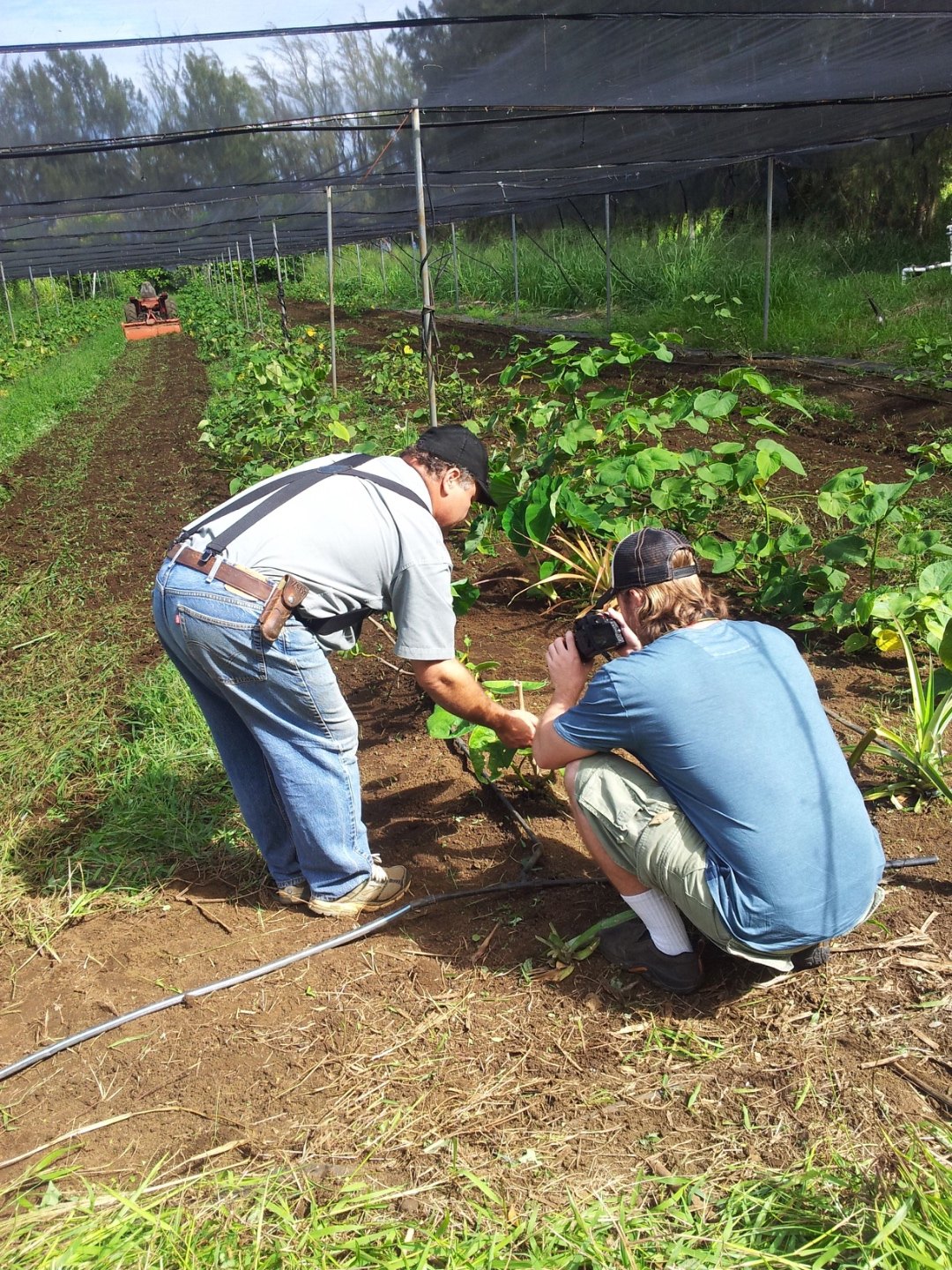
Tyler Blythe, right, with camera, and Zach Gibson at Gibson's farm on the Hāmākua Coast, Hawai‘i Island, 2013, examining kava plants and cultivation practice ahead of the 2015 transfer of ISA planting material to California. Photograph courtesy of Root of Happiness.
The ISA planting stock the Kali ISA line was taken from.
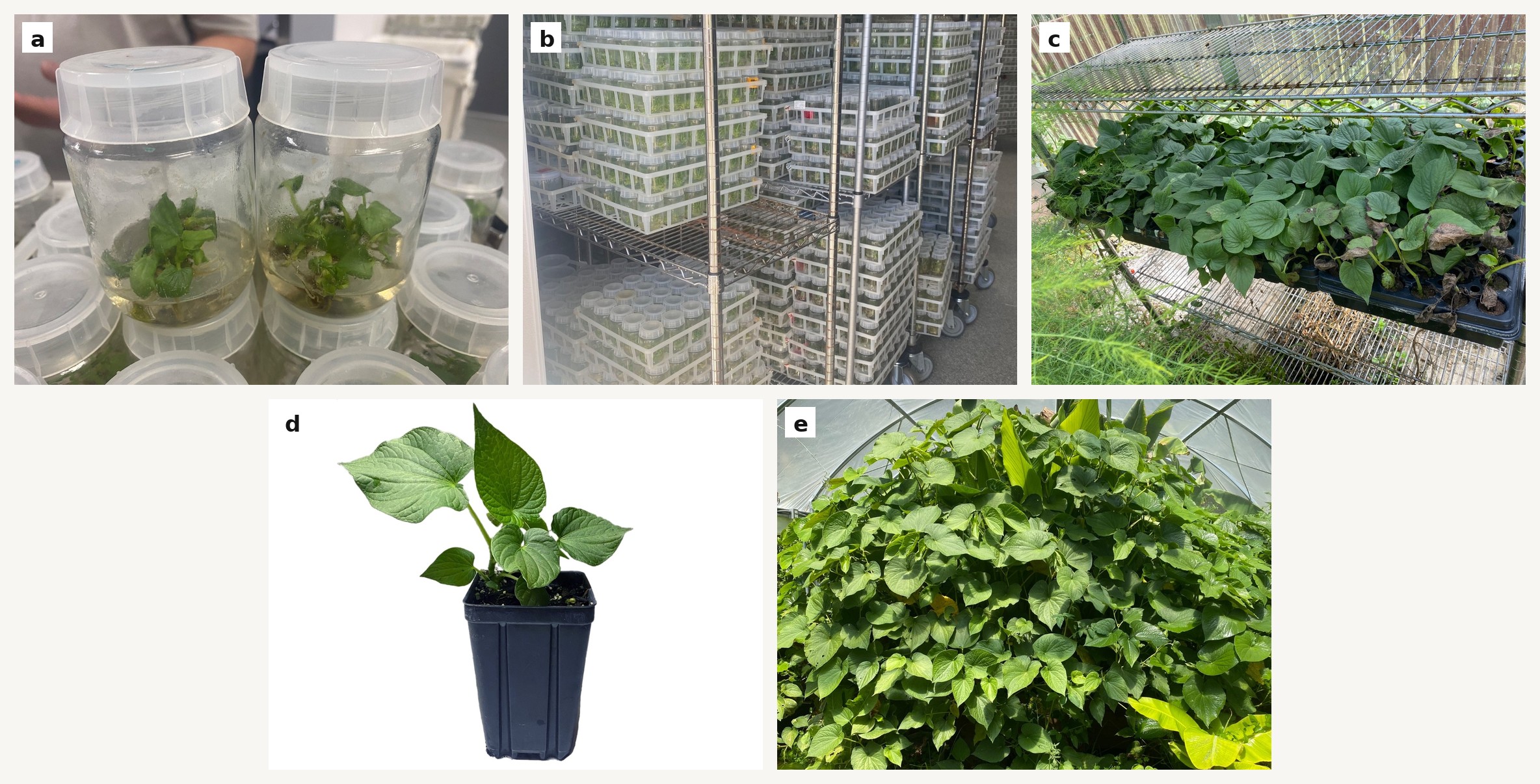
The line from culture to crop. (a) Plantlets on semi-solid medium in culture vessels — every plant in the sequence begins here. (b) Culture vessels held on racks in the propagation room, the stage at which a single selected individual becomes a population and the clonal line is re-cultured across generations. (c) Deflasked plantlets in plug trays under greenhouse cover, during acclimation from sterile culture to ambient humidity and light. (d) An acclimated rooted start in a nursery pot, the form in which plants leave the nursery. (e) An established plant of the line under hoop-house cover.
Across seven root and raw-material assays from October 2023 to July 2026, in Florida and California, the code was 254631 every time. Total kavalactones ranged from 6.38% to 19.9%, approximately a 3.1-fold range. Chips returned 254631 in January and 256431 in May and July, a switch between kavain and methysticin in third and fourth positions. Stems returned 253461, a different pattern with yangonin third and kavain fourth; the last two positions in the July stem represent non-detects rather than a measured ordering. The leading dihydrokavain–dihydromethysticin pair remained the same in every Kali ISA fraction.
The five 2024–2026 farm lots returned kavain-to-flavokavain-B ratios from 8.98 to 18.06 and flavokavain-to-kavalactone ratios from 0.017 to 0.025. The 2023 Sarasota and Boca Raton lots were different: their corresponding ratios were 6.22 and 6.69, and 0.035 and 0.036. Six of the seven root and raw-material lots were below the 0.4% total flavokavain ceiling; Sarasota was the exception. The low farm-lot ratios are an observed result, not proof that climate-tolerance selection caused them.
For context, the published noble-group means are 7.31 for kavain-to-flavokavain B and 0.13 for total flavokavains-to-kavalactones, derived from acetonic extracts measured primarily by HPTLC rather than the raw-material HPLC measurements used here (Lebot et al., 2019). Comparisons with those means are directional, and the means are not safety cutoffs. Within the current-method dataset, the farm lots had lower flavokavain-to-kavalactone ratios than the assayed Madang Short and Madang Tall roots, but those comparator cultivars are represented by one lot each.
The three Florida harvests gave 7.00% total kavalactones in January, 8.10% in May and 6.38% in July while retaining 254631 in the lateral roots. The associated temperatures were a 30-day average of 62 °F before January and seven-day averages of 72 °F and 80 °F before May and July, with July highs of 113 °F. May also had the lowest root flavokavain-to-kavalactone ratio of the three, at 0.017. With one plant per harvest date, increasing age and unequal temperature averaging windows, this is a production observation, not a controlled temperature response or an established optimum. The January result remains directly relevant to mainland cultivation: the harvested lateral roots contained 7.00% total kavalactones after that cool pre-harvest period.
Six subsamples of one lot: absolute limit and ratio
One lot of traditional unpeeled Papua chips was sampled six times, and the six readings show what a single specification number can and cannot capture. All six read 256431. Their total kavalactones ranged from 4.18% to 23.1% w/w, a coefficient of variation of 47.2% inside one lot.
Set that against the 0.4% w/w absolute total flavokavain limit in the American Kava Quality Standard. Four of the six subsamples sat above it and two below. Meanwhile the flavokavain-to-kavalactone ratio across the same six held between 0.026 and 0.033, a sample coefficient of variation of 7.6%, compared with 43.2% for absolute total flavokavains. The subsample furthest below the limit returned the highest ratio in the series; the one furthest above it returned the lowest.
The reason is that absolute concentration and relative composition answer different questions. At a similar flavokavain-to-kavalactone ratio, more concentrated material can exceed an absolute flavokavain ceiling while weaker material passes. Dilution with constituent-free material lowers both concentrations without changing their ratio; blending with chips need not preserve the ratio, because the chips contribute their own kavalactones and flavokavains.
The manuscript illustrates the distinction by calculating raw-material quantities containing 250 mg of total kavalactones. On that nominal basis, Sarasota requires about 1.26 g and contains 8.8 mg of total flavokavains; Boca Raton requires about 2.79 g and contains 8.9 mg. Madang Short and Madang Tall roots contain 12.1 mg and 9.9 mg, respectively, on the same basis, while the five 2024–2026 Kali ISA farm lots contain approximately 4.3–6.2 mg. These are calculations from raw-material composition, not measured beverage doses, extraction yields or a recommended serving. Translating them into actual exposure requires extraction and preparation data.
That supports reporting the ratio alongside the absolute result. It does not establish a safe ratio limit or, by itself, justify replacing the 0.4% ceiling. The manuscript's proposed alternative, total flavokavains at or below 0.4% w/w or a flavokavain-to-kavalactone ratio at or below 0.05, has the following consequences when applied to its own data:
| Material above the 0.4% ceiling | Total flavokavains, % w/w | Flavokavains/kavalactones | Result under the proposed alternative |
|---|---|---|---|
| Kali ISA, Sarasota lateral roots | 0.697 | 0.035 | Passes the ratio branch |
| Madang Short lateral roots | 0.774 | 0.048 | Passes the ratio branch |
| Madang Tall roots | 0.560 | 0.040 | Passes the ratio branch |
| Rai Coast Pink lateral roots | 0.506 | 0.063 | Fails both branches |
| Rai Coast Pink chips | 0.405 | 0.054 | Fails both branches |
These are the sample results in manuscript Tables 4 and 8, with ratios rounded to three decimals; classification uses the unrounded ratios. The alternative would admit Sarasota and both Madang root lots, not Sarasota alone, while continuing to exclude the two Rai Coast Pink fractions. It is a proposal for evaluation, not an adopted change to the standard or a toxicological finding, and flavokavain B should still be reported separately.
Blending changes the certificate, not the identity of the inputs
The two Waka blends in the journal manuscript provide another practical illustration of why a code should not stand in for identity. Unblended July Kali ISA lateral roots returned 254631; the 50:50 Kali ISA/Waka blend returned 246531, and the 33:67 blend returned 426531 with kavain first. Total kavalactones stayed close, at 6.38%, 6.50% and 6.76%, while the kavain-to-flavokavain-B ratio rose from 10.29 to 18.06 and 23.08.
A kavain-led result on the finished blend does not authenticate either input or convert the original Kali ISA material into a different cultivar. The certificate describes the mixture, and the product should be identified by its composition rather than represented as unblended Kali ISA.
What this does not show
- No genetic authentication was performed on any sample. Botanical identity of the Kali ISA raw material was confirmed by high-performance thin-layer chromatography as consistent with the reference profile for kava root, which establishes species and not cultivar. Cultivar identity rests on chemotype consistency and on the designations supplied with each collection, and the dataset itself demonstrates that a chemotype code is not an identity test.
- Several cultivars are represented by single lots. The comparison between Kali ISA and its Madang parent material on flavokavain content is one of those, and it is the finding most exposed to the author's commercial interest.
- The kavain-last pattern is post hoc and rests on five ceremonial readings from two cultivars.
- The values here are not method-matched to the historical Papua New Guinea figures, so the potency comparison carries a methodological component that cannot be separated from a material one.
- The 33 assays span more than one method revision at the same laboratory: 22 used the current kavalactone-and-flavokavain method, six Papua chip subsamples used an earlier method, and Iwi plus four Merauke samples had kavalactone-only assays. Accordingly, 28 samples have flavokavain data, not all 33. Duplicate injections and the three Merauke retests are analytical replication, not independent growing or preparation replicates.
- The five current-program root and raw-material lots have favorable measured ratios, but the study does not separate the contributions of genetic selection, growing conditions, harvest timing and processing. The unreplicated harvest series cannot establish a temperature optimum or prove a heat-stress effect.
- Neither the raw-material assays nor the illustrative 250 mg calculation measures actual beverage exposure. Comparisons with published noble-group means are not method-matched and do not establish safety, noble certification or suitability for sustained daily consumption.
- MISA is a collection label for the second Merauke plant, whose Marind name was not recorded. Its shared chemotype with some Isa-type material does not resolve whether it is the same clone, and the absence of flavokavain results prevents placing either Merauke collection on those comparison axes.
- The selection history of the Kali ISA line is the author's firsthand account together with the account of the growers who hold it. The Hawaiian source farm and the 2013 study visit are named and photographically dated. The mid-1980s introduction account comes from Johnston and Rogers (2006, p. 58), citing Lebot's personal communication, rather than from an accession record reproduced here (Hawaiian ‘Awa). Vandenbroucke and colleagues (2015) document later Hawaiian nursery sourcing for Isa and Iwi, not the date of their first arrival or the complete chain of custody of Kali ISA (Vandenbroucke et al.). The selection itself is identified as uncorroborated, with no selection records, survival counts or accession numbers reproduced.
- The domestication argument is an interpretation of chemotype distribution, not a demonstration. Testing it needs cultivar-level survey in Papua on the scale Vanuatu has had: named cultivars, documented use categories, kavalactones and flavokavains by the same method, and genotyping on the same accessions.
Disclosures
The author has a commercial interest in Kali ISA and in kava retail and kava-bar operations, and holds a position in the American Kava Association. The Merauke material was contributed by John Sanday of Melanesian Trustee Services Limited, who declined payment, asked to be cited, and had no role in the analysis or in the decision to publish. Where his field account presses against the framework used here, it is reported in his terms in the companion manuscript. Laboratory work was performed by Flora Research Laboratories, Grants Pass, Oregon. An AI assistant was used to extract values from the certificates, compute derived codes and ratios, and draft and structure the documents; the data and the conclusions are the author's.
Further studies are being conducted by the American Kava Association on the open questions identified here, and results will be published as they complete. The priorities described in the manuscript include replicated cultivation work, within-cultivar variation, genetic authentication and additional Merauke material.
References
- Dom, M. (n.d.). Assessment of kavalactones in kava, Piper methysticum Forst. f., cultivars of Papua New Guinea. National Agricultural Research Institute, Lae.
- Flora Research Laboratories. (2025). Qualitative confirmation of botanical identity of kava by high-performance thin-layer chromatography (TLC-ID-Kava), job J25-0930-H, Kali ISA raw material, lot KI-R. Grants Pass, Oregon.
- Hrnčíř, V., Sheehan, O., Claessens, S., & Gray, R. D. (2026). Kava consumption and the rise of sociopolitical complexity in Oceania. PNAS, 123(9), e2521658123. doi:10.1073/pnas.2521658123
- Kameubun, K. M. B. (2013). Indigenous knowledge, morphological variation and genetic diversity of kava in Merauke, Papua, Indonesia. Doctoral dissertation, Georg-August-Universität Göttingen. ediss.uni-goettingen.de/handle/11858/00-1735-0000-0022-5EB7-4
- Kali Kava. (2023). Kali-ISA™ breaks new record in Sarasota, FL: 19.9% kavalactones. kalikava.com/blogs/blog/kali-isa-breaks-new-record-in-sarasota-fl-19-9-kavalactones
- Lebot, V., & Lévesque, J. (1989). The origin and distribution of kava: a phytochemical approach. Allertonia, 5(2), 223–281.
- Lebot, V., Michalet, S., & Legendre, L. (2019). Kavalactones and flavokavins profiles contribute to quality assessment of kava. Beverages, 5(2), 34. doi:10.3390/beverages5020034
- Republic of Vanuatu. (2002). Kava Act No. 7 of 2002. faolex.fao.org/docs/pdf/van38473.pdf
- Suharno, Tanjung, R. H. R., Sufaati, S., & Agustini, V. (2016). Wati (Piper methysticum L.) medicinal plant: ethnobiological and ethnomedicinal values of the Marind tribe in Merauke, Papua, Indonesia. Biodiversitas, 17(2), 814–822. smujo.id/biodiv/article/view/731
- Vandenbroucke, H., Mournet, P., Malapa, R., Glaszmann, J.-C., Chaïr, H., & Lebot, V. (2015). Comparative analysis of genetic variation in kava assessed by SSR and DArT. Genome, 58(1), 1–11. doi:10.1139/gen-2014-0166
- Johnston, E., & Rogers, H. (Eds.). (2006). Hawaiian ‘awa: Views of an ethnobotanical treasure. Association for Hawaiian ‘Awa. Chapter 6, p. 58 and Table 6.1. Hawaiian ‘Awa, part 2
- FratiniVergano – European Lawyers. (2015). Scientific and legal assistance for the development of a quality and safety standard for kava production and trade in the Pacific region: Final report. ACP-EU TBT Programme, REG/FED/022-667, Project 042/14. Annex 6.6.5; data compiled in Tables 11–12 of the companion manuscript.
- Wang, J., Qu, W., Bittenbender, H. C., & Li, Q. X. (2015). Kavalactone content and chemotype of kava beverages prepared from roots and rhizomes of Isa and Mahakea varieties and extraction efficiency of kavalactones using different solvents. Journal of Food Science and Technology, 52(2), 1164–1169. Full article. https://doi.org/10.1007/s13197-013-1047-2
- Sanday, J. (2018). Field observations from Merauke, South Papua: interviews with Marind chiefs and community members on the cultural use of wati. Personal communication to T. Blythe, July 19 and 26, 2018. Melanesian Trustee Services Limited, Port Moresby, Papua New Guinea.
Cite This
Blythe, T. (2026). From Madang to the mainland: the Papuan and Hawaiian origin of Kali ISA. American Kava Association discussion article, version 1.5, companion to Technical White Paper No. 23. https://www.americankavaassociation.org/study/kali-isa-flavokavains
Supporting Data and Access
This article reports no new experimental data. Its results are drawn from version 1.5 of the companion manuscript, American Kava Association Technical White Paper No. 23; calculations in this discussion use the concentrations printed in that manuscript's tables. The laboratory certificates and supporting records are available from the corresponding author on reasonable request.
Write to admin@americankavaassociation.org to enquire.