Overview
In 2018 the Association paid NIS Labs, an independent contract laboratory with no position in the kava debate, to prepare four kava beverages the way a drinker would and put them on human cells. Four beverages at 50 g of root per litre, six dilutions each from 0.05 to 5 g/L, triplicate doses against twelve-replicate controls, in human peripheral blood lymphocytes and HepG2 hepatocytes — with Coca-Cola, Johnnie Walker Red and acetaminophen in the same run for scale. Nothing made from kava reduced viability in either cell type. All four raised hepatocyte metabolic activity, the non-noble Isa beverage most of all. The cola and the whisky reduced lymphocyte viability by half at the top dose. This page reports the laboratory's work as it was done, then reconciles what the cells actually received against the Association's later mass-balance measurements, and reads the result against eight subsequent years of evidence.
Abstract
In 2018 the founders of the American Kava Association commissioned NIS Labs, an independent contract research laboratory in Klamath Falls, Oregon, to answer a narrow question: does a kava beverage prepared the traditional way, from dried root in cold water, damage human cells? Four beverages were hand-prepared at 50 g of root powder per litre and tested across a thousand-fold dose range against human peripheral blood lymphocytes and against HepG2 human hepatocytes, with Coca-Cola, Johnnie Walker Red Label and acetaminophen as reference articles. The laboratory released its findings as Report 151-001 on 10 September 2018. None of the four kava beverages reduced viability in either cell type at any dose. All four increased HepG2 mitochondrial metabolic activity, and the largest increase came from the beverage prepared from Isa, a Papua New Guinea cultivar that sits outside every noble classification in use. The two ordinary consumer beverages reduced lymphocyte viability substantially and dose-dependently; kava did not. The discussion that follows the results reconciles the doses actually delivered to the cells against the partitioning data of Technical White Papers No. 2 and No. 5, examines the interpretation of an MTT increase, sets out the evidentiary position at the time Isa was selected for propagation in the United States as Kali-ISA, and assesses eight subsequent years of published literature and commercial practice against the result. That discussion was not part of the laboratory's remit and the laboratory bears no responsibility for it.
Key Findings
- No hepatocyte toxicity was observed. None of the four aqueous kava beverages reduced HepG2 viability at any tested dose from 0.05 to 5 g/L root-powder equivalent, over 48 hours.
- The non-noble cultivar performed best, not worst. Isa produced the largest rise in HepG2 mitochondrial activity, approximately +50% at 2 g/L, against +35% for Palisi, +30% for Borogu and +20% for the Borogu–Palisi blend.
- The consumer reference beverages were the cytotoxic ones. Cola and whisky reduced lymphocyte viability by 45–55% at the highest dose and by 25–35% even at the lowest; the four kava beverages did not.
- The exposure delivered was far smaller than the nominal dose implies. Sterile filtration at 0.22 µm removed the suspended particulate that carries most of a traditional beverage's kavalactones. Reconciled against the mass-balance data of White Papers No. 5 and No. 2, the top dose delivered of the order of 20 to 140 µg/mL of dissolved kavalactone, against the 5,000 µg/mL used in the comparable solvent-extract work.
- Flavokavain exposure was bounded below the cytotoxic range. On the same reconciliations, flavokavain B at the top dose is bounded between roughly 0.5 and 1.3 µg/mL, beneath the flavokavain B IC₅₀ of about 6.6 µg/mL reported in HepG2.
- The cultivar now grown as Kali-ISA carries a low measured flavokavain load. Kali-ISA root assays 2.5 mg of flavokavain per 100 mg of kavalactone, below the 0.07 to 0.22 ratio range reported for 72 noble reference samples and far below the two-day range of 0.25 to 0.54.
- Eight years of hindsight has not contradicted the finding. The independent 2019 VKIA literature review concluded there is insufficient evidence to separate noble from non-noble cultivars on safety grounds, and Papuan Isa now moves through the Fijian supply chain at commercial scale without a reported hepatic signal.
A beverage nobody had put on cells
In 2018 the founders of the American Kava Association paid an independent contract laboratory to answer one narrow question: does a kava beverage prepared the traditional way, from dried root in cold water, damage human cells? NIS Labs of Klamath Falls, Oregon, prepared four beverages at 50 g of root powder per litre and tested them across a thousand-fold dose range — 0.05 to 5 g/L root-powder equivalent — against freshly isolated human peripheral blood lymphocytes and against HepG2 human hepatocytes. Each kava dose ran in triplicate; untreated and acetaminophen control cultures ran in twelve replicates each. Coca-Cola, Johnnie Walker Red Label and acetaminophen were tested alongside as reference articles. The findings were released as Report 151-001 on 10 September 2018.
None of the four kava beverages reduced viability in either cell type at any dose. All four raised HepG2 mitochondrial metabolic activity, and the largest rise came from the beverage prepared from Isa — a Papua New Guinea cultivar that sits outside every noble classification in use. The two ordinary consumer beverages reduced lymphocyte viability substantially and dose-dependently. Kava did not.
What this page is — The methods and results below are a faithful restatement of what the laboratory did and reported, with its figures reproduced unaltered. Everything from the dose reconciliation onward was prepared in 2026, using information the laboratory did not have, and formed no part of its commissioned scope. The laboratory bears no responsibility for it.
What was contested, and what a cell assay could reach
By 2018 the American kava trade was operating under a safety framework it had not generated and could not test. The European regulatory actions of 2002 and 2003 had been argued largely on case reports involving ethanolic and acetonic pharmaceutical extracts, and the explanatory hypotheses that survived those actions — flavokavain content, pipermethystine from aerial parts, mould toxins, glutathione depletion, cultivar nobility — were built from constituent studies, organic-solvent extract work, and cell lines exposed to isolated compounds. Almost none of it had been tested on the article people actually drink. Vendors were being asked to guarantee the safety of a beverage on the strength of experiments that had never used one.
Two of the contested claims were, in principle, addressable in vitro. The first is that non-noble cultivars carry a hepatic risk that noble cultivars do not, which rests substantially on their higher flavokavain content. The second is that traditional aqueous preparation is protective relative to solvent extraction, attributed variously to co-extracted glutathione or simply to the poor water solubility of the more lipophilic constituents. Both predict a measurable difference in a hepatocyte assay: non-noble beverages should be more cytotoxic than noble ones, and aqueous preparations less cytotoxic than the solvent extracts already characterised in the same cell line.
Neither had been tested that way. Gebhardt and Schmidt compared cultivars, plant parts and extraction media in HepG2 and Hep3B cells and reported that extraction medium mattered more than cultivar, but that work used solvent extracts throughout and appeared as a conference communication. Côté and colleagues compared a traditional aqueous extract against acetone, ethanol and methanol extracts and found the nonpolar fractions markedly the more cytotoxic. What was missing was a straight side-by-side of finished traditional beverages made from noble and non-noble root, in the same laboratory, on the same day, on the same cells. No such comparison appears to have been published elsewhere, which is the principal reason for reporting this work eight years after the fact.
NIS Labs was selected because it had no position in the kava debate, no commercial interest in the outcome, and an established cell-based screening practice. The scope was deliberately narrow: prepare the beverage as a drinker would, put it on human cells, report what happens. The laboratory was not asked to adjudicate nobility, to model human pharmacokinetics, or to certify any product.
How it was done
Each beverage was hand-prepared at 50 g of dry root powder per litre of water, within the range used in commercial kava bars and in domestic preparation. The powder went into a 200-micron nut-milk straining bag, water was added in 250 mL increments, the material stood for ten minutes, then was kneaded and massaged repeatedly through the bag with a final wringing squeeze. Prepared beverage was divided into single-use portions and frozen, so no portion saw more than one freeze–thaw cycle before assay. All four kava materials were root powder without peelings.
The filtration step, which matters more than anything else in the design — A finished beverage is an opaque suspension and cannot be placed on cell cultures in that state. Solids were removed by centrifugation and the supernatant passed through a 0.22 µm sterile filter before dilution into culture medium. That step is necessary for the assay, and it is also the single most consequential feature of the design. What it does to the delivered dose is worked through below.
For the lymphocyte arm, freshly isolated human peripheral blood mononuclear cells were cultured for 24 hours with each article dilution, and viability was assessed by flow cytometry — using cell size together with the shrinkage and fragmentation characteristic of apoptotic and dead cells to separate live lymphocytes from debris. Results are reported both as lymphocyte counts per volume and as percentage change from untreated control.
For the hepatocyte arm, HepG2 cells were cultured for 48 hours with each dilution and mitochondrial metabolic activity measured by reduction of the tetrazolium dye MTT, with untreated cultures defining 100% relative activity. Acetaminophen served as the positive control at a dose taken from the literature. Statistical significance in the lymphocyte data is reported at P < 0.05 and P < 0.01 against untreated control. This is a single-laboratory screen with one preparation per material: it establishes direction and approximate magnitude, and does not establish inter-preparation reproducibility.
Table 1. Test and reference articles, doses and rationale, as tested under NIS Report 151-001.
- Kava Borogu — Form: Dried root powder · Preparation: Aqueous, traditional · Dose range tested: 0.05 – 5.0 g/L · Basis for dose: Top dose matches highest extract dose of Gebhardt and Schmidt
- Kava Palisi — Form: Dried root powder · Preparation: Aqueous, traditional · Dose range tested: 0.05 – 5.0 g/L · Basis for dose: As above
- Kava Other (Borogu–Palisi 50:50) — Form: Dried root powder · Preparation: Aqueous, traditional · Dose range tested: 0.05 – 5.0 g/L · Basis for dose: As above
- Kava Papua (Isa) — Form: Dried root powder · Preparation: Aqueous, traditional · Dose range tested: 0.05 – 5.0 g/L · Basis for dose: As above
- Coca-Cola — Form: Liquid · Preparation: As sold, diluted · Dose range tested: 0.1 – 100 mL/L · Basis for dose: Consumer beverage reference
- Johnnie Walker Red — Form: Liquid · Preparation: As sold, diluted · Dose range tested: 0.05 – 50 mL/L · Basis for dose: Consumer beverage reference; culture alcohol held ≤ 2%
- Acetaminophen — Form: Powder · Preparation: Dissolved · Dose range tested: 10 µmol/mL · Basis for dose: Established hepatotoxic positive control
Doses for the kava articles are expressed as grams of dry root powder equivalent per litre of culture-facing dilution.
Lymphocytes: kava flat, cola and whisky down
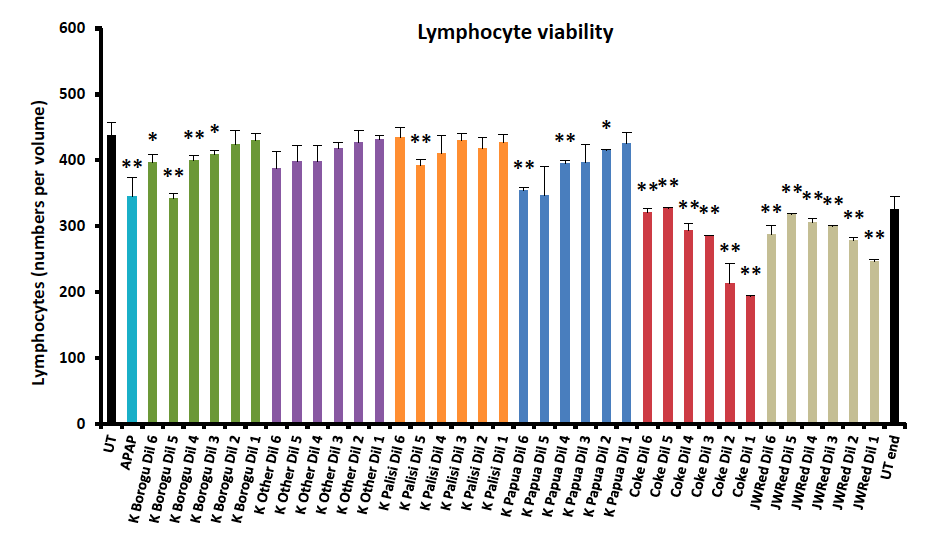
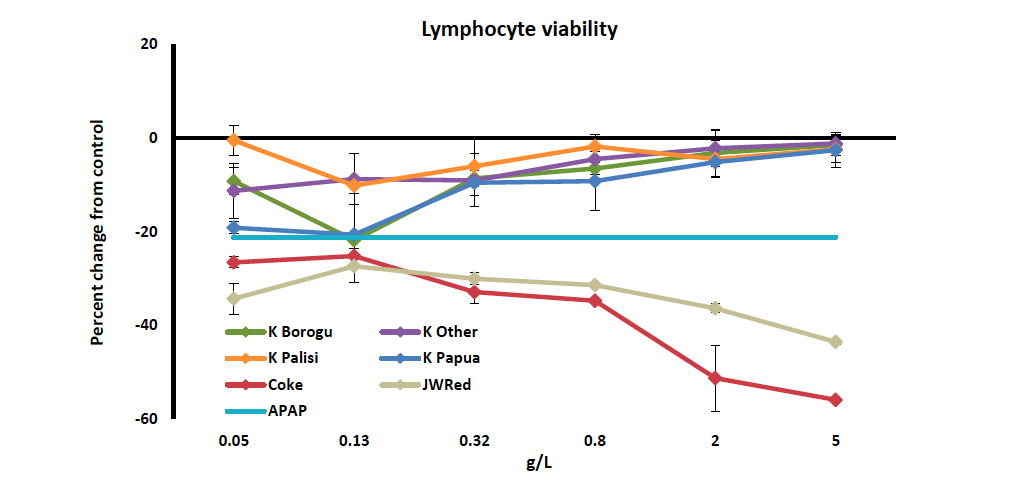
The four kava beverages had minimal effect on lymphocyte viability across the full dose range. Scattered reductions of roughly 20% reached statistical significance at the two lowest doses of the Isa beverage and at the 0.13 g/L dose of Borogu and of the Borogu–Palisi blend — but the effect did not grow with dose. It disappeared as dose rose. The laboratory read that non-monotonic pattern as evidence that the beverages carry compounds supporting lymphocyte viability at higher concentrations, offsetting whatever produced the reduction at low dilution.
The two consumer reference beverages behaved entirely differently. Cola and whisky each reduced lymphocyte viability in a clean dose-dependent manner — by 45–55% at the highest dose, and by 25–35% even at the lowest dose tested. Acetaminophen reduced viability by approximately 20%.
Hepatocytes: nothing went down, and the non-noble beverage went up the most
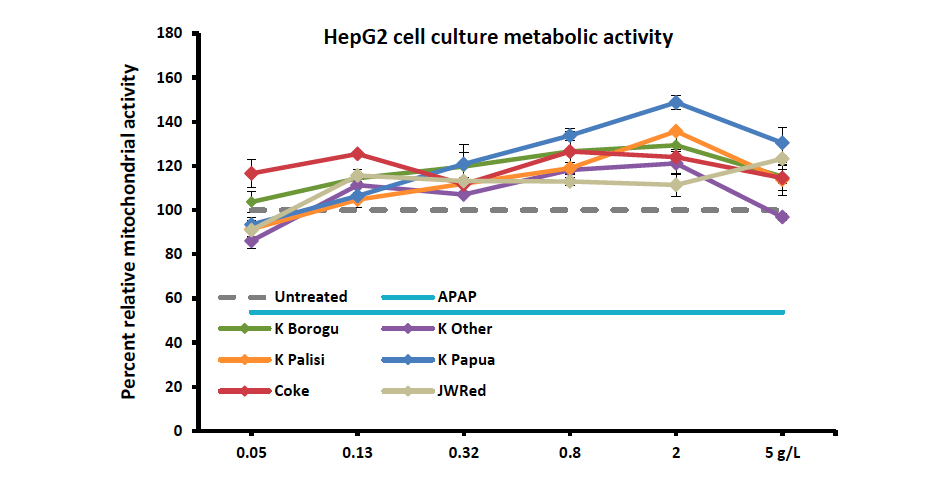
None of the four kava beverages reduced HepG2 viability at any dose. All four increased mitochondrial metabolic activity relative to untreated control, and in every case the largest increase came at 2 g/L, the second-highest dose, with a partial fall-off at 5 g/L.
Table 2. Peak change in HepG2 relative mitochondrial metabolic activity, measured by MTT after 48 hours. Values are approximate readings at the 2 g/L peak dose as reported by the laboratory.
- Kava Papua (Isa) — Cultivar status: Non-noble · Peak change at 2 g/L: +50% · Activity vs. untreated control: ≈ 150%
- Kava Palisi — Cultivar status: Noble · Peak change at 2 g/L: +35% · Activity vs. untreated control: ≈ 135%
- Kava Borogu — Cultivar status: Noble · Peak change at 2 g/L: +30% · Activity vs. untreated control: ≈ 130%
- Kava Other (Borogu–Palisi 50:50) — Cultivar status: Noble blend · Peak change at 2 g/L: +20% · Activity vs. untreated control: ≈ 120%
- Acetaminophen, 10 µmol/mL — Cultivar status: Positive control · Peak change at 2 g/L: − 50% · Activity vs. untreated control: ≈ 50%
The acetaminophen positive control behaved as expected, cutting metabolic activity by about half and confirming that the assay could detect hepatocyte injury under these conditions. Neither cola nor whisky decreased HepG2 metabolic activity; cola in particular raised the reading at the lowest dilution tested. The laboratory noted that sugar and ethanol are themselves metabolic substrates and may act directly on the measured endpoint — a caution about the endpoint rather than a finding about the beverages.
Within the design tested: traditionally prepared aqueous kava beverages were not cytotoxic to human lymphocytes or to HepG2 hepatocytes at doses up to 5 g/L root-powder equivalent; cultivar nobility did not order the results in the direction the flavokavain hypothesis predicts; and two beverages sold without restriction in every market that has restricted kava were the only articles other than the positive control to reduce viability.
What the cells actually received
The two assays measure different things, and neither measures hepatotoxicity in the clinical sense. The lymphocyte assay counts intact cells and therefore reports cell death directly. MTT reports the rate at which a culture reduces a tetrazolium dye, a function of mitochondrial activity and cell number together: a fall is consistent with cell death, with metabolic suppression, or with both; a rise is consistent with proliferation, with metabolic stimulation, or with chemical interference in the assay itself. This is properly read as an absence-of-toxicity result, not as a demonstration of hepatic benefit.
The most important limitation of the 2018 design was invisible in 2018 and is now quantifiable. Technical White Paper No. 5 established by mass balance that a traditional aqueous kava beverage is a suspension rather than a solution: across four varieties and two extraction protocols, 83.7–91.2% of the kavalactones in the finished beverage were carried on fine particulate that passed the strainer, leaving only 8.8–16.3% in true solution. A method that assays only the filtered liquid therefore reports between roughly one seventh and one tenth of what a drinker receives — and the 2018 study assayed only the filtered liquid, necessarily so.
Table 3. Reconciliation of nominal dose against estimated dissolved kavalactone delivered to culture, at the highest dose tested. Root kavalactone content was not measured in the 2018 study; a 6–12% w/w range is applied here as a plausible bracket for dried noble and Papuan root.
- Beverage strength as prepared — Basis: 50 g root powder per litre · Low estimate: 50 g/L · High estimate: 50 g/L
- Highest dose tested — Basis: 5 g/L root-powder equivalent = 1:10 dilution of the beverage · Low estimate: 5 g/L · High estimate: 5 g/L
- Assumed root kavalactone content — Basis: Not measured; bracket applied · Low estimate: 6% w/w · High estimate: 12% w/w
- Nominal kavalactone at top dose — Basis: Dose × root content × 78% single-extraction efficiency · Low estimate: ≈ 234 µg/mL · High estimate: ≈ 468 µg/mL
- Dissolved fraction surviving 0.22 µm — Basis: 8.8–16.3% of beverage kavalactone · Low estimate: 8.8% · High estimate: 16.3%
- Estimated delivered kavalactone — Basis: Nominal × dissolved fraction · Low estimate: ≈ 21 µg/mL · High estimate: ≈ 76 µg/mL
A second reconciliation is now possible on measured rather than assumed inputs. Technical White Paper No. 2 reports a beverage-state mass balance for three American-grown cultivars in which root kavalactone content, transfer into the beverage and phase partitioning were all measured on the same material by validated HPLC. One of those cultivars is Kali-ISA, propagated from the same Papua New Guinea Isa germplasm as the Papua article tested in 2018 — the closest characterised proxy available for the beverage that produced the largest HepG2 response, and higher on every term that matters here.
Table 4. Second reconciliation of the highest dose tested, using measured beverage-state values for Kali-ISA rather than the bracketed assumptions of Table 3.
- Root kavalactone content — Basis (Kali-ISA, measured): HPLC, characterised lot · Value: 14.3% w/w
- Root flavokavain content — Basis (Kali-ISA, measured): HPLC, flavokavains A+B+C · Value: 0.354% w/w
- Transfer into beverage — Basis (Kali-ISA, measured): Total kavalactone extraction efficiency · Value: 90.4 ± 1.2%
- Non-particulate share — Basis (Kali-ISA, measured): Proportion of beverage kavalactone not particle-associated · Value: 21.3 ± 0.7%
- Non-particulate kavalactone — Basis (Kali-ISA, measured): 143 mg/g × 90.4% × 21.3% · Value: ≈ 27.5 mg per g root
- Delivered kavalactone at top dose — Basis (Kali-ISA, measured): 27.5 mg/g × 5 g/L · Value: ≈ 137 µg/mL
- Delivered flavokavain at top dose — Basis (Kali-ISA, measured): 3.54 mg/g × 93.9% × 24.3% × 5 g/L · Value: ≈ 4.0 µg/mL
These are upper bounds: the non-particulate fraction in White Paper No. 2 is a residual quantity defined by 150 µm straining, and the 2018 assay filtered at 0.22 µm, which would have removed sub-strainer colloidal material counted here as non-particulate.
The two routes bracket rather than contradict each other — 21–76 µg/mL by assumption, a ceiling near 137 µg/mL by measurement. Taken together, the kavalactone concentration reaching the cells at the highest dose was of the order of tens to low hundreds of micrograms per millilitre, against the 5,000 µg/mL at which solvent extracts were compared in the same cell line: a shortfall of roughly 35- to 240-fold.
The reconciliation cuts both ways, and it would be dishonest to present only one edge of it. Against the study, the design did not test dose-equivalence with the solvent extracts whose top dose it was built to match, so a null result at 5 g/L is a weaker statement than the figure looks. In favour of it, the exposure tested was a fair representation of the dissolved phase of a real beverage — and the dissolved phase is the fraction most readily available for absorption across the gut wall. The 2018 study is best understood as having tested the soluble load of traditional kava, not its total load.
The flavokavain bound — White Paper No. 5 measured flavokavain delivery at about 2.3 mg per 100 mg of kavalactone in the finished beverage. Applied as an upper bound to Table 3, that gives roughly 0.5–1.8 µg/mL of flavokavain at the top dose; the measured route of Table 4 raises the ceiling to about 4.0 µg/mL of total flavokavain, of which flavokavain B is roughly a third on published constituent proportions — approximately 1.3 µg/mL. Pinner and colleagues report a flavokavain B IC₅₀ of 23.2 µM in HepG2, about 6.6 µg/mL. On either route the delivered exposure sits below the reported cytotoxic threshold, by a factor of roughly four to thirteen on the Table 3 bracket and roughly five on the Table 4 ceiling. Flavokavains are less polar than the kavalactones, so their dissolved share is likely lower still, which makes those generous bounds.
The inference that follows is modest: a traditionally prepared kava beverage, stripped of its particulate phase, cannot deliver flavokavain B to a hepatocyte culture at the concentrations at which flavokavain B is reported to kill hepatocytes. The 2018 null result is what that arithmetic predicts. It should not have needed a laboratory to establish — but it had not been established.
What HepG2 cannot see
HepG2 is a hepatoblastoma-derived line, and its central limitation as a hepatotoxicity model is weak or absent expression of the cytochrome P450 superfamily, including CYP3A4, CYP2C9, CYP2C19 and CYP2D6. Compounds whose toxicity depends on metabolic bioactivation are systematically under-detected in this line, which is precisely why P450-transfected HepG2 variants were developed. Several of the leading hypotheses for kava-associated liver injury are bioactivation or interaction hypotheses — reactive metabolite formation, P450 inhibition and consequent interference with co-medication. A null result in wild-type HepG2 does not speak to those mechanisms at all.
This is the strongest reason for treating the 2018 study as permissive rather than exculpatory. It shows that the dissolved phase of traditional kava is not directly cytotoxic to hepatocytes at the concentrations tested. It cannot show that traditional kava is safe in a person taking other drugs.
The cultivar test came out backwards
The 2018 design contained a genuine test with a clear predicted direction. Non-noble material carries higher total flavokavain content than noble material; flavokavain B is the most potent hepatocyte-toxic constituent identified in kava; and the beverages were prepared identically from noble Borogu, noble Palisi, a 50:50 blend of the two, and non-noble Isa. If flavokavain content ordered hepatocyte outcome, the Isa beverage should have been the worst performer of the four.
It was the best. Isa produced the largest increase in HepG2 metabolic activity, with the two single-cultivar noble beverages between it and the blend. That is one experiment, in one line, on one preparation of each material, with an endpoint that is not a clean viability measure, and it would be an overreach to call it a refutation. What it does is remove the easiest version of the argument: the claim that a traditionally prepared non-noble beverage is hepatically more dangerous than a traditionally prepared noble one, at drinking dilution, has a directional prediction that has now been tested once and came out backwards.
Why a cola and a whisky were in the run
Including them was not a rhetorical device; it was a calibration. Regulatory and in vitro toxicology results are routinely reported without any indication of what an ordinary article of commerce does under the same conditions, which leaves the reader with no scale. Here both reference beverages reduced lymphocyte viability substantially and dose-dependently, including at the lowest dilution tested, and the kava beverages did not. Neither reference beverage is restricted in any of the jurisdictions that have restricted kava.
This is not an argument that kava is safer than alcohol — a question a 24-hour lymphocyte assay is not competent to answer, and the whisky arm in particular is constrained by the 2% culture alcohol ceiling. What it establishes is that the assay was capable of detecting a cytotoxic consumer beverage, and detected two of them. The kava result is a null against a demonstrated positive, not a null in an insensitive system.
The 2018 decision: Isa, and the origin of Kali-ISA
In 2018, before any programme of mass propagation existed, the founders were assessing which kava genetics could be grown in the United States. Isa was agronomically attractive for reasons since documented in the Association's propagation work — vigorous growth, thick stems, pest resistance, and a rooting performance that makes it viable in nursery conditions. It was also, on every classification then in use, non-noble. Selecting it meant taking a position on a safety claim the literature had asserted but not tested on the beverage.
Commissioning an outside laboratory was the response to that, and the counterfactual is worth stating: had the Isa beverage shown hepatocyte toxicity in this screen, or shown it at a level the noble beverages did not, the material would not have been taken forward. The assessment was made before selection rather than after it, and by a party with nothing to gain from the answer.
The data licensed a narrow conclusion: at drinking dilution, in the dissolved phase, an Isa beverage was not more toxic to human hepatocytes or lymphocytes than beverages from established noble cultivars, and was not toxic in absolute terms. It did not license a claim that Isa is a noble cultivar, that it is suitable for daily drinking on organoleptic or physiological grounds, or that its chemotype is equivalent to Borogu's. The two-day effects associated with non-noble cultivars — nausea, lethargy, headache — are real, reported and unpleasant without being hepatic.
Provenance — The Isa tested in 2018 was Papua New Guinea material purchased as dried root through the ordinary import trade. Kali-ISA reaches the same germplasm by a longer route: Isa was carried from Papua New Guinea to Hawaii by Vincent Lebot in the 1990s as a hedge against the narrow genetic base of Hawaiian kava, grown there for roughly twenty-five years — Hawaiian-grown Isa entered the published record when Wang and colleagues characterised beverages from Isa and Mahakea roots and rhizomes — and that line was subsequently obtained by Kali Kava and propagated on the American mainland. The 2018 test article and the American cultivar are the same genetic material separated by a quarter century of Hawaiian cultivation and a further change of growing environment.
That distinction matters because the constituent at issue is measured, not inferred. As grown in Sacramento and prepared by short warm-water extraction, Kali-ISA root assayed 0.354% w/w total flavokavains against 14.3% w/w total kavalactones — a flavokavain-to-kavalactone ratio of 0.025, or 2.5 mg of flavokavain per 100 mg of kavalactone. In the reference dataset of Lebot, Michalet and Legendre — 72 noble and 82 two-day samples — the noble mean ratio was 0.13 with a range of 0.07 to 0.22, and the two-day mean was 0.36 with a range of 0.25 to 0.54. The absolute figure tells the same story: 3.5 mg of total flavokavain per gram of dry root, against a noble range of 5.1 to 30.5 mg/g and a two-day range of 17.6 to 85.7 mg/g. On both measures this material sits below the noble reference range, not above it, and an order of magnitude below the two-day mean.
Two qualifications bound that comparison. It is a comparison across laboratories and methods — the American values obtained by validated HPLC on fresh-frozen greenhouse material, the reference values by high-throughput screening of Pacific field samples. And the two American noble cultivars assayed in the same study returned lower ratios still, 1.9 mg per 100 mg for Kali-Hiwa and 1.6 mg for Kali-Rogu, so part of the low absolute load in all three is attributable to growing conditions, plant age and analytical method rather than to genotype. What the data support is the narrower statement: as this line is grown and processed in the United States, it does not carry the flavokavain load its two-day classification attributes to it.
Eight years on
The most consequential development since 2018 is not a new toxicology result but an independent assessment of the whole evidence base. In 2019 the Vanuatu Kava Industry Association commissioned Dentali, Chan and Brown to review the scientific literature on whether the evidence supports different regulatory treatment of noble and non-noble cultivars on safety grounds. The review examined more than four hundred files, and its conclusions are unusually direct for a commissioned literature review.
It found no validated method for classifying cultivars as noble or non-noble, noting that the chemotype rule proposed in the regional standard fails against published data in which non-noble Malogro and Tudei samples returned chemotypes beginning 42 or 24 while samples identified as noble Borogu returned 43 and 23. It found the flavokavain evidence conflicting and far from conclusive, and noted that whether flavokavains are hepatotoxic has not been shown to relate to the adverse effects consumers actually report from non-noble material. On glutathione it concluded there is insufficient information to substantiate a hepatotoxicity mechanism that glutathione would mitigate. Its overall finding was that the available data are insufficient to determine whether a beverage made from a non-noble cultivar would be more likely to cause hepatotoxicity than one made from a noble cultivar, and that quality-based regulatory separation of cultivars, while consistent with precaution, cannot be justified on a significant body of scientific safety evidence.
Two inferences follow. The 2018 negative result is consistent with the state of the wider evidence rather than anomalous within it: an independent review reaching for a cultivar-specific hepatic signal across four hundred documents did not find one either. And the safety architecture built around cultivar nobility was already resting on an unsubstantiated premise in 2019, with the intervening years supplying no missing evidence. The German ban that generated the framework was itself lifted by court in 2015 on the grounds that the hepatotoxicity case had been inadequately made.
The commercial record — Papuan root, Isa prominent among it, now enters Fiji at industrial volume, where it is consumed domestically, blended with Fijian material and re-exported. On trade-level estimates that flow is now on the order of five hundred tonnes annually. That figure is an industry estimate rather than a customs statistic and is not presented as verified — but the underlying practice is documented: Fiji permits import of PNG kava as whole root but not as finished product, PNG suppliers have publicly lobbied to widen that permission, the PHAMA Plus value chain analysis records that imported product is likely blended and re-exported, Vanuatu's 2022 objection was precisely that its material was being re-exported unacknowledged as Fijian, and Papua New Guinea is now a registered supplier under Australia's commercial kava import programme in its own right.
What has not accompanied that flow is a hepatic signal. Fiji produces on the order of four thousand tonnes of dried kava annually and exported 552 tonnes in 2021 alone, the domestic drinking population is very large, and blended material has been moving into the export chain for years. If traditionally prepared non-noble Papuan kava carried a materially elevated risk of liver injury at population scale, this is the exposure in which it would be expected to appear. No published epidemiological signal of that kind was located.
The inferential limits should be stated rather than glossed. Absence of a reported signal is not evidence of absence: passive surveillance in the Pacific is limited, blended product is by construction untraceable to cultivar, and a rare idiosyncratic injury would not surface in trade statistics. What the commercial record does establish is that the practical premise of the restrictive framework — that non-noble material entering general consumption presents an urgent hazard — has been tested informally at very large scale for years without producing the consequences the framework anticipates. That is a weaker claim than proof of safety and a stronger one than nothing.
What would change this reading — A properly powered comparison of traditionally prepared noble and non-noble beverages in metabolically competent hepatocytes, primary human or P450-competent, showing a cultivar-ordered difference. A whole-beverage assay including the particulate phase that reproduced a cultivar-ordered difference at delivered concentrations. Or a controlled epidemiological study in a Pacific drinking population that separated cultivar exposure and found a hepatic gradient. Any of the three would carry more weight than the study reported here.
Limitations
- Only the dissolved phase was tested. Sterile filtration removed the particulate that carries the great majority of a traditional beverage's kavalactones; delivered exposure was of the order of 20–140 µg/mL at the highest dose rather than the several hundred µg/mL the nominal dose implies.
- HepG2 lacks meaningful cytochrome P450 activity. Any toxicity requiring metabolic bioactivation, and any co-medication interaction mechanism, is outside the reach of this model.
- MTT is not a viability assay. It reports dye reduction, which conflates cell number with metabolic rate and is susceptible to direct chemical interference by plant polyphenols and other reducing constituents. The increases in Table 2 should not be read as proliferation or as hepatic benefit.
- Single preparation, single laboratory, no replication across preparations. One batch of each beverage was prepared and assayed in triplicate at each dose. Direction and approximate magnitude are supported; the precision of any individual figure is not.
- Root kavalactone and flavokavain content were not measured in 2018. Table 3 relies on a bracketed assumption, and the measured values in Table 4 come from a later study on fresh-frozen American-grown material rather than the dried Papuan and Vanuatu root actually assayed.
- Cultivar identity rests on supply-chain designation. The materials were identified as Borogu, Palisi and Isa by commercial provenance; no genetic or chemotypic verification was performed, and the 2019 VKIA review is explicit that no validated classification method exists in any case.
- Twenty-four and forty-eight hour exposures. Neither assay addresses chronic exposure, cumulative effect, or the pattern of daily consumption over years that characterises actual kava drinking.
- The whisky comparison is dose-capped. Culture alcohol was held at or below 2%, so that arm does not represent consumption-equivalent exposure.
Further work
The laboratory's own recommendation in 2018 was a direct comparison of water-based kava extracts against organic-solvent extracts in the same system. That remains the single most useful unperformed experiment in this area, and it would test the aqueous-preparation hypothesis head-on. Four further priorities follow from the limitations above: a culture-compatible presentation of the particulate phase, by micronisation or suspension in a serum-supplemented vehicle, so the fraction carrying most of the dose can be assayed rather than discarded; repetition of the cultivar comparison in primary human hepatocytes or a P450-competent line, with a co-medication arm; pairing MTT with a dye-independent endpoint such as neutral red uptake, ATP quantitation or direct cell counting, plus a cell-free dye reduction control to quantify interference; and repetition with kavalactone and flavokavain assay of each root lot, genetic verification of cultivar identity where methods permit, and independent preparations as the unit of replication.
Disclosures and conflicts of interest
The laboratory work was commissioned and paid for by the founders of the American Kava Association and carried out by NIS Labs as a fee-for-service contract. NIS Labs designed and executed the cell assays, performed the statistical analysis and authored Report 151-001. The interpretation, dose reconciliation and discussion that follow the results here were prepared by the authors, were not part of the commissioned scope, and are not the responsibility of the laboratory.
Tyler Blythe and Travis Lowin are founders of the American Kava Association and hold commercial interests in kava retail, kava bar operation and American kava cultivation, including material propagated as Kali-ISA. The Association commissioned and paid for the 2018 study and has a commercial interest in its interpretation. NIS Labs was paid a service fee for the laboratory work and holds no interest in kava commerce; its personnel are not authors of this paper and had no role in the interpretation. Readers should weigh the discussion in light of the authors' interests; the methods and results report the findings of a laboratory that had none.
The authors thank Kathleen F. Benson and Gitte S. Jensen of NIS Labs for undertaking the work in 2018 without any interest in its outcome, and Dentali Botanical Sciences and the British Columbia Institute of Technology for a 2019 literature review whose willingness to report an absence of evidence made this retrospective possible.
References
- American Kava Association. (2026). Outdoor Nursery Propagation of Kava (Piper methysticum) by Air Layering. Technical White Paper No. 4. https://www.americankavaassociation.org/study/air-layering-florida
- American Kava Association. (2026). Soft-Stem Propagation of Piper methysticum Using Peat-Based Media and Aeroponic Cloning Systems. Technical White Paper No. 1. https://www.americankavaassociation.org/study/aeroponic-cloning-peat
- Arzumanian, V. A., Kiseleva, O. I., & Poverennaya, E. V. (2021). The curious case of the HepG2 cell line: 40 years of expertise. International Journal of Molecular Sciences, 22(23), 13135.
- Blythe, T., Bowman, J., & Masifilo, M. (2026). Standardized Preparation and Extraction Efficiency of Traditional Aqueous Kava Beverages. American Kava Association Technical White Paper No. 5. https://www.americankavaassociation.org/study/alu-shaker-extraction
- Blythe, T., Bowman, J., & Masifilo, M. (2026). Where the Kavalactones Go: A Mass Balance of the American Kava Beverage. American Kava Association Technical White Paper No. 2. https://www.americankavaassociation.org/study/kavalactone-mass-balance
- Bruggisser, R., von Daeniken, K., Jundt, G., Schaffner, W., & Tullberg-Reinert, H. (2002). Interference of plant extracts, phytoestrogens and antioxidants with the MTT tetrazolium assay. Planta Medica, 68(5), 445–448.
- Côté, C. S., Kor, C., Cohen, J., & Auclair, K. (2004). Composition and biological activity of traditional and commercial kava extracts. Biochemical and Biophysical Research Communications, 322(1), 147–152.
- Dentali, S., Chan, M., & Brown, P. (2019). Analysis of the Scientific Literature and Expert Opinion Regarding Strength of the Evidence for Different Regulatory Treatments of Noble and Narafala Cultivars on the Basis of Safety. Vanuatu Kava Industry Association Kava Scientific Literature Review.
- Fiji Broadcasting Corporation News. Kava exports stalled by high local consumption. https://www.fbcnews.com.fj/news/kava-export-faces-challenges/
- Fiji Ministry of Agriculture. (2023). 2021 Key Statistics on Fiji Agriculture Sector.
- Food and Agriculture Organization of the United Nations & World Health Organization. (2016). Kava: A Review of the Safety of Traditional and Recreational Beverage Consumption. Rome.
- Gebhardt, R., & Schmidt, M. (2006). Impact of kava cultivar, plant part and extraction medium on in-vitro cytotoxicity of kava in HepG2 and Hep3B cells. 54th Annual Meeting of the Society of Medicinal Plant Research, Helsinki.
- Han, D., Dara, L., Win, S., et al. (2012). Regulation of drug-induced liver injury by signal transduction pathways: critical role of mitochondria. Journal of Biological Chemistry, 287(50), 42165–42179.
- Islands Business. PNG producer lobbying to get more out of kava. https://islandsbusiness.com/news-break/png-producer-lobbying-to-get-more-out-of-kava/
- Jhoo, J.-W., Freeman, J. P., Heinze, T. M., et al. (2006). In vitro cytotoxicity of nonpolar constituents from different parts of kava plant (Piper methysticum). Journal of Agricultural and Food Chemistry, 54(8), 3157–3162.
- Kuchta, K., Schmidt, M., & Nahrstedt, A. (2015). German kava ban lifted by court: the alleged hepatotoxicity of kava (Piper methysticum) as a case of ill-defined herbal drug identity, lacking quality control, and misguided regulatory politics. Planta Medica, 81(18), 1647–1653.
- Lako, J., et al. (2018). Kava (Piper methysticum): an important source of income for the rural farmers in Fiji Islands. Advances in Crop Science and Technology, 6, 325.
- Lebot, V., Michalet, S., & Legendre, L. (2019). Kavalactones and flavokavins profiles contribute to quality assessment of kava (Piper methysticum G. Forst.), the traditional beverage of the Pacific. Beverages, 5(2), 34.
- Maioli, E., Torricelli, C., Fortino, V., et al. (2009). Critical appraisal of the MTT assay in the presence of rottlerin and uncouplers. Biological Procedures Online, 11, 227–240.
- Mosmann, T. (1983). Rapid colorimetric assay for cellular growth and survival: application to proliferation and cytotoxicity assays. Journal of Immunological Methods, 65(1–2), 55–63.
- National Institute of Diabetes and Digestive and Kidney Diseases. (2020). Kava Kava. In LiverTox: Clinical and Research Information on Drug-Induced Liver Injury. https://www.ncbi.nlm.nih.gov/books/NBK548637/
- Pacific Islands News Association. (2022, May 25). Vanuatu to stop exporting kava to Fiji. https://pina.com.fj/2022/05/25/vanuatu-to-stop-exporting-kava-to-fiji/
- Pacific Trade Invest. (2026). A Kava Pilot Program — Q1 2026 Update.
- PHAMA Plus. (2024). Fiji Kava Value Chain Analysis.
- Pinner, K. D., Wales, C. T., Gristock, R. A., et al. (2016). Flavokawains A and B from kava (Piper methysticum) activate heat shock and antioxidant responses and protect against hydrogen peroxide-induced cell death in HepG2 hepatocytes. Pharmaceutical Biology, 54(9), 1503–1512.
- Radio New Zealand Pacific. Papua New Guinea producer lobbying to get more out of kava. https://www.rnz.co.nz/international/pacific-news/528930/
- Raza, H., & John, A. (2015). Implications of altered glutathione metabolism in aspirin-induced oxidative stress and mitochondrial dysfunction in HepG2 cells. PLoS ONE, 10(12), e0145965.
- Soares, R. B., Dinis-Oliveira, R. J., & Oliveira, N. G. (2022). An updated review on the psychoactive, toxic and anticancer properties of kava. Journal of Clinical Medicine, 11(14), 4039.
- Teschke, R., Qiu, S. X., & Lebot, V. (2011). Herbal hepatotoxicity by kava: update on pipermethystine, flavokavain B, and mould hepatotoxins as primarily assumed culprits. Digestive and Liver Disease, 43(9), 676–681.
- Teschke, R., Sarris, J., & Lebot, V. (2011). Kava hepatotoxicity solution: a six-point plan for new kava standardization. Phytomedicine, 18(2–3), 96–103.
- Tolosa, L., Gómez-Lechón, M. J., Pérez-Cataldo, G., Castell, J. V., & Donato, M. T. (2013). HepG2 cells simultaneously expressing five P450 enzymes for the screening of hepatotoxicity. Archives of Toxicology, 87(6), 1115–1127.
- Ulbricht, C., Basch, E., Boon, H., et al. (2005). Safety review of kava (Piper methysticum) by the Natural Standard Research Collaboration. Expert Opinion on Drug Safety, 4(4), 779–794.
- Wang, J., Qu, W., Bittenbender, H. C., & Li, Q. X. (2015). Kavalactone content and chemotype of kava beverages prepared from roots and rhizomes of Isa and Mahakea varieties and extraction efficiency of kavalactones using different solvents. Journal of Food Science and Technology, 52(2), 1164–1169.
- Wang, Y., Narayanapillai, S. C., Tessier, K. M., et al. (2020). Kava as a clinical nutrient: promises and challenges. Nutrients, 12(10), 3044.
- Whitton, P. A., Lau, A., Salisbury, A., Whitehouse, J., & Evans, C. S. (2003). Kava lactones and the kava-kava controversy. Phytochemistry, 64(3), 673–679.
- Zhou, P., Gross, S., Liu, J.-H., et al. (2010). Flavokawain B, the hepatotoxic constituent from kava root, induces GSH-sensitive oxidative stress through modulation of IKK/NF-κB and MAPK signaling pathways. FASEB Journal, 24(12), 4722–4732.
Cite This
Blythe, T.; Lowin, T. Cellular Toxicity of Traditionally Prepared Kava Beverages in HepG2 Hepatocytes and Human Lymphocytes. American Kava Association Technical White Paper No. 24; American Kava Association: Las Vegas, NV, USA, 2026.
Supporting Data and Access
The primary source for the methods and results is NIS Labs Report 151-001, "Cellular toxicity of Kava root extracts," released 10 September 2018 and signed by Kathleen F. Benson, Research and Development Analyst, and Gitte S. Jensen, Research Director. Figures 1 to 3 are reproduced from that report without alteration to the plotted data. The partitioning figures used in the dose reconciliation are drawn from American Kava Association Technical White Papers No. 5 and No. 2. The underlying laboratory report is held by the Association and is available to researchers, regulators and standards bodies on request to the corresponding author.
The discussion published on this page is complete as an argument. It states the method, the numbers, the limitations and the conflicts of interest, and it is free to read, cite and disagree with. The records underneath it are held for the Association’s members.
Access to those records is open to stakeholders in the American kava growing industry — growers with at least one acre in production and a contract in place for the purchase of licensed planting material.
The reason is simply who this organization is. The American Kava Association is funded by its members and operates for their benefit, and its members are American kava farmers with land, capital and years committed to the crop. This work is self-funded: it was paid for out of working farms, to answer questions those farms were already facing. What the people who paid for it are owed is a working advantage in their own fields. So we publish the findings in full, limitations included, so the work can be judged on its merits — and we keep the underlying files inside the membership that produced them. That is a decision about who we are resourced to serve, not a judgement on anyone who asks.
Researchers and institutions interested in working with this material are welcome to propose a funded collaboration. That is the basis on which the Association can extend it, and we would rather say yes to a properly resourced study than no to a request.
Write to admin@americankavaassociation.org to enquire.