Overview
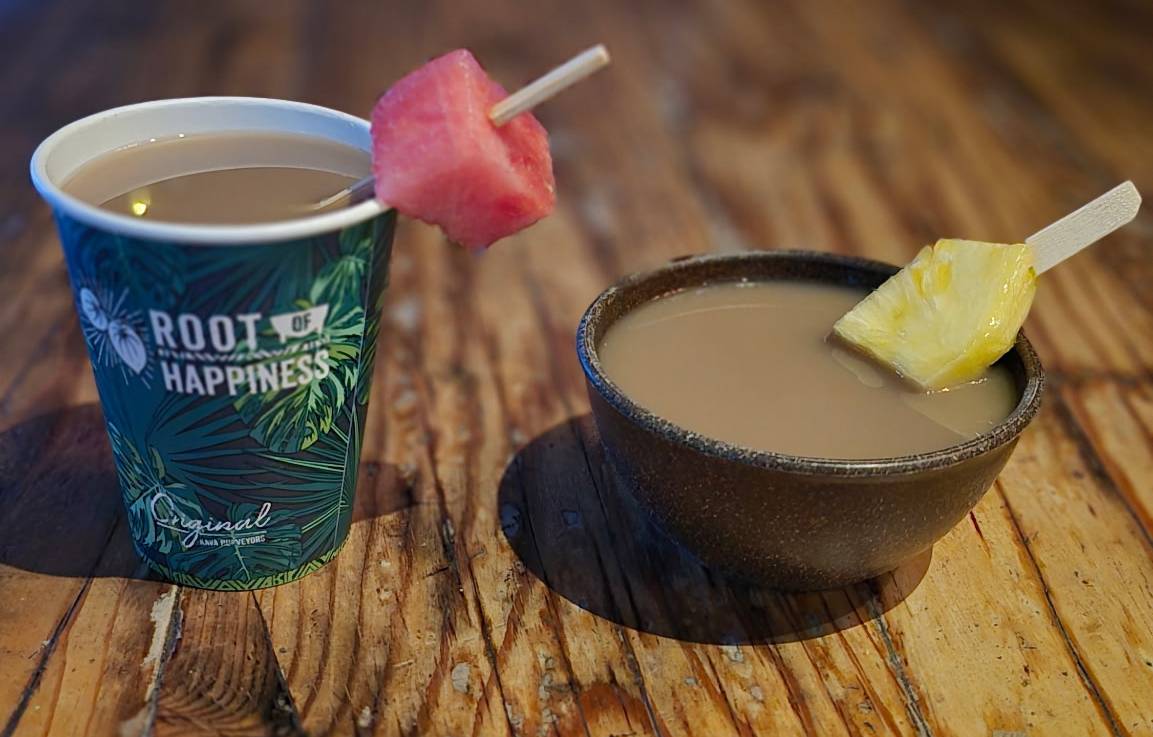
Hard Nak is a fresh green, lateral-root-only kava poured by three independent operating groups on a reputation that had never been measured. This field report attaches a number to one production batch. A single 2 lb preparation was sampled at two points — the 6 qt primary brew and the 3 qt rebrew of its spent marc — and submitted to an accredited independent laboratory alongside a standard Fresh Fiji High Tide shell brewed on the same line. Each batch was stirred to the condition of a normal pour and drawn with the 12 oz service ladle, so the assays describe a served suspension rather than a settled or clarified one. Beyond the headline potency, the per-compound data produced something the sampling was never designed to find: second-pass carryover ordered by aqueous mobility, yangonin last out and dihydrokavain first out, independently reproducing under bar conditions the transfer pattern established in Technical White Paper No. 2. Every figure rests on one batch at one site with no replicate and no raw-material assay behind it.
Abstract
Hard Nak is a fresh green, lateral-root-only kava served at Root of Happiness in California, at The Nak in Boca Raton, and across Ohana Kava Bar franchise locations. It is sold on a reputation for strength that has rested on how the product drinks rather than on what it measures. A single 2 lb preparation, made by short warm-water extraction, was sampled at two points and submitted to an accredited independent laboratory alongside a standard Fresh Fiji High Tide comparator brewed on the same line. The primary brew carried 1.884 mg/mL of total kavalactone — 669 mg in a 12 oz shell, of which 232 mg is kavain alone — 3.34 times the comparator and at the top of the concentration range reported for finished traditional preparations. The marc left after the primary rebrewed to 0.727 mg/mL, 38.6% of the primary but 29% above the fresh Fijian comparator: the fraction a bar would ordinarily discard out-measures a full fresh Fijian extraction. Chemotype was conserved exactly across both passes at 463215, with flavokavains at 1.8–2.1% of total, and second-pass carryover was compound-selective in the direction aqueous mobility predicts — yangonin 47.7%, dihydrokavain 35.4%. The figures come from one batch, at one site, with no replicate and no raw-material assay, and are a first measurement rather than a specification.
Key Findings
- Hard Nak is measurably strong, not merely assertive. 1.884 mg/mL of total kavalactone — 669 mg in a 12 oz shell — against 0.564 mg/mL and 200 mg for the Fresh Fiji High Tide comparator brewed on the same line. A ratio of 3.34 to 1.
- A single shell carries 232 mg of kavain, more than the entire six-kavalactone content of a full Fresh Fiji shell (200 mg). Kavain leads the profile in all three samples, at 34.6% of total in the primary.
- It sits at the top of the published traditional-beverage range: roughly 2.6 times the traditional Hawaiian preparations of Brown and colleagues, above the traditional-method aqueous infusions of Jhoo and colleagues, and inside the upper part of the Micronesian sakau range.
- The spent marc is not spent. The second-pass rebrew held 38.6% of the primary at 0.727 mg/mL, or 258 mg per shell — 29% above the fresh Fijian comparator, and a serviceable shell in its own right rather than a waste stream.
- Chemotype is conserved across the second pass. Primary and rebrew both returned 463215; the comparator returned 462315. Flavokavains ran 1.8–2.1% of total across all three, consistent with beverage-grade noble material.
- Second-pass carryover is compound-selective, and in the predicted direction. Yangonin carried over at 47.7% and dihydrokavain at 35.4%, tracking inverse aqueous mobility — reproducing from a bar-scale batch, assayed by an unconnected laboratory, the transfer ordering reported in Technical White Paper No. 2.
- A 2 lb charge delivers about 12.8 g of kavalactone into finished beverage: roughly 10.7 g in the 6 qt primary and 2.1 g in the 3 qt rebrew, across 24 shells at a 12 oz pour. The second pass contributes 16% of the batch total.
About this report — This is a Root of Happiness field report, not an American Kava Association technical white paper. It is republished here because its second-pass carryover result independently reproduces a finding from AKA Technical White Paper No. 2, and because the potency figures bear directly on how the product is served. It describes one batch drawn at one site and does not carry the Association's review.
A product sold on a reputation nobody had measured
Kavalactone content is not distributed evenly through the kava plant. Lateral roots are the most kavalactone-dense tissue, consistently above rhizome and stump in the cultivar surveys that have examined tissue partition. Hard Nak takes that fact to its conclusion: it is prepared from fresh green lateral root only, with no rhizome and no stump in the charge. The resulting beverage is both stronger and considerably more assertive in flavour than the fresh Fijian preparation that anchors the standard menu.
Because Hard Nak is now poured at Root of Happiness locations in California, at The Nak in Boca Raton, and across Ohana Kava Bar franchise locations, its potency has stopped being a house question. Three operating groups serve a product under one name, and none has had a measured figure to work from. Bar staff pace a shell on how it drinks; that is a reasonable instinct with a familiar product and an unreliable one with an unfamiliar one, particularly where the flavour is assertive enough to be mistaken for the effect.
A second question arises from the same tissue selection. If the primary brew starts from the densest material in the plant, how much remains in the marc after the first pass — and is that residue a waste stream or a beverage? Aqueous kava preparation is known to be incomplete in a single pass, with roughly 10% to 20% of starting kavalactone retained in the strained root even after three cycles under characterized conditions. What has not been reported for a lateral-root-only preparation is whether the residue clears the bar for a servable product.
How the samples were taken
The raw material was 2 lb of fresh green Hard Nak biomass — lateral root only. The primary brew followed the SWWE procedure of Technical White Papers No. 2 and No. 3: high-speed maceration of thawed homogenate in warm, slightly alkaline filtered water, hand-kneading and straining through a 150 µm nylon bag, repeated over three cycles. No organic solvent and no CO₂ extraction at any stage. The preparation yielded 6 qt. The spent marc was then rebrewed by the same aqueous method, yielding a further 3 qt, and a Fresh Fiji High Tide comparator was brewed independently from fresh, previously unextracted Fijian root.
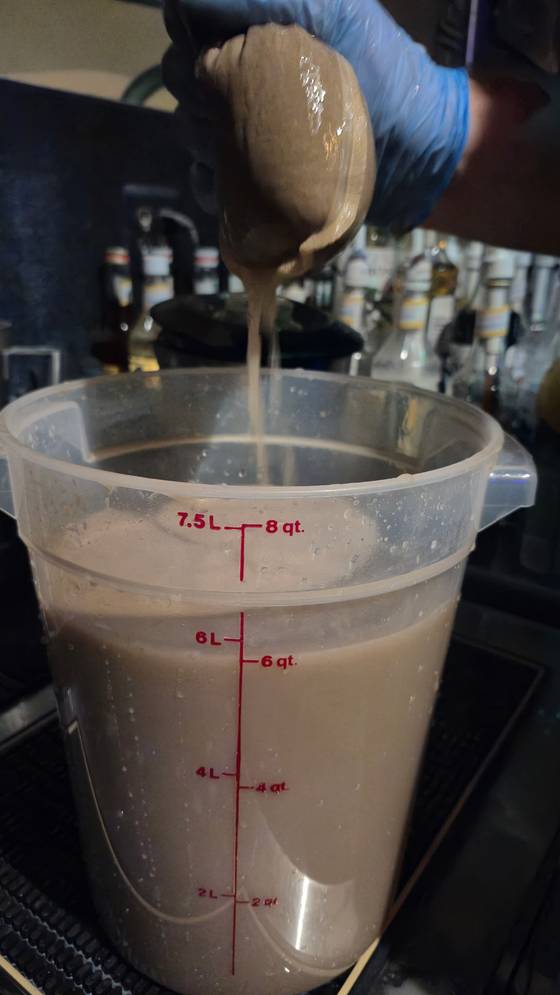
Bar scale is not laboratory scale — The characterized laboratory preparation uses 454 g of homogenate to 1250 mL of water — a ratio near 1 : 2.8. This batch took a 907 g charge to a 6 qt yield, a ratio near 1 : 6.3. The maceration, mesh aperture and cycle count are the same; the dilution is not. That difference is the parameter governing the concentrations reported here, and it is why these figures should not be read as a restatement of the white-paper values under a different name.
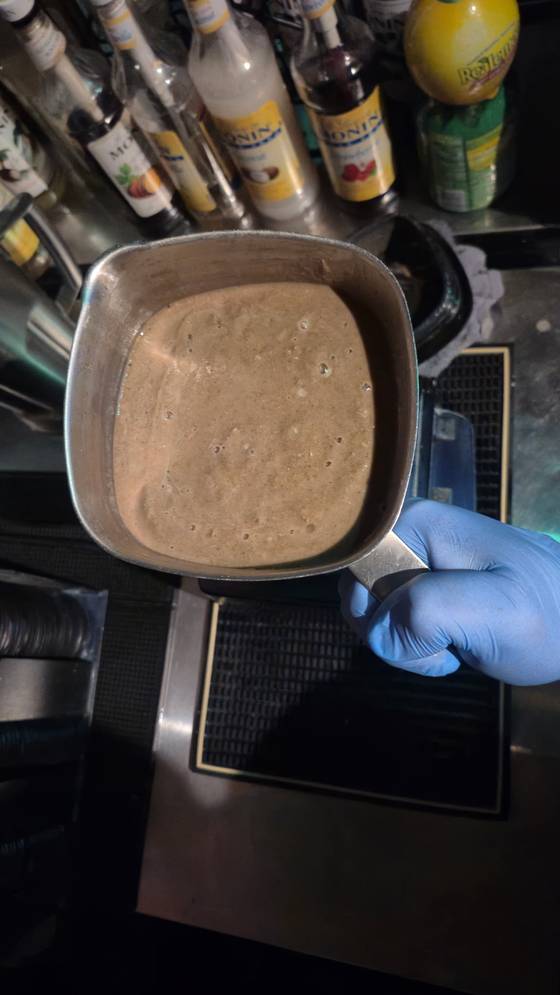
Each finished batch was stirred thoroughly to the condition of a normal service pour and sampled with the 12 oz ladle used on the bar. This matters more than it may appear. The majority of the kavalactone delivered by an aqueous kava beverage is carried on fine particulate that passes the 150 µm mesh rather than dissolved in the water, so a sample drawn from a settled vessel, or from a filtered or centrifuged aliquot, systematically understates what a drinker receives. Sampling an agitated batch with the service vessel means the assays describe a served suspension, and the per-shell figures here are serving-representative rather than nominal.
A certificate trap worth knowing about — Cambium reports two totals: "Total Kavalactones" and "Total Kavalactones and Kavains", the latter appearing as the headline. Kavain is already one of the six kavalactones and is in the first total. The arithmetic on all three certificates shows what the second actually adds — 1.9084 − 1.8694 = 0.0390 mg/g on the primary against a reported flavokavain total of 0.0391. The laboratory is using "kavains" to mean the flavokavains. This report uses the six-kavalactone total throughout, because that is the quantity the beverage literature reports. Anyone quoting these certificates directly should make the same distinction: citing the headline as a kavalactone figure would overstate the product by 2%.
Table 1. Samples submitted to Cambium Analytica under batch 062126, as named on the certificates, with the measured density used to convert certificate mg/g values to mg/mL.
- Hard Nak Roseville — COA: DTS-260624-038 · Lot code: HNR062126 · Density (g/mL): 1.0077 · Description: Primary SWWE brew; 2 lb fresh lateral root, 6 qt yield
- Hard Nak Spent Roseville — COA: DTS-260624-040 · Lot code: HNSR062126 · Density (g/mL): 1.0001 · Description: Rebrew of the spent Hard Nak marc, 3 qt yield
- Fresh Fiji Roseville — COA: DTS-260624-039 · Lot code: FFR062126 · Density (g/mL): 1.0019 · Description: Standard Fresh Fiji High Tide, from fresh Fijian root
Shell potency
Total kavalactone delivered per 12 oz shell
The gap between the primary brew and everything else on the menu is the operationally significant finding in the report. The blend bar is a volume-weighted calculation from the two measured concentrations, not an assay result.
- Hard Nak primary — 669 mg
- Fresh Fiji High Tide — 200 mg
- Marc rebrew — 258 mg
- Blend, 3 qt : 6 qt (calculated) — 219 mg
Six-kavalactone totals. Serving basis is the 12 oz service ladle taken as 355 mL.
On a six-kavalactone basis the primary Hard Nak brew carried 1.884 mg/mL, giving 669 mg in a 12 oz shell against 200 mg for the comparator — a ratio of 3.34 to 1. Kavain alone accounts for 232 mg of the Hard Nak shell, against 65 mg in the comparator and 83 mg in the rebrew. One Hard Nak shell delivers more kavain than a full Fresh Fiji shell delivers of all six kavalactones combined.
Table 2. Total kavalactone concentration and content per 12 oz (355 mL) shell. The blend row is a volume-weighted calculation from the two measured concentrations, not an assay result.
- Hard Nak primary (fresh lateral root) — COA: -038 · mg/mL: 1.884 · Per 12 oz shell: 669 mg · Kavain / shell: 232 mg · vs. Fresh Fiji: 3.34×
- Fresh Fiji High Tide (comparator) — COA: -039 · mg/mL: 0.564 · Per 12 oz shell: 200 mg · Kavain / shell: 65 mg · vs. Fresh Fiji: 1.00×
- Hard Nak marc rebrew (second pass) — COA: -040 · mg/mL: 0.727 · Per 12 oz shell: 258 mg · Kavain / shell: 83 mg · vs. Fresh Fiji: 1.29×
- Blend — 3 qt rebrew : 6 qt Fresh Fiji (calculated) — COA: — · mg/mL: 0.618 · Per 12 oz shell: 219 mg · Kavain / shell: — · vs. Fresh Fiji: 1.10×
Including flavokavains, as the certificate headline does, the same shells carry 683 mg, 263 mg and 204 mg respectively.
The full profile, compound by compound
Individual kavalactone concentration by beverage
Kavain leads in every sample. Note yangonin and dihydrokavain: effectively tied in the primary, cleanly separated in the rebrew, and reversed in the fresh Fijian comparator.
- Kavain — Hard Nak primary: 0.652 mg/mL · Fresh Fiji: 0.184 mg/mL · Marc rebrew: 0.233 mg/mL
- Methysticin — Hard Nak primary: 0.352 mg/mL · Fresh Fiji: 0.104 mg/mL · Marc rebrew: 0.146 mg/mL
- Yangonin — Hard Nak primary: 0.258 mg/mL · Fresh Fiji: 0.077 mg/mL · Marc rebrew: 0.123 mg/mL
- Dihydrokavain — Hard Nak primary: 0.255 mg/mL · Fresh Fiji: 0.091 mg/mL · Marc rebrew: 0.09 mg/mL
- Desmethoxyyangonin — Hard Nak primary: 0.223 mg/mL · Fresh Fiji: 0.054 mg/mL · Marc rebrew: 0.079 mg/mL
- Dihydromethysticin — Hard Nak primary: 0.145 mg/mL · Fresh Fiji: 0.053 mg/mL · Marc rebrew: 0.056 mg/mL
Chemotype was identical in the primary brew and its second-pass rebrew: both returned 463215 — kavain, methysticin, yangonin, dihydrokavain, desmethoxyyangonin, dihydromethysticin in descending order. The Fresh Fiji comparator returned 462315, differing by a single adjacent transposition. The Hard Nak string is a close match to the Kali-Hiwa profile reported at 463251 in Technical White Paper No. 2.
One rank position is unsettled — Yangonin and dihydrokavain sit at 0.2557 and 0.2531 mg/g in the primary — a separation of 1.0%, well inside what a replicate could reverse. Positions three and four should be read as 46(32)15 rather than as a firm ordering. In the rebrew the same pair is cleanly separated, for the reason set out below.
Table 3. Individual kavalactone and flavokavain concentrations in mg/mL, computed from the certificate mg/g values and the measured density of each beverage.
- Kavain (K) — Hard Nak primary: 0.652 · Fresh Fiji: 0.184 · Marc rebrew: 0.233
- Methysticin (M) — Hard Nak primary: 0.352 · Fresh Fiji: 0.104 · Marc rebrew: 0.146
- Yangonin (Y) — Hard Nak primary: 0.258 · Fresh Fiji: 0.077 · Marc rebrew: 0.123
- Dihydrokavain (DK) — Hard Nak primary: 0.255 · Fresh Fiji: 0.091 · Marc rebrew: 0.090
- Desmethoxyyangonin (DMY) — Hard Nak primary: 0.223 · Fresh Fiji: 0.054 · Marc rebrew: 0.079
- Dihydromethysticin (DHM) — Hard Nak primary: 0.145 · Fresh Fiji: 0.053 · Marc rebrew: 0.056
- Total kavalactones — Hard Nak primary: 1.884 · Fresh Fiji: 0.564 · Marc rebrew: 0.727
- Total flavokavains — Hard Nak primary: 0.039 · Fresh Fiji: 0.011 · Marc rebrew: 0.013
- Flavokavains, % of total — Hard Nak primary: 2.1% · Fresh Fiji: 2.0% · Marc rebrew: 1.8%
- Chemotype — Hard Nak primary: 463215 · Fresh Fiji: 462315 · Marc rebrew: 463215
Chemotype digits: 1 desmethoxyyangonin, 2 dihydrokavain, 3 yangonin, 4 kavain, 5 dihydromethysticin, 6 methysticin, descending by abundance. Totals are computed before rounding and may differ from the sum of rounded rows by one in the last digit.
The spent marc is not spent
Second-pass carryover by compound
Ordered highest carryover first. Yangonin — the least water-mobile of the six — is left behind most by the first pass and therefore carries over most in the second. Dihydrokavain, the most water-mobile, carries over least.
- Yangonin — 47.7 %
- Methysticin — 41.4 %
- Dihydromethysticin — 38.8 %
- Kavain — 35.8 %
- Desmethoxyyangonin — 35.6 %
- Dihydrokavain — 35.4 %
Beverage-to-beverage ratios, not fractions of a measured starting mass. Total across all six: 38.6%.
Overall the rebrew carried 38.6% of the primary's kavalactone concentration. Taken alone that is an ordinary second-pass figure. Two things make it worth reporting. The first is the absolute value it lands on: 0.727 mg/mL is 29% above the fresh Fijian comparator, so the fraction a bar would normally discard out-measures a full fresh Fijian extraction. The second is that the carryover is not uniform across the six compounds.
That ordering is the one the mass-balance work predicts. Technical White Paper No. 2 found dihydrokavain the most completely transferred of the six on a first pass and yangonin the least, tracking published aqueous solubility — which runs from 8.1 mg per 100 mL for dihydrokavain down to 0.3 for yangonin at 21 °C. A first pass that removes dihydrokavain most efficiently must leave a marc enriched in yangonin, and a rebrew of that marc must show yangonin carrying over at the higher rate. It does.
This is also the mechanism behind the chemotype observation above. Yangonin and dihydrokavain are effectively tied in the primary at a ratio of 1.01, but the second pass separates them: in the rebrew the ratio is 1.36, and in the fresh Fijian comparator — an unextracted first pass from different root — it runs the other way at 0.84. The rebrew's cleanly ordered string is not a different cultivar profile; it is the same profile with the water-mobile fraction preferentially removed one pass earlier.
Why this one is worth flagging beyond the batch — It is an independent field reproduction — on production material at bar scale, by a laboratory that did not perform the original work — of a transfer pattern established under controlled laboratory conditions on different cultivars. Nothing here was designed to test that pattern, which is part of why the agreement is interesting.
What a 2 lb charge actually delivers
- 12.8 g — Total kavalactone into finished beverage per 2 lb charge
- 24 — Shells at a 12 oz pour, across both passes
- 16% — Share of the batch total contributed by the second pass
- 3.34× — Primary brew against the Fresh Fiji comparator
Table 4. Batch-level delivery from a single 2 lb charge, computed from measured concentration and nominal volume. Volumes converted at 946.4 mL per quart; shell counts at a 12 oz pour.
- Hard Nak primary — Volume: 6 qt (5,678 mL) · mg/mL: 1.884 · Shells: 16 · Total delivered: ≈ 10.7 g
- Hard Nak marc rebrew — Volume: 3 qt (2,839 mL) · mg/mL: 0.727 · Shells: 8 · Total delivered: ≈ 2.1 g
- Fresh Fiji comparator (reference) — Volume: 6 qt (5,678 mL) · mg/mL: 0.564 · Shells: 16 · Total delivered: ≈ 3.2 g
- Hard Nak batch total — Volume: 9 qt (8,517 mL) · mg/mL: — · Shells: 24 · Total delivered: ≈ 12.8 g
Computed figures — assayed concentrations multiplied by nominal volumes — carrying the full uncertainty of a single unreplicated assay.
Against the published beverage literature
Most published kava potency figures describe dried root assayed with organic solvent, which is not what anyone drinks. The comparison that matters for a bar is against studies that measured finished beverages. Normalized to concentration, the primary Hard Nak brew sits at the top of that small literature — above the traditional Hawaiian and traditional-infusion figures and inside the upper part of the sakau range — while the standard Fresh Fiji shell sits below all of them.
Table 5. Beverage concentration compared with prior beverage-focused studies. Per-12 oz figures are computed at 355 mL for comparability and are not the serving volume used in the source studies.
- Hard Nak primary — Source: This report · mg/mL: 1.884 · Per 12 oz (calculated): 669 mg
- Micronesian sakau, traditional — Source: Balick & Lee 2002 · mg/mL: ≈ 1.39–2.00 · Per 12 oz (calculated): ≈ 494–710 mg
- Traditional-method aqueous infusion — Source: Jhoo et al. 2006 · mg/mL: ≈ 0.92–1.38 · Per 12 oz (calculated): ≈ 327–490 mg
- Hard Nak marc rebrew — Source: This report · mg/mL: 0.727 · Per 12 oz (calculated): 258 mg
- Traditional Hawaiian preparation — Source: Brown et al. 2007 · mg/mL: ≈ 0.71 · Per 12 oz (calculated): ≈ 253 mg
- Fresh Fiji High Tide — Source: This report · mg/mL: 0.564 · Per 12 oz (calculated): 200 mg
Rows ordered by the lower bound of the reported concentration range. Indicative only: preparation method, root-to-water ratio, tissue composition and analytical method differ across the studies listed.
The characterized SWWE preparations of Technical White Paper No. 2 are deliberately absent from that table. They were made at a laboratory root-to-water ratio near 1 : 2.8 against this batch's 1 : 6.3, so the difference between them is dilution rather than material — and listing their concentrations beside a bar pour would invite exactly the misreading flagged earlier. What No. 2 contributes to this report is the extraction method and the second-pass transfer ordering discussed above, not a potency benchmark. The related point worth keeping separate is that a more dilute preparation can still deliver more absolute kavalactone per serving when the pour is larger: a 12 oz shell is 2.84 times a 125 mL serving. Conflating concentration with dose is the most common error in potency talk across the trade.
What it means on the bar floor
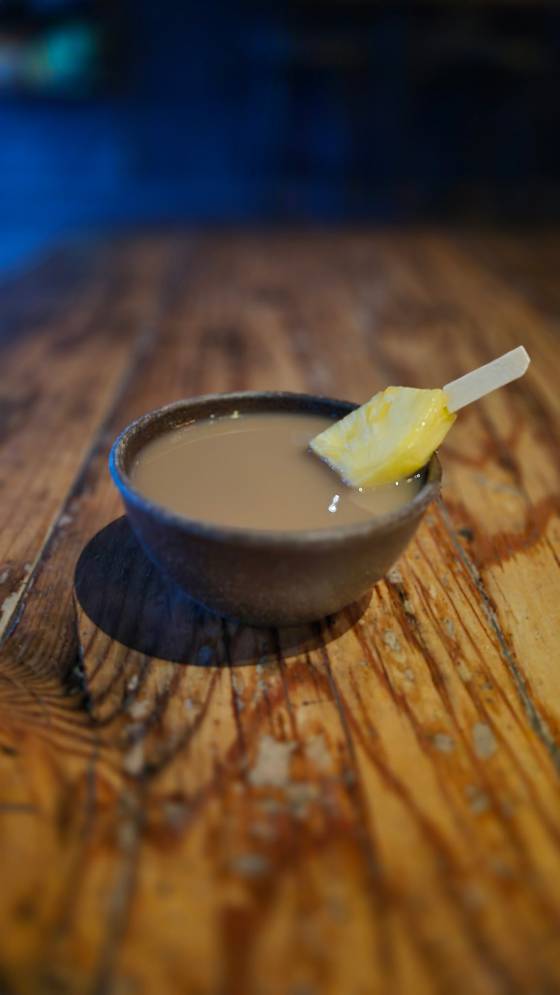
Two things in this dataset are usually run together on the floor and are worth separating. The first is that Hard Nak measures strong. The second is that Hard Nak tastes strong. Lateral root delivers both at once, and staff who pace a shell by flavour intensity are, with this product, reading a signal that happens to point the right way — but only by coincidence of the tissue selection. That coincidence would not hold for a filtered or flavoured preparation, and it is not a method anyone should rely on.
- Hard Nak is a different pacing category, not a matter of degree. At 669 mg per shell it delivers roughly what three and a third standard Fresh Fiji shells deliver. Whatever pour and pacing guidance the house uses for a standard fresh Fijian shell does not transfer to it unchanged.
- Agitation before pouring is dose control, not presentation. The active material is largely particulate and separates on standing, so a shell poured from the top of an unstirred batch and one poured from the bottom are not the same dose. These figures describe a well-stirred batch and do not describe a settled one.
- The marc is worth recovering, but it needs its own place on the menu rather than being quietly folded into an existing one. At 258 mg standalone it is stronger than the shell most guests order by default.
- The kavain figure sharpens the pacing point. Kavain is the most studied of the six for anxiolytic activity and the principal positive modulator of GABA-A among them. A 3.6-fold increase in kavain delivery per serving is not a marginal change in what is being handed across the bar.
The rebrew result runs against the usual assumption that a second pass is too weak to serve, and it holds only because the primary starts so concentrated. A second pass on a standard fresh Fijian batch, retaining a comparable fraction, would land near 0.22 mg/mL and would not be a servable product by any reasonable standard. The finding is specific to lateral-root-only material at this primary strength and should not be generalized across the menu without measuring it.
Two routes exist for the recovered fraction. Served on its own, the rebrew is a legitimate 258 mg shell, stronger than the standard fresh Fijian pour, but it carries the full assertive lateral-root flavour into eight shells. Folded into a fresh Fijian batch it computes to 0.618 mg/mL across a uniform 9 qt — roughly a 10% lift over standard Fresh Fiji, with the flavour cut into a familiar profile. The blend route distributes the gain rather than concentrating it, which is the more defensible choice operationally, and it is also the less evidenced one: the blend has never been assayed, and a volume-weighted calculation assumes complete and stable mixing of a suspension whose active fraction settles.
On consistency across sites — A single figure measured at one location does not describe a product served by three operating groups. Root of Happiness, The Nak and the Ohana Kava Bar franchises each prepare on their own equipment, with their own water, their own mesh and their own hands, and every one of those variables moves the number. Nothing in this report supports a claim that a Hard Nak shell in Boca Raton matches a Hard Nak shell in Roseville. Until per-site batches are assayed against the same method, the honest framing for any external statement is that a characterized Root of Happiness batch prepared by SWWE at a 1 : 6.3 ratio measured 669 mg per 12 oz shell — naming the batch, the site, the ratio and the pour.
Limitations and open gaps
The findings are directionally clear and the margins are wide. They are not yet a specification. Four gaps remain open, each closable with modest effort:
- No raw-material assay. No COA or moisture determination exists for the fresh Hard Nak biomass, so extraction efficiency and theoretical yield cannot be computed and the carryover figures remain beverage-to-beverage ratios rather than true retention fractions. A raw-biomass assay plus a marc assay would close the batch into a full mass balance.
- Single batch, no replicate. Every figure here is n = 1. No batch-to-batch variability is known and no uncertainty interval can be given. The tied yangonin–dihydrokavain rank in the primary, separated by 1.0%, is the figure most likely to move on a replicate.
- Single site. All three samples were drawn at Roseville. Nothing here characterizes what is poured at any other site.
- The blend was never assayed. The 0.618 mg/mL blend value is a volume-weighted calculation assuming complete and stable mixing. A blended sample should be prepared and submitted before the figure is used externally.
A raw-biomass COA and a second replicate batch would move this report from a field observation to a defensible internal standard. Adding one sampled batch from The Nak and from a representative Ohana Kava Bar location would extend that standard across the three operating groups actually serving the product — which is the claim the product name currently implies and the data do not yet support.
Conflicts of interest
All three authors are commercially engaged in the kava trade and have a direct financial interest in the product evaluated here. Hard Nak is a Root of Happiness product sold at Root of Happiness locations and supplied to partner sites, and the authors stand to benefit commercially from favourable findings about it. This report does contain favourable findings about it. T.B. is also an author of Technical White Paper No. 2, against which the transfer-ordering result is compared; readers should weigh that agreement with the shared authorship in mind, noting that the analytical work in the two studies was performed by different laboratories on different material.
The analytical values here were produced by an independent accredited laboratory from samples submitted without any of the interpretations offered in this report, none of the authors participated in the analysis, and the limitations are stated at least as prominently as the results. No comparison against any competing product or preparation method outside the Root of Happiness menu was performed, and no claim of superiority over any other operator's product is made or supported here.
This work received no external funding; materials and analytical costs were borne by Root of Happiness. T.B. designed the sampling, performed the calculations and prepared the report. T.L. and K.G. contributed to conceptualization, to the operational interpretation, and to review and editing.
Use of generative artificial intelligence — In preparing this report the authors used Claude Opus 5 (Anthropic) to extract the certificate data into tabular form, perform and check the density, per-serving, chemotype and carryover arithmetic, and draft and edit the text. The authors reviewed all output, verified the calculations against the certificates, and take full responsibility for the content.
References
- Cambium Analytica. Certificates of Analysis DTS-260624-038, -039 and -040, batch 062126; methods LAB-TM-067 (kavalactones and kavains by LC-DAD) and LAB-TM-017 (Brix and density). Traverse City, MI, USA, 1 July 2026. ISO/IEC 17025:2017 accreditation #108157.
- Blythe, T.; Bowman, J.; Masifilo, M. Where the Kavalactones Go: A Mass Balance of the American Kava Beverage. American Kava Association Technical White Paper No. 2; Las Vegas, NV, USA, 2026.
- American Kava Association. Technical White Paper No. 3: extraction pH in short warm-water preparation of kava; Las Vegas, NV, USA, 2026.
- Brown, A.C.; Onopa, J.; Holck, P.; et al. Traditional kava beverage consumption and liver function tests in a predominantly Tongan population in Hawaii. Clin. Toxicol. 2007, 45, 549–556.
- Jhoo, J.-W.; Freeman, J.P.; Ang, C.Y.W.; Mihalov, J.J. Assessment of kavalactones in kava beverage products and aqueous infusions. J. Food Sci. 2006, 71, C345–C351.
- Balick, M.J.; Lee, R. Traditional use of sakau (kava) in Pohnpei: lessons for integrative medicine. Altern. Ther. Health Med. 2002, 8, 96–98.
- Siméoni, P.; Lebot, V. Identification of factors determining kavalactone content and chemotype in kava (Piper methysticum Forst. f.). Biochem. Syst. Ecol. 2002, 30, 413–424.
- Lebot, V.; Merlin, M.; Lindstrom, L. Kava: The Pacific Elixir; Healing Arts Press: Rochester, VT, USA, 1997.
- Lebot, V.; Michalet, S.; Legendre, L. Kavalactones and flavokavins profiles contribute to quality assessment of kava (Piper methysticum G. Forst.). Beverages 2019, 5, 34.
- Wang, J.; Qu, W.; Bittenbender, H.C.; Li, Q.X. Kavalactone content and chemotype of kava beverages prepared from roots and rhizomes of Isa and Mahakea varieties. J. Food Sci. Technol. 2015, 52, 1164–1169.
- Duve, R.N.; Prasad, J. Efficacy of extraction of constituents in the preparation of yaqona beverage. Part 2: major active constituents. Fiji Agric. J. 1984, 46, 11–16.
- Teschke, R.; Lebot, V. Proposal for a kava quality standardization code. Food Chem. Toxicol. 2011, 49, 2503–2516.
- Lebot, V.; Kaoh, J.; Legendre, L. High-throughput analysis of flavokawains in kava roots, chips and powders. Food Anal. Methods 2020, 13, 1583–1593.
- Chua, H.C.; Christensen, E.T.H.; Hoestgaard-Jensen, K.; et al. Kavain, the major constituent of the anxiolytic kava extract, potentiates GABA-A receptors. PLoS ONE 2016, 11, e0157700.
Cite This
Blythe, T.; Lowin, T.; Garrett, K. Hard Nak: Field Potency and Kavalactone Profile of a Lateral-Root Kava Beverage and Its Second-Pass Rebrew. Root of Happiness Field Report No. 1, version 1.1a; Root of Happiness Kava: Las Vegas, NV, USA, 2026.
Supporting Data and Access
The records behind this report are the certificates of analysis issued by Cambium Analytica under DTS-260624-038, -039 and -040 for batch 062126, covering all six kavalactones, three flavokavains, density and specific gravity; the recorded batch volumes and yields; and the calculation worksheet containing the density conversions, per-shell, per-batch, chemotype, carryover and blend computations from which every table here was derived. No raw-material assay exists for this batch and none can be supplied.
The discussion published on this page is complete as an argument. It states the method, the numbers, the limitations and the conflicts of interest, and it is free to read, cite and disagree with. The records underneath it are held for the Association’s members.
Access to those records is open to stakeholders in the American kava growing industry — growers with at least one acre in production and a contract in place for the purchase of licensed planting material.
The reason is simply who this organization is. The American Kava Association is funded by its members and operates for their benefit, and its members are American kava farmers with land, capital and years committed to the crop. This work is self-funded: it was paid for out of working farms, to answer questions those farms were already facing. What the people who paid for it are owed is a working advantage in their own fields. So we publish the findings in full, limitations included, so the work can be judged on its merits — and we keep the underlying files inside the membership that produced them. That is a decision about who we are resourced to serve, not a judgement on anyone who asks.
Researchers and institutions interested in working with this material are welcome to propose a funded collaboration. That is the basis on which the Association can extend it, and we would rather say yes to a properly resourced study than no to a request.
Write to admin@americankavaassociation.org to enquire.