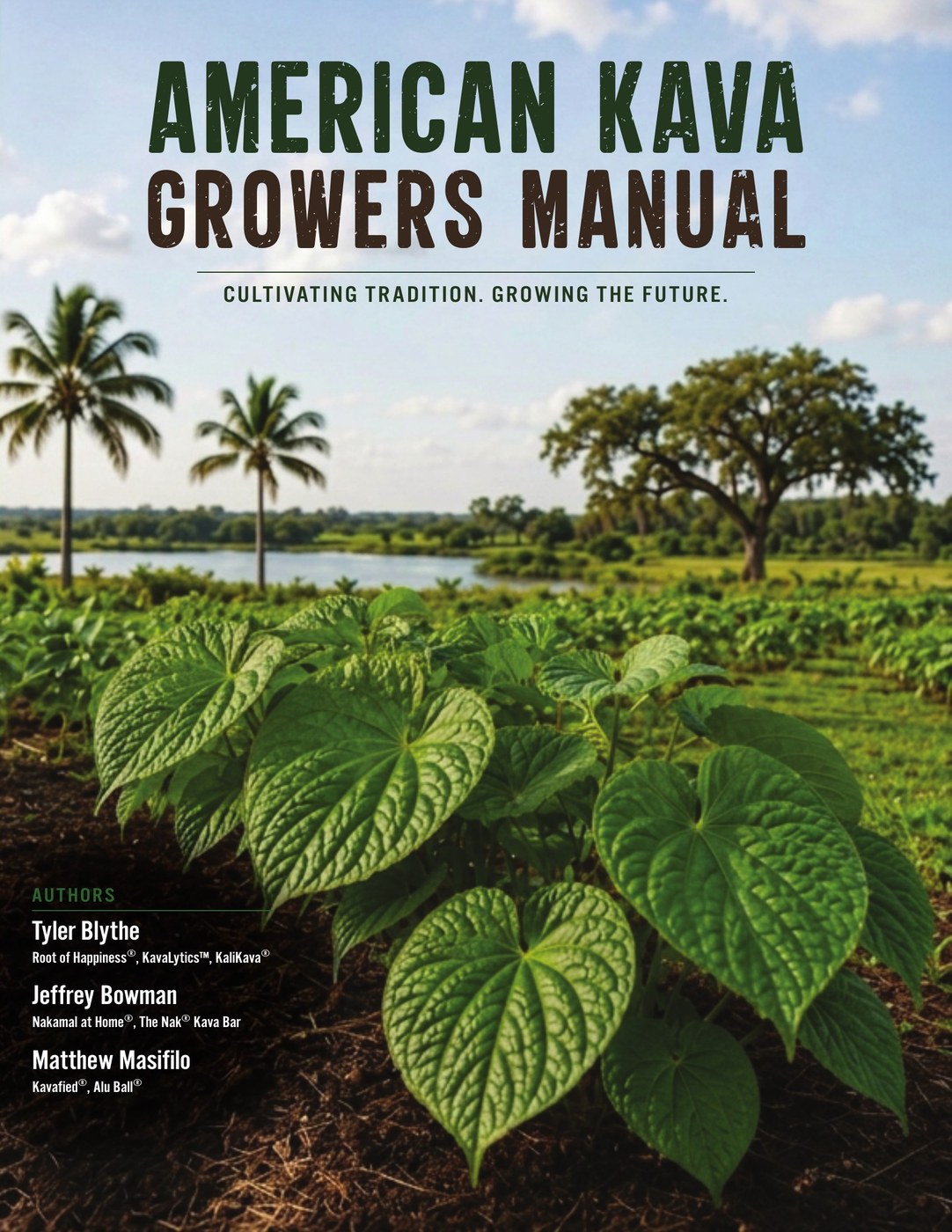
Overview
The second edition of the American Kava Growers Manual is the reference work American kava did not have. It runs from hardiness zones and Myakka sand through propagation, nursery practice, high-density field layout, protected and hydroponic production, pests, harvest, washing and drying, a written quality standard with numbers in it, FSMA coverage, and a full enterprise budget. What separates it from every prior kava growing guide is its provenance: Tyler Blythe in Sacramento wrote it from plantings he currently maintains, with contributions from Jeffrey Bowman in Boca Raton and Matthew Masifilo in Sarasota — the three climates where mainland kava is actually grown. This review sets out what the book contains, where it is strongest, and — because the Association publishes it — where a reader should apply their own scepticism.
Abstract
Kava has been grown in the Pacific for three thousand years and written about, agronomically, almost entirely for Pacific conditions. Mainland American growers work in USDA Zones 9b–10b — marginal subtropics, not the Zone 12–13 tropics the extension literature assumes — on Myakka sands and in California high tunnels, under a regulatory regime with no Pacific equivalent. The second edition of the American Kava Growers Manual is the first book to take that situation as its subject rather than as a footnote. It covers site selection, cultivar choice, five propagation routes, nursery and field systems including American high-density layouts, protected and soilless production, soil and irrigation, pests and diseases, harvest, post-harvest processing, a written quality standard, U.S. food-safety compliance, and a worked enterprise budget. Its distinguishing quality is not comprehensiveness but candour: it states repeatedly where the American record is empty, labels every illustrative figure as illustrative, and answers a published criticism of its own cultivar program in the text rather than around it.
Key Findings
- It is written from ground the author is standing on. Tyler Blythe (Sacramento, high tunnels and greenhouse) writes from plantings he currently maintains, with contributions from Jeffrey Bowman (Boca Raton, outdoor nursery) and Matthew Masifilo (Sarasota, outdoor field). Almost every photograph in the book is of an American plant in an American season.
- It names the real growing envelope and does not flatter it. Commercial mainland kava is happening in USDA Zones 9b–10b: outdoors in Florida south of Tampa on the Gulf and south of Melbourne on the Atlantic, and in coastal Southern California from San Clemente to San Diego. A simple unheated high tunnel buys roughly one hardiness zone, which is what makes Northern California, central Florida and southern Texas possible at all.
- Five American selections are described with chemotype, reported TKC, vigour and observed cold behaviour — Kali-Isa, Kali-Hiwa, Kali-Kea, Kali-Myakka #1 and Kali-Hina — with the plainly stated caveat that none has been through a replicated third-party trial and that the figures are orientation, not specification.
- The high-density chapter is the most consequential agronomy in the book. HD at 3 ft × 3 ft gives 4,840 plants per acre and, at 2 kg fresh and 500 g dry per plant at three years, 9,680 kg fresh and 2,420 kg dry per acre. UHD at 2 ft × 2 ft gives 10,800 plants — and the manual tells you to budget on 8,100 kg fresh rather than the arithmetic ceiling of 10,800 kg, because gaps, replants and runts are real.
- Chapter 12 is a written specification, not a slogan. A lot is one cultivar, one plant part, one harvest date, one processing run. Dried moisture at or below 12%. Fresh-frozen held below 0 °F (−18 °C). Total flavokavains at or below 0.4% w/w dry, adopting the Kava Coalition's 2025 limit, with flavokavain B reported as its own line rather than buried in a total.
- Chapter 13 handles the compliance problem most kava writing skips: which FSMA rules cover your farm, the pesticide label rule (a product is legal on kava only if Piper methysticum, kava or ʻawa appears on the label), and the farm-to-facility trap — drying stays on the farm side, milling does not automatically.
- Chapter 14 is a full enterprise budget that refuses to invent a yield or a price. Every number in it is labelled illustrative and the text says why: there is no published American benchmark for dry root yield or price, and printing one would let a grower plant against a projection nobody has measured.
- It answers the questions people actually ask about American cultivars. Is a named American selection a hybrid? Was it made in a laboratory? Is it real kava you would want to drink? The manual takes all three head on rather than around: kava is sterile and sets no viable seed, so nothing here is a cross or an engineered plant — every selection is a clone descended from Pacific material, chosen by surviving a Florida freeze or a Sacramento summer and then propagated, which is how clonally propagated crops have always been improved. And the answers arrive with numbers rather than assurances: chemotypes for each selection, reported total kavalactone content, and a dated laboratory report from a named lab reproduced in full, showing 19.9% total kavalactones by HPLC on a Sarasota lateral-root sample — presented as one sample from one plant, not as a specification.
Disclosure — The American Kava Association publishes this manual. Its author is the Association's principal researcher and both contributors are Association members and co-authors on the technical white papers in this library. This review is therefore an account of what the book contains and how it is built, not an independent verdict on it. Where the manual makes a claim we would want a reader to check, we say so.
The book American kava did not have
Everything written about growing kava before this was written for the Pacific. That literature is good — the SPC producer's guides, Lebot's germplasm surveys, the Hawaiian extension bulletins — and almost none of it addresses the situation a grower in Sarasota or Sacramento is actually in. The Pacific guides assume Zone 12 to 13 conditions, deep volcanic or alluvial soils, ambient humidity that never has to be manufactured, three to five year harvest cycles, and a regulatory environment in which kava is simply food. A mainland American grower has none of those things.
Commercial American kava is being grown in USDA Plant Hardiness Zones 9b through 10b. That is genuinely marginal subtropical ground: outdoors in Florida south of Tampa on the Gulf Coast and south of Melbourne on the Atlantic, and in the humid coastal strip of Southern California from San Clemente through San Diego. Everything else — Northern California, central Florida, southern Texas — depends on protected structures. The manual's flat statement that a simple unheated high tunnel may let you grow about one hardiness zone beyond an outdoor site is, in practical terms, the sentence that defines the American industry's footprint.
The second edition takes that as its subject. It is fifteen chapters running from hardiness zones and Myakka sand through propagation, nursery practice, planting systems, soil and irrigation, pests and diseases, harvest, washing, sorting, drying and fresh-frozen handling, a written quality standard, U.S. food-safety compliance, and a worked enterprise budget — closing with a research agenda that reads as a list of the things the book itself could not answer.
Written from ground the authors are standing on
This is the part that cannot be replicated by a better writer with a better library. Tyler Blythe grows in Sacramento at 38° N, under shade cloth outdoors and in a 30 ft × 100 ft high tunnel, and runs the greenhouse where the Association's propagation trials are carried out. Jeffrey Bowman runs the outdoor container nursery in Boca Raton where the air-layering work was done. Matthew Masifilo grows outdoors in Sarasota on the Myakka sands that make Florida kava difficult. Three climates, three production systems, three sets of failures already paid for.
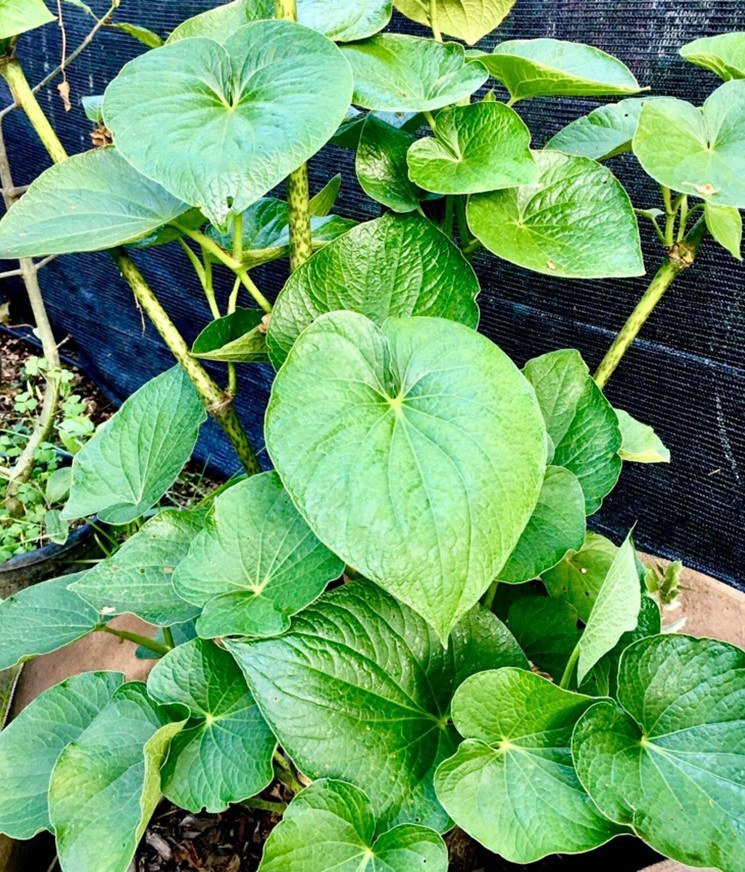
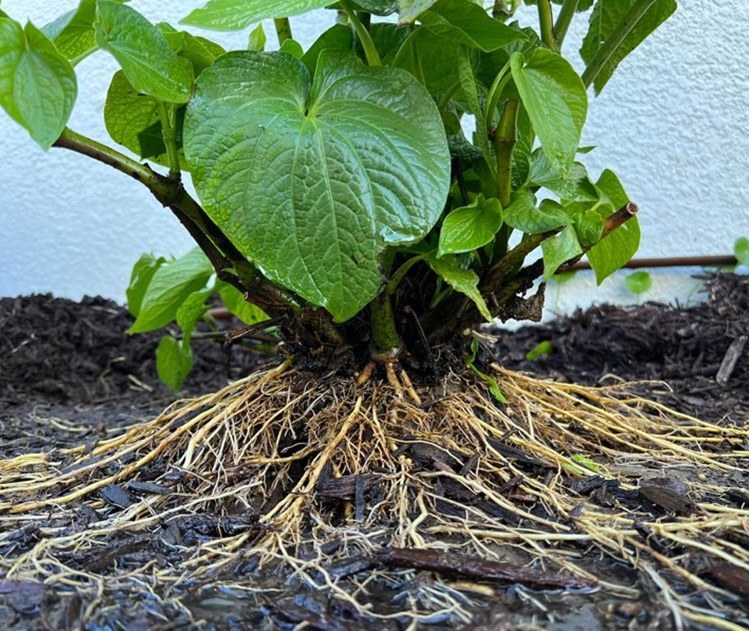
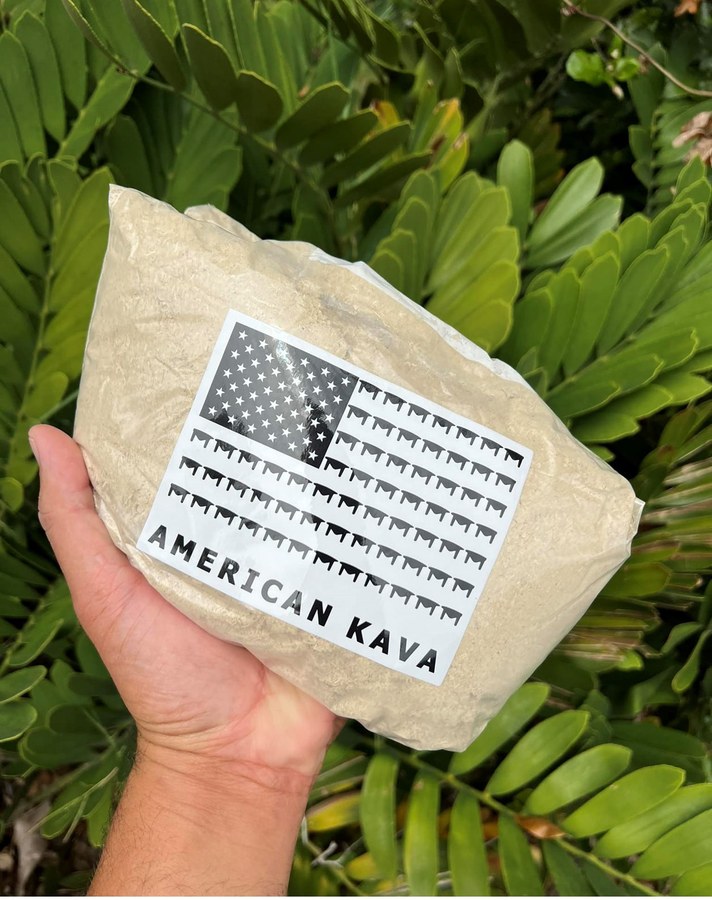
Left and centre: Kali-Isa outdoors in Northern California, and a fifteen-month Kali-Isa plant grown in Sarasota, Florida. Right: dried American-grown kava, Sarasota. Sources: Kali Kava; Matthew Masifilo.
It shows in the specificity. The book does not say kava needs good drainage; it says Kali-Isa has survived about 28 °F (−2 °C) for a single night in Sarasota and several weeks of repeated upper-30s nights, and that Kali-Hiwa should not be planted where cold is prolonged or drops below 40 °F. It does not say hydroponics is possible; it reports a 2015–2019 deep-water-culture and aeroponic trial in which root rot developed whenever the root zone rose above 65 °F (18 °C), plants reached 4–6 ft and flowered at ten months, and lateral roots returned 6.6% TKC — then labels that result unreplicated, single-site, and not a benchmark. That pattern of a hard number followed immediately by its limits runs through the whole book.
Five American selections, and a criticism answered head-on
Chapter 3 describes five selections out of the Kali Kava program — Kali-Isa, Kali-Hiwa, Kali-Kea, Kali-Myakka #1 and Kali-Hina — with chemotype, reported total kavalactone content, vigour, observed cold behaviour and siting notes. Where a cultivar has given more than one chemotype across samples, every value observed is listed rather than an average, on the reasoning that chemotype shifts with plant part, age and site and a single figure would be tidier and less true.
The five American selections as described in Chapter 3. Reported TKC is given for comparison between cultivars; the manual is explicit that it is not a specification and that every lot still needs its own assay.
- Kali-Isa — Chemotypes observed: 256, 254, 245 · Reported TKC: 15–20% · Vigour: Hardiest and most vigorous · Observed cold behaviour: About 28 °F (−2 °C) for a single night in Sarasota; repeated upper-30s nights over weeks
- Kali-Hiwa™ — Chemotypes observed: 462, 463, 436 · Reported TKC: 10–11% · Vigour: Tall, vigorous shooting · Observed cold behaviour: Low 40s °F for weeks; not where cold is prolonged or below 40 °F
- Kali-Kea™ — Chemotypes observed: 462, 426 · Reported TKC: 10–12% · Vigour: Tall · Observed cold behaviour: Low 40s °F for weeks; not where cold is prolonged or below 40 °F
- Kali-Myakka #1™ — Chemotypes observed: 462, 426 · Reported TKC: 10–12% · Vigour: Tall and thin · Observed cold behaviour: Low 40s °F for weeks; not where cold is prolonged or below 40 °F
- Kali-Hina™ — Chemotypes observed: 436, 463 · Reported TKC: 10–12% · Vigour: Medium, thick stems · Observed cold behaviour: Low 40s °F for weeks; not where cold is prolonged or below 40 °F
Program-level selection targets across the wider collection are cold tolerance to 28 °F (−2 °C), heat tolerance to 113 °F (45 °C), and relative humidity down to 10%, plus salinity, drought and disease tolerance. The manual states plainly that these are breeder's selection criteria, not certified specifications, and that no selection has been through a replicated third-party controlled-freeze or controlled-drought trial.
The most interesting page in the chapter is the one a cautious publisher would have cut. Vincent Lebot — whose germplasm surveys the manual cites throughout — has argued in the press that kava cultivars cannot be bred and that a trademarked American cultivar is simply a clone of Pacific kava. The manual quotes the objection, concedes the botany outright, and then draws the distinction that actually matters.
What a program like mine does is narrower and older than breeding: select among existing clones and their somatic variants for the ones that survive a Florida freeze or a Sacramento summer, propagate those, discard the rest, and name what you keep so that growers can order a known plant instead of an unknown cutting.
— American Kava Growers Manual, Chapter 3
That is the correct answer, and printing it is the right call. Piper methysticum is sterile, sets no viable seed, and every plant in every field in the book is a clone descended from Pacific material — which the manual acknowledges at the front and repeats here. A manual that ignored a published challenge to its own cultivars would look less confident than one that answers it.
The systems chapters, and why the arithmetic is worth reading twice
Chapters 6 and 7 are where the book stops being a translation of Pacific practice and becomes American agronomy. American systems developed around four advantages the Pacific does not have: shorter harvest cycles, selected cultivars, ready fertilizer access, and roughly 50% more annual sunshine hours in Florida and California than in the Pacific growing districts. What follows from that is tighter planting and a two-to-three-year cycle rather than five.
- 4,840 — HD plants per acre at 3 ft × 3 ft
- 2,420 kg — HD dry root per acre at 3 years
- 10,800 — UHD plants per acre at 2 ft × 2 ft
- 8,100 kg — UHD fresh per acre — the budget figure, not the ceiling
That last figure is the tell. The UHD table shows 8,100 kg fresh per acre where 10,800 plants at 1 kg each would give 10,800 kg, and instead of quietly reconciling the two the manual explains the gap: 8,100 assumes 0.75 kg per plant, which is what a block averages once you account for gaps, replants and the smallest plants in the grid. Budget on 8,100 and treat 10,800 as the ceiling on a block that comes through clean. Very few crop guides show you their own inconsistency and then tell you which number to plan on.
Chapter 7 covers what most growers on this continent will actually use: high tunnels and greenhouses, 70 gal (265 L) fabric pots at least 36 in (91 cm) tall, and soilless systems with the root-zone temperature requirement stated first, before the system type. The propagation chapter carries five routes — traditional node cuttings, tissue culture, soft stem cuttings, air layering and direct planting — two of which are documented at full length in this library as Technical White Papers No. 1 and No. 4.
A quality standard with numbers in it
Chapter 12 is the American Kava Quality Standard, and it is written as a buyer-and-laboratory specification rather than as a marketing position. A lot is defined as material of one cultivar, one plant part, one harvest date and one processing run under one lot code. Permitted material is lateral roots, peeled rootstock and peeled basal stem to the first node; leaves, upper stems, peelings and extraction residues are rejected outright. Dried moisture at or below 12% and fresh-frozen held below 0 °F (−18 °C) follow Codex CXS 336R-2020.
Two provisions are stricter than the trade norm and worth naming. The standard adopts the Kava Coalition's 2025 limit of 0.4% w/w dry for total flavokavains and fails a dried lot above it absent a binding buyer requirement. And it requires flavokavain B to be reported as its own result, separate from any total — because flavokavain B, not flavokavain A, is the compound associated in the literature with tudei-related concern. A laboratory report that gives only a combined flavokavain line cannot release a lot under this standard.
The regulatory record, stated as facts — The manual sets out the U.S. position without softening it: FDA's March 2002 consumer advisory; its August 2020 memorandum concluding it had no basis to determine kava GRAS for conventional foods; Hawaii's narrow January 30, 2024 GRAS determination for noble root and rhizome prepared by aqueous extraction, which extends to no other variety, preparation or state; and the 2025 Southern District of New York ruling upholding New York City's ban on steeped kava beverages. A grower planning a beverage product should read Chapter 12.3 before ordering planting material, not after.
The chapter that refuses to make a number up
Chapter 14 is a full enterprise budget — establishment worksheet, annual operating worksheet, harvest and processing worksheet, revenue projection, breakeven and sensitivity, cash-flow timeline, recordkeeping system, market planning, USDA programs and a risk register. It follows the structure Cooperative Extension uses for perennial crops, with the arithmetic fully worked. And every dollar figure in it is labelled illustrative.
The manual explains why rather than apologising for it: there is no published American benchmark for dry lateral-root yield, no verified fresh-to-dry conversion, and no price series. Inventing numbers to fill that gap would let a grower plant against a projection nobody has measured. What it gives instead is the structure, a real comparator from a different crop — a 2021 UC Davis study putting navel orange establishment at $10,407 per acre — and an instruction to drop in your own quotes and your own harvest records. The risk register is similarly unsentimental: no federal crop-insurance product exists for kava, single-buyer concentration is a single point of failure, and labour should be budgeted at a real agricultural wage rather than the federal minimum.
This is the second edition's defining habit. The two-to-three-year gap between planting and first harvest is the thing that kills kava farms, and the book says so in the chapter's opening paragraphs rather than in a footnote: build the cash-flow timeline before you order planting material, not after.
What it is, and who should read it
It is a working field manual, built from what three growers have established on their own ground and set down in one place. Chapter 3 is direct about the state of the public record: no replicated multi-cultivar trial at a mainland site has been published, so grower experience — this manual included — is what the field currently has. The final chapter turns that into a program of work: a common cultivar trial across land-grant universities and participating farms, published yield and cost benchmarks, a laboratory proficiency-testing program, and a shared de-identified lot database with governance agreed before commercial data is collected. That is the agenda the second edition sets for the third.
On Pacific kava the book is equally direct, and says so at the front. The acknowledgment of Pacific Island stewardship and the foreword make the same commitment: American cultivation stands alongside Pacific knowledge and history rather than in place of it, and where the manual draws on Pacific practice the obligation is to name the source, seek permission, give credit, and pay people fairly for work, advice and propagation material.
Who it is for: anyone who intends to put kava in the ground in the mainland United States, and anyone buying from someone who has. A grower gets the site, cultivar, propagation, planting, soil, pest, harvest and processing decisions in one place, with U.S. customary units first. A buyer gets Chapter 12, a specification they can write straight into a purchase order. A bar operator gets the vocabulary to ask a domestic supplier a question that has a checkable answer.
The cover calls this the definitive manual for growing kava in the mainland United States, and on the present record the claim holds: there is nothing else in the field, and what is here comes from farms that have carried cultivars through full cycles in American conditions. The manual is unusual in also printing the list of studies that would take the field past it.
References
- Blythe, T. American Kava Growers Manual, 2nd ed.; American Kava Association LLC: Las Vegas, NV, USA, 2026. With contributions from Jeffrey Bowman and Matthew Masifilo.
- Blythe, T. American Kava Growers Manual, 1st ed.; American Kava Association LLC: Las Vegas, NV, USA, 2024. ISBN 979-8-218-63362-2.
- Codex Alimentarius Commission. Regional Standard for Kava Products for Use as a Beverage When Mixed with Water, CXS 336R-2020.
- U.S. Food and Drug Administration. Consumer advisory on kava-containing dietary supplements and severe liver injury, March 2002; scientific memorandum on the GRAS status of kava in conventional foods, August 2020.
- Hawaii Department of Health. GRAS determination for noble kava root and rhizome prepared by aqueous extraction, January 30, 2024.
- Kavasutra 6th Street, Inc. v. Adams, U.S. District Court for the Southern District of New York, merits ruling, 2025.
- Kava Coalition. Voluntary quality framework for dried kava material, 2025, specifying a combined flavokavain A, B and C limit of 0.4% w/w on a dry basis.
- AOAC SMPR 2018.005 and AOAC Official Method 2018.17, kavalactones and flavokavains in kava plant material, dietary ingredients and supplements.
- Lebot, V.; Merlin, M.; Lindstrom, L. Kava: The Pacific Elixir; Healing Arts Press: Rochester, VT, USA, 1997.
- Lebot, V.; Michalet, S.; Legendre, L. Kavalactones and flavokavins profiles contribute to quality assessment of kava (Piper methysticum G. Forst.). Beverages 2019, 5, 34.
- Secretariat of the Pacific Community. Pacific Kava: A Producer's Guide.
- University of California Cooperative Extension and UC Davis Department of Agricultural and Resource Economics. Sample costs to establish and produce navel oranges, San Joaquin Valley, 2021.
Cite This
American Kava Association. The American Kava Growers Manual, Second Edition: A Review. American Kava Association Grower Resources; American Kava Association: Las Vegas, NV, USA, 2026.
Supporting Data and Access
This is a review of a published book, not a study, and it reports no original data. The manual itself is available from the American Kava Association; write to admin@americankavaassociation.org for availability and permissions. The propagation methods described in its Chapter 4 are published at full length in this library as Technical White Paper No. 1 (soft-stem cuttings in peat cubes and aeroponic cloners) and Technical White Paper No. 4 (outdoor nursery air layering).
Write to admin@americankavaassociation.org to enquire.