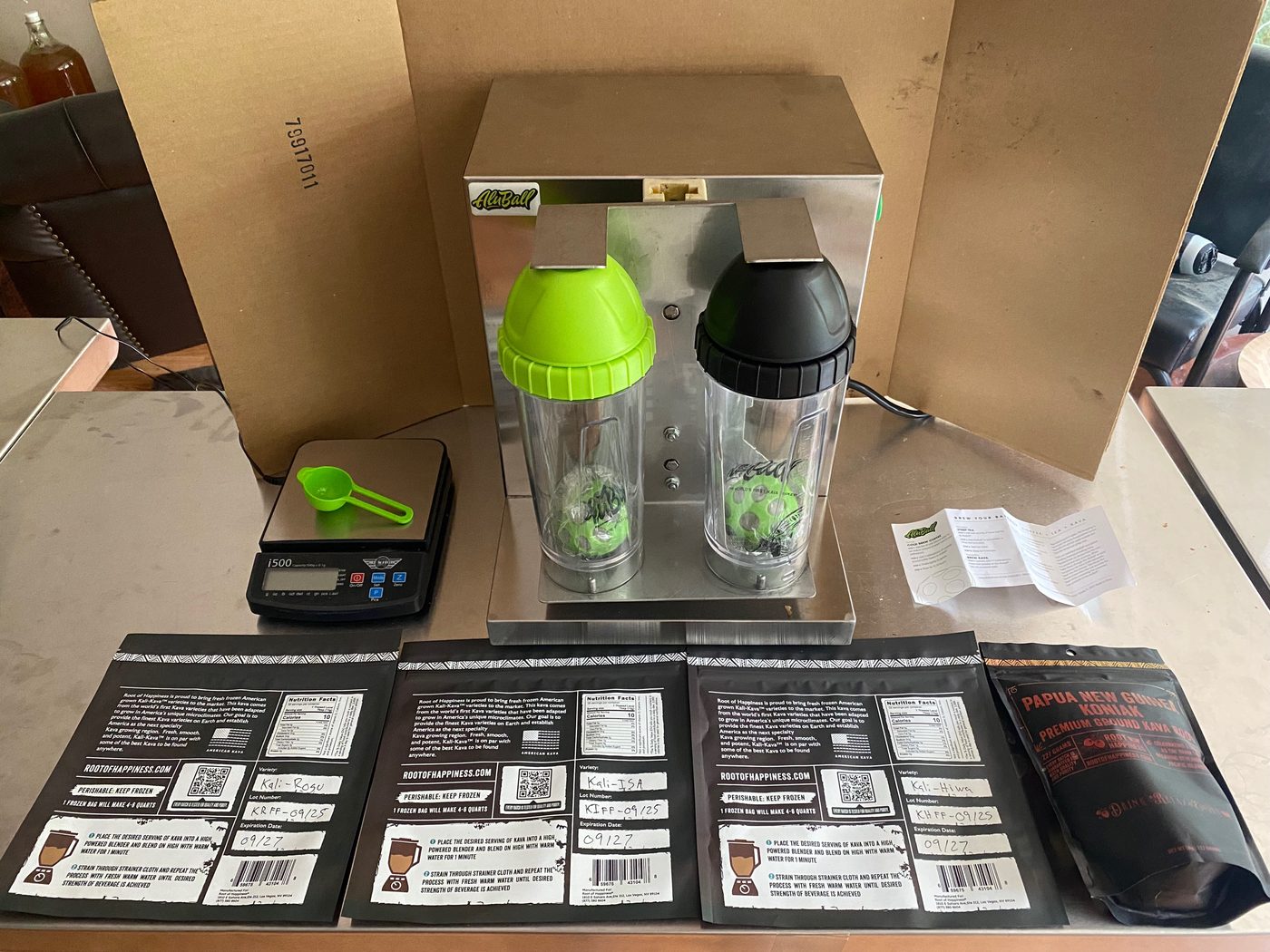
Overview
Kava beverages were prepared under fixed mechanical conditions — 70 µm strainer, 38 °C water, fixed volume and a 60-second cycle — and every kavalactone accounted for by mass balance: what was in the root, what reached the drink, what stayed in the spent root, and how much of what reached the drink was genuinely dissolved rather than suspended. Across three American varieties and one Papua New Guinea variety, a single extraction transferred a mean of 77.8% of the available kavalactone, and 89.6% of what arrived in the cup was particle-associated.
Abstract
Traditional aqueous kava is made by kneading ground root in water inside a porous straining bag. Nothing about that process is fixed: bag porosity, kneading time, hand strength and technique all vary between preparers, and so does the drink. That variability is why two servings of the same kava can differ in strength, and why the industry has had no defensible way to state how much kavalactone a serving actually contains. This paper reports what happens when the preparation step is mechanized and held constant. Using the Alu Bottle Shaker®, which strains through a 70 µm Alu Ball® at a fixed temperature, water volume and shaking time, we prepared beverages from three greenhouse-grown American varieties and one Papua New Guinea variety, then accounted for every kavalactone by mass balance: what was in the root, what came out in the drink, what stayed behind in the spent root, and how much of what came out was genuinely dissolved rather than carried as suspended particulate. The central result is that traditional aqueous kava is a suspension, not a solution. Across every variety and both extraction protocols, roughly nine parts in ten of the kavalactone delivered to the cup rode through the strainer on fine particulate matter; less than two parts in ten were in true solution. Potency is therefore governed by what passes through the mesh, not by how much kavalactone the water can dissolve, which reframes pore size, grind and shaking energy as the primary levers of control, ahead of water temperature or pH.
Key Findings
- A single extraction captures most of what is available. A mean of 77.8% of the kavalactone present in the root was transferred to the beverage in one 60-second cycle, ranging from 71.3% to 85.7% across the four varieties.
- A second extraction adds recovery but costs potency. Re-extracting the same spent root raised cumulative recovery to a mean of 85.5%, a gain of 7.7 points, but halved per-serving strength from a mean of 100 mg to 55 mg of kavalactone per 125 mL because the yield is spread across twice the water.
- Potency is particulate, not dissolved. A mean of 89.6% of the kavalactone in a single-extraction beverage was particle-associated. Across all varieties and both protocols the particulate share was 83.7–91.2% and the dissolved share only 8.8–16.3%.
- The effect is uniform across varieties. Under a single extraction the four varieties fell inside a four-point band, 87.6% to 91.2% particulate, despite a twofold range in the kavalactone content of the roots themselves.
- Acidification did not help. Adjusting the extraction water to pH 5 produced no consistent gain: mean cumulative recovery was 85.1% against 87.0% at pH 8. Marc dry weights were measured separately at both pH values; the comparison is unreplicated.
- Chemotype is largely preserved. Six of the eleven beverages reproduced the kavalactone rank order of their starting material exactly. The five that differed represent only two distinct transpositions, each involving compounds separated by less than 2% — finer than the method can resolve — so no selective extraction is demonstrated.
How to read this paper — Every number here rests on fifteen HPLC-UV analytical reports from Flora Research Laboratories, covering all four cultivars across both extraction protocols, with each reported concentration the laboratory's mean of duplicate injections on its validated kavalactone method and eight-point calibration curves at R² ≥ 0.999. Three constraints matter and are declared rather than buried: the marc dry weights on which the whole mass balance rests are single determinations; the four varieties were not age-matched, one having been harvested at eighteen months against three years for two others; and botanical identity was confirmed for the three American cultivars but not for the commercial Papua New Guinea material. Each is treated in full under Limitations.
Why the preparation step needed fixing
Piper methysticum Forst. f. has been prepared the same way for centuries: peeled root and basal stump, macerated in water inside a porous straining bag, kneaded and wrung until the liquid takes on the opaque, sediment-laden look that defines the drink. The strainer is a coarse filter, not a clarifier — it holds back the fibrous marc while letting fine particulate through into the cup. The finished beverage is a suspension of root solids in water, not a clarified aqueous extract.
Nothing in that process is standardized. Bag porosity, kneading duration, operator strength and handling practice all vary, and each of them moves the result. That is a problem for research reproducibility, for commercial scaling, and for any attempt to state a dose. It is also why the published literature on aqueous extraction efficiency openly contradicts itself.
- 5–10% — Kavalactone recovery reported for cold-water infusions [18]
- ~3% — Traditional aqueous yield relative to acetone extraction [19]
- 81–83% — Transfer into Fijian yaqona reported by gas chromatography [20,21]
Part of that disagreement is definitional. A figure for a filtered liquid and a figure for a whole beverage are not the same quantity: on the reading taken here, the low recoveries describe kavalactone in clarified solution, while the yaqona figure describes transfer into the strained beverage as consumed, suspended particulate included. Neither source frames its result that way, so the assignment is an interpretation offered here rather than something reported in the cited work.
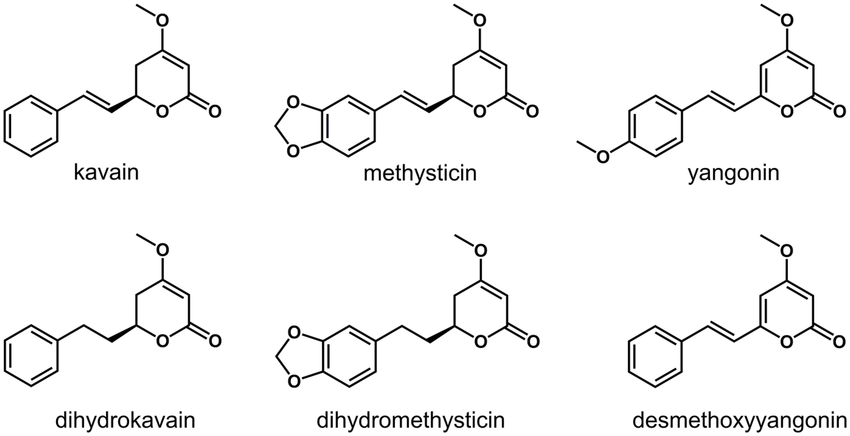
The rest of the disagreement is physical chemistry, and it is decisive. The only compiled water-solubility figures available for the individual kavalactones sum to under 14 mg per 100 mL at 21 °C — an order of magnitude below the kavalactone concentration routinely measured in a traditional preparation. Even read loosely, those numbers mean a recovery figure in the eighties cannot possibly be describing dissolved material.
Compiled aqueous solubility of the individual kavalactones at 21 °C [24,25]
- Dihydrokavain — 8.1
- Kavain — 2.2
- Dihydromethysticin — 1.5
- Methysticin — 1.2
- Desmethoxyyangonin — 0.5
- Yangonin — 0.3
- Total — 13.8
These values originate in an unpublished 1997 conference presentation [25] and no accessible primary measurement could be located, so they are indicative rather than authoritative.
Reconciling the two ends of that range requires a preparation in which the transfer of solids and the dissolution of kavalactones are measured separately, rather than inferred together from a single assay of the finished liquid. That is what this study does.
Method
Materials
Kali-ISA, Kali-Rogu and Kali-Hiwa were grown at the American Kava Association Research Greenhouse in Sacramento, California and harvested in September 2025. Kali-Rogu and Kali-Hiwa were three years old at harvest; Kali-ISA was eighteen months old, which confounds variety with maturity in any comparison involving it. Material was washed, size-reduced, flash-frozen and held at −20 °C. A 454 g frozen sub-sample of each was air-dried at 38 °C for 48 h to 3.0% residual moisture. A dried Papua New Guinea sample — “Superior Koniak”, batch VHM-020324 — was supplied by Root of Happiness and dried alongside to the same moisture.
Identity and grade
Identity was established by HPTLC at Flora Research Laboratories following the British Herbal Pharmacopoeia Piper methysticum root protocol, modified for modern instrumentation. All three American cultivars produced the characteristic intense band at Rf ≈ 0.4 with co-migration of the kavain standard, the diagnostic blue-fluorescing bands at Rf 0.4–0.5 and the red-fluorescing upper band under UV 366 nm. Chemotype was determined separately by HPLC-UV. HPTLC addresses what the material is; HPLC-UV addresses what it contains; neither was relied on alone. The Papua New Guinea material was a commercial batch and was not identity-tested.
Beverage grade is two questions, not one — Cultivar class and flavokavain chemistry are assessed independently and neither answers the other. A textbook kavain-led chemotype with flavokavains above 0.4% w/w is non-beverage grade however favourable the ranking looks; a low flavokavain result does not by itself make a lot a Codex noble variety. All four materials here sit below the 0.4% w/w ceiling and below the 5% relative limit, so all four are beverage grade on the flavokavain criterion. On cultivar class they divide: Kali-Rogu (423516) and Kali-Hiwa (463251) are kavain-led codes inside the noble range; Kali-ISA (254631) and PNG Koniak (256431) are reported as beverage-grade Isa-type material and no noble claim is made for them.
Preparation
- 30 g of dried material milled 30 s to a fine powder.
- 10 g of powder loaded into a 70 µm Alu Ball®, sealed, and placed in an Alu Shaker® Pro bottle charged with 900 mL of reverse-osmosis water at 38 °C, pH 8.0.
- Two bottles processed simultaneously for a single 60-second cycle.
- The Alu Ball® then either set aside for marc analysis (first-extraction condition) or returned to a second bottle with a further 900 mL under identical conditions for another 60 s (sequential condition; combined filtrate 1,800 mL).
- For the acidified arm, citric acid was titrated into the water to pH 5.0 before the Alu Ball® was introduced. Kali-ISA, Kali-Rogu and Kali-Hiwa were run at pH 5 under the sequential protocol; PNG Koniak was not.
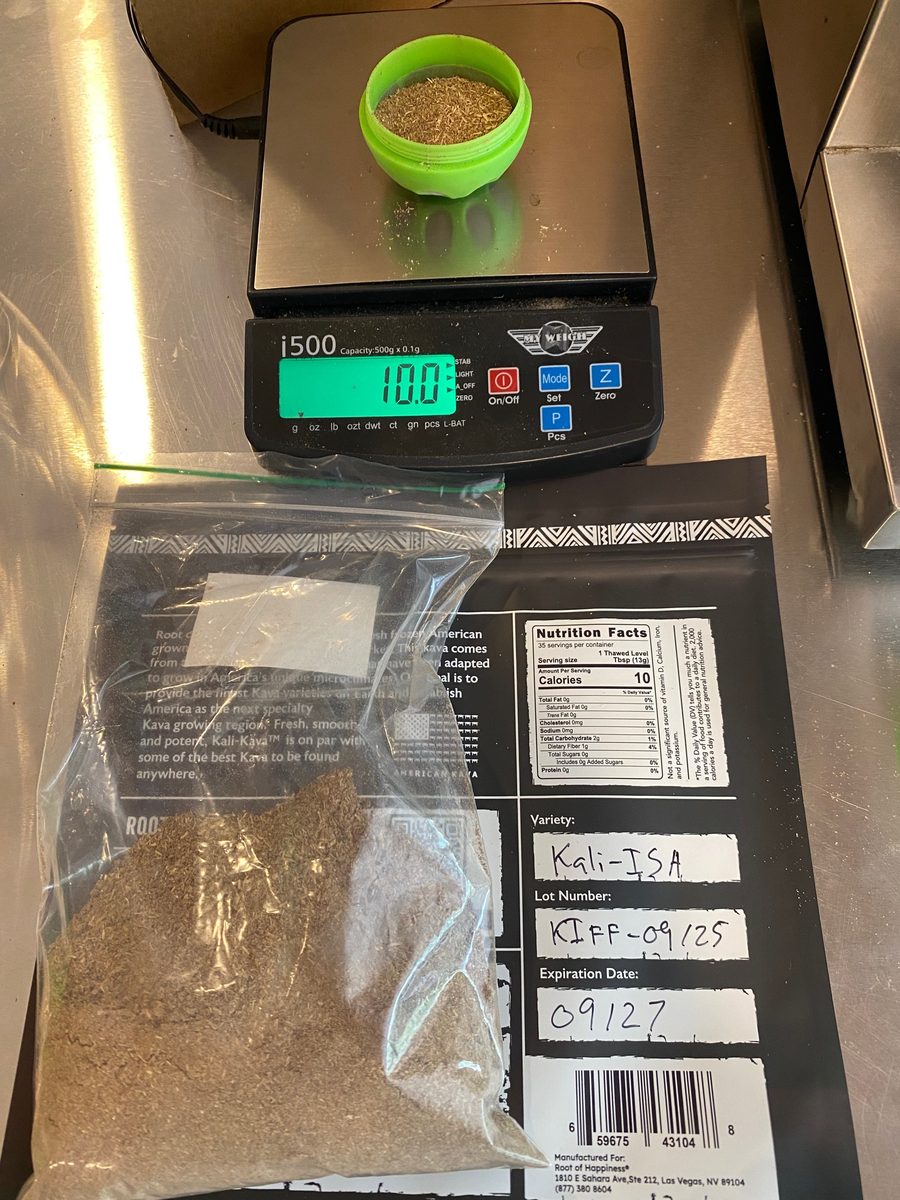

Figures 3–4. A 10 g charge of Kali-ISA powder weighed into the Alu Ball®, and the machine set for its 60-second cycle.
Analysis and mass balance
Individual kavalactones and flavokavains in starting materials, beverages and marcs were quantified by HPLC-UV at Flora Research Laboratories using the laboratory's validated method (HPLC-QNT-KAVA2), adapted from Liu et al. and consistent with AOAC SMPR 2018.005. Separation on an Agilent Poroshell 120 SB-C18 column at 55 °C; detection at 240 nm for methysticin, dihydromethysticin, kavain and dihydrokavain and 355 nm for yangonin, desmethoxyyangonin and the flavokavains; eight-point external calibration, R² ≥ 0.999; reporting limit 100 µg g⁻¹ per analyte.
The mass balance itself is simple, and everything downstream depends on it. The kavalactone mass transferred to the beverage is obtained by difference from the residue: mKL,bev = mKL,init − mKL,marc, with efficiency η = mKL,bev / mKL,init, applied both to total kavalactones and to each compound individually. The difference between the starting dry weight and the recovered marc dry weight gives the mass of solid that passed the 70 µm mesh; applying the starting material's kavalactone percentage to that solid mass gives the particle-associated fraction, and the remainder of the transferred mass is taken as truly dissolved.
Replication — stated plainly — This is a single-replicate mass-balance characterization. One preparation per variety per condition; each sample assayed once, the reported concentration being the laboratory's mean of duplicate injections. No between-preparation standard deviations exist and no inferential statistics were performed. Duplicate injection characterizes instrument precision, not the repeatability of the whole determination. Differences smaller than the analytical precision of the method should not be read as real.
Results
Total extraction efficiency
The first extraction recovered the large majority of the available kavalactone in every variety. The second added a consistent but smaller increment — 3.5 points for Kali-ISA, whose marc lost the least additional mass between runs, up to 9.4 points for PNG Koniak.
Table 1. Total kavalactone extraction efficiency at pH 8, as a percentage of the kavalactone mass in the starting material.
- Kali-ISA — 1st extraction: 74.2% · 1st + 2nd: 77.7% · Additional recovery: 3.5%
- PNG Koniak — 1st extraction: 71.3% · 1st + 2nd: 80.7% · Additional recovery: 9.4%
- Kali-Rogu — 1st extraction: 85.7% · 1st + 2nd: 94.4% · Additional recovery: 8.7%
- Kali-Hiwa — 1st extraction: 80.1% · 1st + 2nd: 89.1% · Additional recovery: 9.0%
- Mean — 1st extraction: 77.8% · 1st + 2nd: 85.5% · Additional recovery: 7.7%
Extraction efficiency by variety
Figure A.
- Kali-ISA — First extraction: 74.2 % · First + second: 77.7 %
- PNG Koniak — First extraction: 71.3 % · First + second: 80.7 %
- Kali-Rogu — First extraction: 85.7 % · First + second: 94.4 %
- Kali-Hiwa — First extraction: 80.1 % · First + second: 89.1 %
- Mean — First extraction: 77.8 % · First + second: 85.5 %
Percentage of the kavalactone mass present in the starting material that reached the beverage, pH 8.
Acidification to pH 5
The pH effect had no consistent direction. Kali-ISA gained 3.4 points; Kali-Hiwa was unchanged (89.06% against 89.05%, a difference the rounded table cannot show); Kali-Rogu lost 9.1. The mean was a small net decrease driven entirely by Kali-Rogu.
Table 2. Cumulative (first plus second) extraction efficiency at pH 8 and pH 5. PNG Koniak was not evaluated at pH 5.
- Kali-ISA — pH 8: 77.7% · pH 5: 81.1% · Difference: +3.4%
- Kali-Rogu — pH 8: 94.4% · pH 5: 85.3% · Difference: −9.1%
- Kali-Hiwa — pH 8: 89.1% · pH 5: 89.0% · Difference: −0.0%
- Mean — pH 8: 87.0% · pH 5: 85.1% · Difference: −1.9%
Marc dry weights were determined separately for each condition, so the pH 5 column rests on measured rather than inferred masses. The condition is unreplicated.
The Kali-Rogu loss did not come from less solid passing the mesh — its acidified marc was the lighter of the two, 2.02 g against 2.10 g. It came from a richer residue: the pH 5 marc assayed 5.15% total kavalactone against 1.89% for its pH 8 counterpart. Three features of that sample resist a solubility explanation and are reported exactly as measured rather than adjusted or excluded: its post-double-extraction concentration (5.15%) exceeds the pH 8 marc after a single extraction (4.05%); its methysticin (0.705%) exceeds the raw starting material (0.658%); and its flavokavain total moved opposite to its kavalactone concentration, breaking an otherwise monotonic series. No single mechanism accounts for both directions, and the condition is unreplicated.
Particulate versus dissolved — the central result
This is the finding the paper turns on. Particle-associated kavalactones accounted for 83.7–91.2% of beverage content across every variety and both protocols, with the dissolved fraction correspondingly 8.8% to 16.3%. Under a single extraction the four varieties fell inside a four-point band despite a twofold range in the kavalactone content of their roots.
Where the kavalactone in the cup comes from (single extraction)
Figure B.
- Kali-ISA — Carried on particulate: 90.3 % · Truly dissolved: 9.7 %
- PNG Koniak — Carried on particulate: 89.5 % · Truly dissolved: 10.5 %
- Kali-Rogu — Carried on particulate: 87.6 % · Truly dissolved: 12.4 %
- Kali-Hiwa — Carried on particulate: 91.2 % · Truly dissolved: 8.8 %
- Mean — Carried on particulate: 89.6 % · Truly dissolved: 10.4 %
Share of the kavalactone delivered to the beverage, first extraction (900 mL). The two series sum to 100% within each variety.
Table 3. First extraction (900 mL): partitioning between particulate (PT KL) and dissolved (WS KL), with delivery per 125 mL serving.
- Kali-ISA — PT KL: 90.3% · WS KL: 9.7% · KL mg / 125 mL: 147 · FK mg / 125 mL: 2.6 · FK per 100 mg KL: 1.7
- PNG Koniak — PT KL: 89.5% · WS KL: 10.5% · KL mg / 125 mL: 79 · FK mg / 125 mL: 2.5 · FK per 100 mg KL: 3.1
- Kali-Rogu — PT KL: 87.6% · WS KL: 12.4% · KL mg / 125 mL: 84 · FK mg / 125 mL: 3.4 · FK per 100 mg KL: 4.1
- Kali-Hiwa — PT KL: 91.2% · WS KL: 8.8% · KL mg / 125 mL: 90 · FK mg / 125 mL: 0.9 · FK per 100 mg KL: 1.0
- Mean — PT KL: 89.6% · WS KL: 10.4% · KL mg / 125 mL: 100 · FK mg / 125 mL: 2.3 · FK per 100 mg KL: 2.3
The final column normalizes flavokavain content to the 100 mg mean kavalactone dose. The Mean-row figure in that column is the ratio of the two column means (2.3), not the arithmetic mean of the four variety values (2.5).
Table 4. Combined first and second extraction (1,800 mL): partitioning and per-serving delivery.
- Kali-ISA — PT KL: 89.6% · WS KL: 10.4% · KL mg / 125 mL: 77 · FK mg / 125 mL: 1.3 · FK per 55 mg KL: 0.9
- PNG Koniak — PT KL: 85.0% · WS KL: 15.0% · KL mg / 125 mL: 45 · FK mg / 125 mL: 1.3 · FK per 55 mg KL: 1.6
- Kali-Rogu — PT KL: 83.7% · WS KL: 16.3% · KL mg / 125 mL: 46 · FK mg / 125 mL: 1.8 · FK per 55 mg KL: 2.1
- Kali-Hiwa — PT KL: 85.3% · WS KL: 14.7% · KL mg / 125 mL: 50 · FK mg / 125 mL: 0.5 · FK per 55 mg KL: 0.6
- Mean — PT KL: 85.9% · WS KL: 14.1% · KL mg / 125 mL: 55 · FK mg / 125 mL: 1.2 · FK per 55 mg KL: 1.2
The dissolved share is systematically higher under the combined protocol (14.1% against 10.4%), consistent with extra water and contact time favouring dissolution while a finite particulate load is divided across a larger volume.
Table 5. Water-dissolved kavalactones as a percentage of the kavalactone content of the starting material.
- Kali-ISA — 1st extraction: 7.2% · 1st + 2nd: 8.1%
- PNG Koniak — 1st extraction: 7.5% · 1st + 2nd: 12.1%
- Kali-Rogu — 1st extraction: 10.7% · 1st + 2nd: 15.4%
- Kali-Hiwa — 1st extraction: 7.1% · 1st + 2nd: 13.1%
- Mean — 1st extraction: 8.1% · 1st + 2nd: 12.2%
Dissolution alone accounts for a mean of 8.1% of the available kavalactone in a single extraction and 12.2% across two. The process is dominated by mechanical particle transfer.
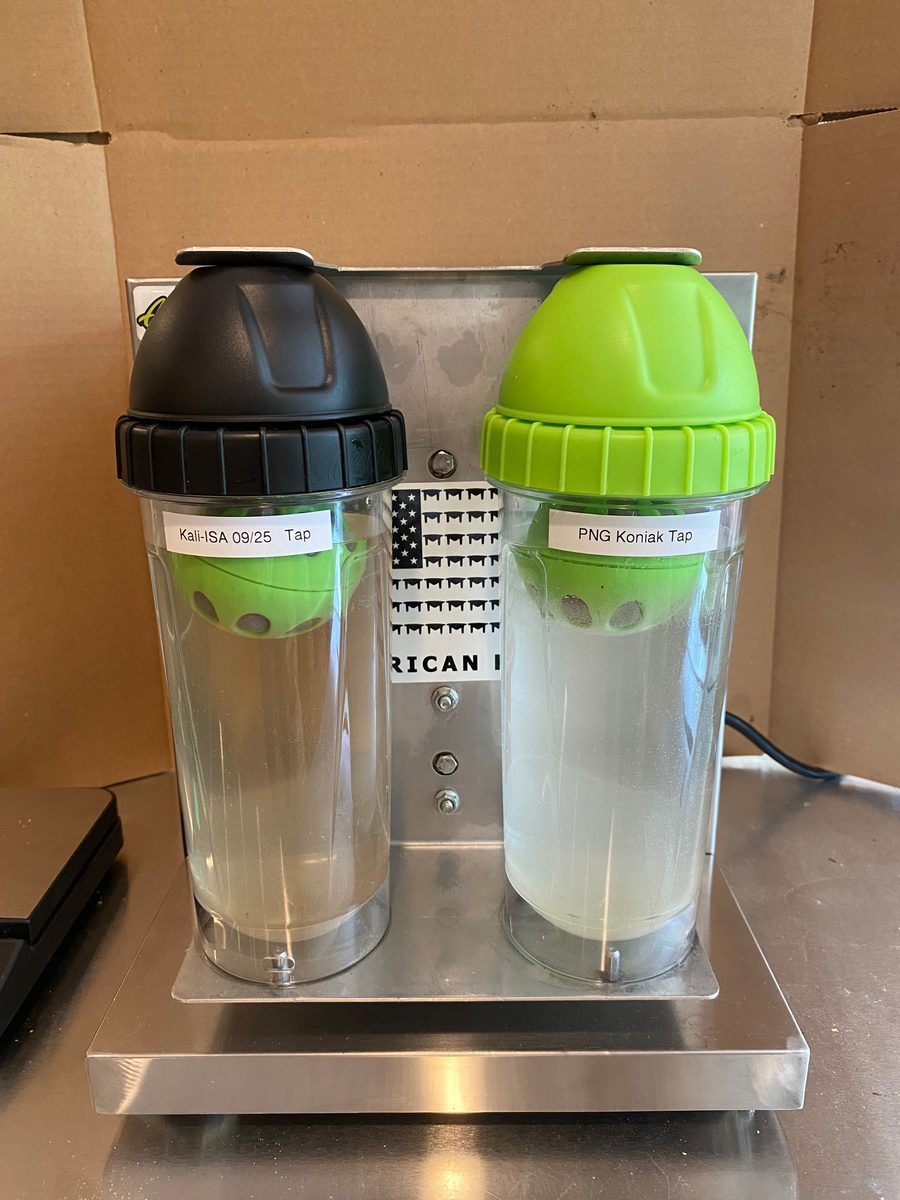
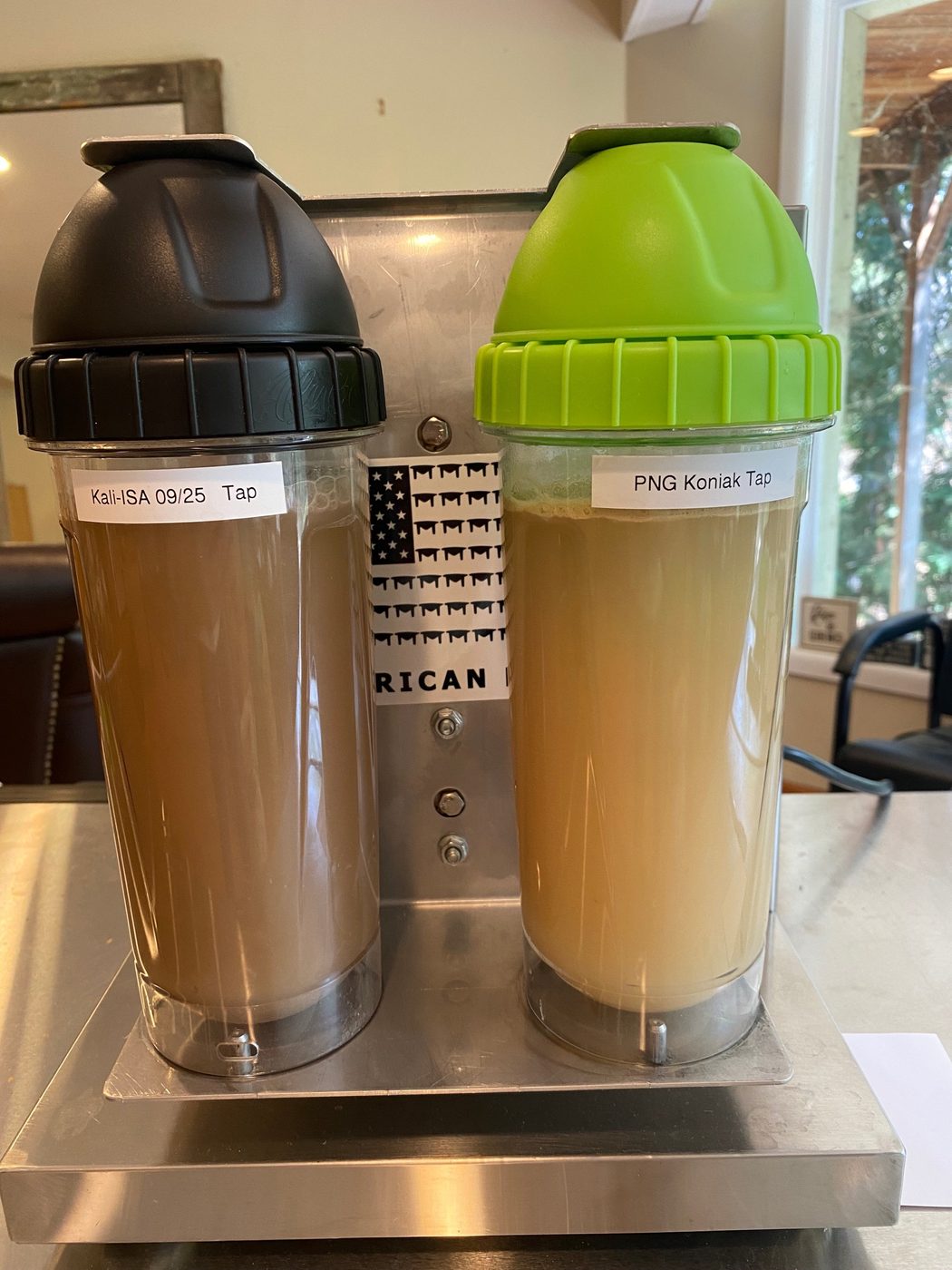
Figures 5–6. Both bottles run simultaneously in the two brackets of the machine, and the finished beverages — opaque and sediment-laden, which is the point: that suspended load is where nine tenths of the kavalactone is.
Compound-level selectivity and chemotype
Kavalactone rank order in the finished beverages closely tracked the starting materials. Kali-ISA held 254631 unchanged under all three conditions and PNG Koniak held 256431 under both protocols. Five of the eleven beverages differed, but those five represent only two distinct transpositions, each of a single adjacent pair: Kali-Rogu moved 423516 → 423561 under both pH 8 protocols and returned to 423516 at pH 5; Kali-Hiwa moved 463251 → 462351 under all three conditions. Both involve compounds separated by less than 2% — finer than the method can resolve — so no selective extraction is demonstrated.
Table 6. Individual kavalactone and flavokavain concentrations (% w/w) for every starting material and residual marc.
- Kali-ISA — Sample: raw · M: 2.03 · DHM: 3.15 · K: 2.33 · DK: 4.42 · Y: 1.48 · DMY: 0.832 · TKL: 14.24 · TFK: 0.253
- — Sample: M1 pH 8 · M: 1.58 · DHM: 2.51 · K: 1.88 · DK: 3.35 · Y: 1.13 · DMY: 0.689 · TKL: 11.14 · TFK: 0.207
- — Sample: M2 pH 8 · M: 1.62 · DHM: 2.38 · K: 1.70 · DK: 2.76 · Y: 1.27 · DMY: 0.726 · TKL: 10.46 · TFK: 0.230
- — Sample: M2 pH 5 · M: 1.45 · DHM: 2.08 · K: 1.48 · DK: 2.35 · Y: 1.14 · DMY: 0.659 · TKL: 9.16 · TFK: 0.211
- PNG Koniak — Sample: raw · M: 1.00 · DHM: 2.10 · K: 0.977 · DK: 2.62 · Y: 0.825 · DMY: 0.446 · TKL: 7.97 · TFK: 0.260
- — Sample: M1 pH 8 · M: 0.793 · DHM: 1.64 · K: 0.823 · DK: 2.02 · Y: 0.627 · DMY: 0.409 · TKL: 6.31 · TFK: 0.229
- — Sample: M2 pH 8 · M: 0.650 · DHM: 1.23 · K: 0.618 · DK: 1.45 · Y: 0.564 · DMY: 0.382 · TKL: 4.89 · TFK: 0.235
- Kali-Rogu — Sample: raw · M: 0.658 · DHM: 0.815 · K: 2.06 · DK: 1.93 · Y: 0.934 · DMY: 0.670 · TKL: 7.07 · TFK: 0.293
- — Sample: M1 pH 8 · M: 0.403 · DHM: 0.491 · K: 1.14 · DK: 1.08 · Y: 0.459 · DMY: 0.480 · TKL: 4.05 · TFK: 0.190
- — Sample: M2 pH 8 · M: 0.194 · DHM: 0.212 · K: 0.477 · DK: 0.432 · Y: 0.287 · DMY: 0.291 · TKL: 1.89 · TFK: 0.164
- — Sample: M2 pH 5 · M: 0.705 · DHM: 0.690 · K: 1.35 · DK: 1.16 · Y: 0.822 · DMY: 0.424 · TKL: 5.15 · TFK: 0.090
- Kali-Hiwa — Sample: raw · M: 1.56 · DHM: 0.949 · K: 2.16 · DK: 1.40 · Y: 1.42 · DMY: 0.644 · TKL: 8.13 · TFK: 0.102
- — Sample: M1 pH 8 · M: 1.10 · DHM: 0.729 · K: 1.29 · DK: 1.04 · Y: 1.19 · DMY: 0.652 · TKL: 6.00 · TFK: 0.132
- — Sample: M2 pH 8 · M: 0.731 · DHM: 0.408 · K: 0.630 · DK: 0.455 · Y: 1.01 · DMY: 0.475 · TKL: 3.71 · TFK: 0.119
- — Sample: M2 pH 5 · M: 0.716 · DHM: 0.380 · K: 0.597 · DK: 0.384 · Y: 1.06 · DMY: 0.454 · TKL: 3.59 · TFK: 0.106
M methysticin · DHM dihydromethysticin · K kavain · DK dihydrokavain · Y yangonin · DMY desmethoxyyangonin · TKL total kavalactones · TFK total flavokavains. M1 = marc after one extraction; M2 = marc after two.
Five negative values, reported rather than truncated — A few marc entries exceed their starting material — methysticin in the Kali-Rogu pH 5 marc, desmethoxyyangonin in the Kali-Hiwa first-extraction marc, and flavokavain totals in all three Kali-Hiwa marcs — which yields small negative apparent dissolved values, the largest being −0.00095 g. All fall inside the repeatability the method is permitted to carry (AOAC SMPR 2018.005 sets RSDr at 7.5%; the two kavalactone exceedances are 7.1% and 1.2%). The flavokavain cases have a specific cause: flavokavain C was below the 100 µg g⁻¹ reporting limit in the raw material but quantifiable in the marcs, so the two totals do not comprise the same set of analytes. Truncating these at zero would conceal the residual uncertainty and bias the reported dissolved fractions upward, since only negative deviations would be clipped.
What it means
The dissolved fractions can be checked directly against the solubility figures, and they hold up. In the single extraction, 10 g of powder went into 900 mL, so the dissolved masses correspond to 11.4 mg per 100 mL for Kali-ISA, 8.4 for Kali-Rogu, 6.6 for PNG Koniak and 6.4 for Kali-Hiwa. The compiled 21 °C solubilities sum to 13.8 mg per 100 mL — a saturation ceiling of roughly 124 mg in 900 mL. Every variety sits below it, at 46–83%, and none exceeds it. Because the kavalactone available in the root exceeded that ceiling several-fold in every case — 707 to 1,424 mg against 124 mg — the aqueous phase was never supply-limited: the dissolved fraction is bounded by solubility, not by process efficiency.
Two things follow. First, the inverse relationship between starting content and dissolved percentage is expected rather than anomalous: Kali-ISA carried nearly twice the kavalactone of Kali-Rogu yet returned a lower dissolved percentage of its starting material (7.2% against 10.7%), because the numerator is capped while the denominator is not. Second, and more practically, no adjustment to shaking time, agitation intensity or water temperature within the range used in practice can raise the dissolved fraction more than marginally — there is almost no headroom left to exploit.
A thirty-year puzzle, resolved by arithmetic — Cold aqueous macerates were long observed to carry up to ~70 mg of total kava pyrones per 100 mL against a measured kavain solubility of 2.2 mg per 100 mL, and the gap was attributed to matrix constituents acting as solubilizers. This mass balance offers a simpler explanation for the bulk of it: in these beverages total kavalactone reached 118 mg per 100 mL for Kali-ISA while the dissolved concentration was 11.4 mg per 100 mL. The excess over the solubility limit was never dissolved at all — it was suspended. Matrix-mediated solubilization may still contribute at the margin, but no solubilization mechanism is required to account for a beverage carrying ten times more kavalactone than water alone can hold.
Sequential extraction clarifies the relationship between efficiency and dilution, and the trade is unavoidable. The second pass recovers a further 7.7% on average, raising cumulative yield to 85.5% — but spread across twice the water, per-serving strength falls from a mean of 100 mg to 55 mg per 125 mL. An operation can optimize cost per gram of root, or consistency of dose per cup. It cannot optimize both at once.
The marcs also show the limits of aqueous extraction. On a mass-balance basis 25.8% of the starting kavalactone remained in the Kali-ISA marc after one extraction and 22.3% after two; PNG Koniak 28.7% and 19.3%; Kali-Hiwa 19.9% and 10.9%; Kali-Rogu only 14.3% and 5.6%. Solid retention fell in a narrow band, 25.0% of the charged dry mass for Kali-Rogu to 36.2% for PNG Koniak — and retention of solids tracks retention of kavalactone closely. Kali-Rogu, which passed the most solid through the mesh, also gave up the most kavalactone; PNG Koniak retained the most of both.
Kali-ISA stood out on a different axis: the highest kavalactone delivery per serving (147 mg under single extraction) with total flavokavains at just 2.6 mg — well under half the normalized flavokavain load of Kali-Rogu (1.7 mg against 4.1 mg per 100 mg kavalactone). That combination may have organoleptic relevance, since higher kavalactone concentration contributes to perceived strength and mouthfeel while lower flavokavain levels may reduce reported bitterness and astringency. It is subject to three caveats: the flavokavain C reporting-limit artifact, the eighteen-month age of the Kali-ISA plant against three years for the others, and its reporting as beverage-grade Isa-type material for which no noble claim is made.
Finally, acidification. Kavalactones are neutral α-pyrones with no ionizable group, so pH should not touch their intrinsic solubility directly; any effect must act on the plant matrix. None was found. Mean cumulative efficiency at pH 5 (85.1%) came in below pH 8 (87.0%), and only Kali-ISA gained at all. Within this preparation framework, extraction efficiency is governed far more strongly by mechanical particle transfer and filtration dynamics than by modest changes in aqueous chemistry — which reinforces the central conclusion rather than complicating it.
What this changes in practice
For preparers and kava bars
Strainer pore size and grind fineness are the primary determinants of beverage strength — ahead of water temperature, shaking time or pH. Because roughly nine parts in ten of the delivered kavalactone travels as suspended particulate, any change that alters how much fine solid passes the mesh changes potency proportionally, while changes intended to improve dissolution have very little to work with. A bar that standardizes its strainer and its grind has standardized most of the variability in its product. One that standardizes water temperature alone has not.
Sequential re-extraction is a yield decision, not a strength decision. And because most of the active material is particulate, settling matters: a beverage that has been standing is not uniform, and a serving drawn from the top of an unstirred vessel does not carry the same dose as one drawn from the bottom. Consistent agitation before pouring is a dose-control measure, not presentation.
For producers and product developers
A label claim about kavalactone content in a traditional aqueous product is a claim about particle transfer. A stated milligram figure per serving is only reproducible if pore size, grind, water volume, temperature, agitation and the number of extraction passes are all fixed and disclosed, because every one of those variables moves the figure. Stating the kavalactone content of the root without stating the preparation parameters says very little about what reaches the consumer.
Chemotype survives preparation substantially intact. Rank order in the beverage tracked the starting material closely across all four varieties, with changes confined to adjacent positions. Selecting a variety for a particular kavalactone profile is therefore a meaningful decision — the profile a grower selects for is broadly the profile a drinker receives, which is not something that could be assumed before it was measured. And since normalized flavokavain load ranged from about 1.0 to 4.1 mg per 100 mg kavalactone between varieties, variety selection is a more effective lever on flavokavain exposure than preparation method.
For regulators and standards bodies
Any specification that regulates only the composition of the raw material is incomplete, because the same root prepared two ways delivers materially different doses. A workable specification must fix the preparation parameters or state the dose as a range conditional on them.
And analytical methods applied to finished aqueous kava must account for the particulate fraction. A method that assays only the filtered liquid reports between 8.8% and 16.3% of the kavalactone a consumer actually receives — roughly one tenth under a single extraction, nearer one seventh under the combined protocol. That is a substantial and systematic underestimate, and it applies to any compliance testing, potency verification or exposure assessment carried out on traditional aqueous preparations.
Limitations
- No preparation-level replication. Each variety was prepared once per condition, so the reproducibility this method is designed to deliver is asserted from its mechanical design rather than demonstrated from the data. Quantifying that variability is the first priority for follow-on work and a prerequisite to any claim of superiority over manual preparation.
- The marc dry weight is a single determination. Dissolved mass is the product of the marc weight and a concentration difference, so it scales linearly with that weight — and no HPLC-UV quantity can constrain it independently. The accuracy of every reported efficiency rests on that gravimetry alone.
- Plant age was not matched. Kali-ISA was eighteen months old against three years for Kali-Rogu and Kali-Hiwa, so any comparison involving Kali-ISA confounds variety with maturity. Since it carried both the highest kavalactone concentration and high solid retention, maturity rather than cultivar identity may drive part of its behaviour.
- The particulate calculation assumes uniform composition. Solids passing the mesh are assumed to carry the same kavalactone concentration as the bulk material. If the fine fraction is enriched in resinous, kavalactone-bearing tissue, the particulate share reported here is an underestimate.
- No nobility classification was made. HPTLC plus chemotype establishes cultivated-type P. methysticum of beverage grade, not certified noble status, which requires SSR genotyping, FTIR chemometrics or the Codex acetonic absorbance test — none of which was applied. The PNG material was not identity-tested at all, so results attributed to “Koniak” describe the batch as received.
- The pH 5 arm is reproducible as an endpoint, not as a dose. Water was titrated to pH 5.0 rather than dosed with a fixed quantity of citric acid, so acid concentration differed by variety according to buffering capacity and was not recorded.
- No sensory work. Particle load, dilution, pH and extraction intensity may all influence mouthfeel, flavour and perceived potency; none was assessed.
What this paper does not establish — The findings rest on one preparation per variety per condition, with the mass balance anchored to marc dry weights each determined once. The paper establishes the magnitude and direction of the particulate effect, which is large enough to be robust to plausible weighing error. It does not establish the precision of any individual figure, and it does not demonstrate reproducibility across independent preparations. Treat the particulate finding as established and the specific percentages as best current estimates awaiting replication.
Disclosures and conflicts of interest
Both authors are commercially engaged in the kava trade, and readers should weigh the findings accordingly. Kavafied manufactures the equipment under evaluation — the Alu Bottle Shaker® machine, the 70 µm Alu Ball® and the Alu Shaker® Pro bottle — and donated it for this study, so it stands to benefit commercially from favourable findings about the system. T.B. is affiliated with Root of Happiness, which donated the Papua New Guinea material, was the named client on the analytical reports and provided financial support, and in which T.B. holds an ownership interest; T.B. is also affiliated with Kali-Kava, which donated the Kali-Hiwa, Kali-ISA and Kali-Rogu material. J.B. is affiliated with Nakamal at Home, a kava retailer. The American kava materials were donated by the American Kava Association and grown by T.B. The corresponding author is additionally a contributing author of AOAC SMPR 2018.005, cited in the methods. This paper is published by the American Kava Association, which also maintains the research greenhouse, and the authors are members of that organization.
None of these parties participated in the analysis or in generating the data, which were produced by an independent accredited laboratory from samples submitted blind to the interpretations offered here. The paper reports what the system delivered under one set of conditions and does not compare it against any competing preparation method; no claim of superiority over manual preparation or over any other device is made or supported here. This work received no external grant funding; analytical costs were borne by the authors.
Alu Bottle Shaker®, Alu Ball® and Alu Shaker® are registered trademarks of Kavafied. Their use here does not imply endorsement of this paper by the trademark owner beyond the disclosures given above.
References
- Singh, Y.N., Ed. Kava: From Ethnology to Pharmacology; CRC Press: Boca Raton, FL, USA, 2004.
- Lebot, V.; Merlin, M.; Lindstrom, L. Kava: The Pacific Drug; Yale University Press: New Haven, CT, USA, 1992.
- Singh, Y.N.; Singh, N.N. Therapeutic potential of kava in the treatment of anxiety disorders. CNS Drugs 2002, 16, 731–743.
- Lebot, V.; Aradhya, M.K.; Manshardt, R.M. Geographic survey of genetic variation in kava (Piper methysticum Forst. f. and P. wichmannii C. DC.). Pac. Sci. 1991, 45, 169–185.
- White, C.M. The pharmacology, pharmacokinetics, efficacy, and adverse events associated with kava. J. Clin. Pharmacol. 2018, 58, 1396–1405.
- Lebot, V.; Lévesque, J. The origin and distribution of kava (Piper methysticum Forst. f., Piperaceae): a phytochemical approach. Allertonia 1989, 5, 223–281.
- Siméoni, P.; Lebot, V. Identification of factors determining kavalactone content and chemotype in kava (Piper methysticum Forst. f.). Biochem. Syst. Ecol. 2002, 30, 413–424.
- Bian, T.; Corral, P.; Wang, Y.; et al. Kava as a clinical nutrient: promises and challenges. Nutrients 2020, 12, 3044.
- Mamallapalli, J.; Henderson, A.; Berthold, E.; et al. Prevalence and use patterns of kava (Piper methysticum) in a US nationally representative sample. J. Ethnopharmacol. 2026, 355, 120617.
- Pont-Fernandez, S.; Kheyfets, M.; Rogers, J.M.; Smith, K.E.; Epstein, D.H. Kava (Piper methysticum) in the United States: the quiet rise of a substance with often subtle effects. Am. J. Drug Alcohol Abuse 2023, 49, 85–96.
- Olsen, L.R.; Grillo, M.P.; Skonberg, C. Constituents in kava extracts potentially involved in hepatotoxicity: a review. Chem. Res. Toxicol. 2011, 24, 992–1002.
- Tugcu, G.; Kırmızıbekmez, H.; Aydın, A. The integrated use of in silico methods for the hepatotoxicity potential of Piper methysticum. Food Chem. Toxicol. 2020, 145, 111663.
- Kuchta, K.; Schmidt, M.; Nahrstedt, A. German kava ban lifted by court. Planta Med. 2015, 81, 1647–1653.
- Lebot, V.; Labouisse, J.-P.; Rivallan, R.; Kaoh, J.; Davrieux, F. Use of SSR markers and FTIR chemometrics to assess the nobility of kava cultivars from the Pacific. Food Control 2024, 164, 110598.
- Kilham, C. Kava: Medicine Hunting in Paradise; Park Street Press: Rochester, VT, USA, 1996; p. 166.
- Merlin, M.; Raynor, W. Modern use and environmental impact of the kava plant in remote Oceania. In Dangerous Harvest; Oxford University Press: New York, NY, USA, 2004; pp. 274–293.
- Shimoda, L.M.N.; Park, C.; Stokes, A.J.; Gomes, H.H.; Turner, H. Pacific Island ʻawa (kava) extracts, but not isolated kavalactones, promote proinflammatory responses in model mast cells. Phytother. Res. 2012, 26, 1934–1941.
- Koch, M.; Plat, M.; Mehri, H.; Saillant, J.-P.; Kornowski, H. Dosage des kawalactones totales et des dihydro-5,6 kawalactones dans les préparations de kawa. Ann. Pharm. Fr. 1973, 31, 133–138.
- Denham, A.; McIntyre, M.; Whitehouse, J. Kava — the unfolding story: report on a work-in-progress. J. Altern. Complement. Med. 2002, 8, 237–263.
- Duve, R.N.; Prasad, J. Efficacy of extraction of constituents in the preparation of yaqona beverage. Part 1: general constituents. Fiji Agric. J. 1984, 46, 5–9.
- Duve, R.N.; Prasad, J. Efficacy of extraction of constituents in the preparation of yaqona beverage. Part 2: major active constituents. Fiji Agric. J. 1984, 46, 11–16.
- Côté, C.S.; Kor, C.; Cohen, J.; Auclair, K. Composition and biological activity of traditional and commercial kava extracts. Biochem. Biophys. Res. Commun. 2004, 322, 147–152.
- Xuan, T.D.; Fukuta, M.; Wei, A.C.; et al. Efficacy of extracting solvents to chemical components of kava (Piper methysticum) roots. J. Nat. Med. 2008, 62, 188–194.
- Lebot, V.; Michalet, S.; Legendre, L. Kavalactones and flavokavins profiles contribute to quality assessment of kava (Piper methysticum G. Forst.). Beverages 2019, 5, 34.
- Kurth, H. Kava-Kava Chemical Analysis. Presented at the International Symposium on Kava and Other Medicinal Plants of the South Pacific, Kona, HI, USA, 14–17 May 1997. (Unpublished; original source of the solubility values reproduced in [24].)
- Wang, J.; Qu, W.; Bittenbender, H.C.; Li, Q.X. Kavalactone content and chemotype of kava beverages prepared from roots and rhizomes of Isa and Mahakea varieties. J. Food Sci. Technol. 2015, 52, 1164–1169.
- Blythe, T.; Bowman, J.; Masifilo, M. Quantitative mass-balance determination of kavalactone transfer, partitioning and chemotype behavior in American-grown kava (Piper methysticum) beverages. Manuscript in preparation, 2026.
- British Herbal Medicine Association. British Herbal Pharmacopoeia 1996; Exeter, UK, 1996. (Piper methysticum monograph; TLC identity test.)
- FAO/WHO. Regional Standard for Kava Products for Use as a Beverage When Mixed with Water, CXS 336R-2020; Codex Alimentarius Commission: Rome, Italy, 2020; amended 2023.
- Kava Coalition. Harmonized Multinational Piper methysticum (Kava) Product Standards, Version 1.1; November 2024.
- Republic of Vanuatu. Kava Act No. 7 of 2002; as amended by the Kava (Amendment) Act No. 6 of 2015.
- Blythe, T. American Kava Growers Manual, 1st ed.; American Kava Association LLC: Las Vegas, NV, USA, 2024. ISBN 979-8-218-63362-2.
- Root of Happiness. Noble vs. Tudei Kava: Beverage Grade and Non-Beverage Grade Classification. (Accessed 28 August 2026.)
- Bilia, A.R.; Scalise, L.; Bergonzi, M.C.; Vincieri, F.F. Analysis of kavalactones from Piper methysticum (kava-kava). J. Chromatogr. B 2004, 812, 203–214.
- Gautz, L.D.; Kaufusi, P.; Jackson, M.C.; Bittenbender, H.C.; Tang, C.-S. Determination of kavalactones in dried kava powder using near-infrared reflectance spectroscopy and partial least-squares regression. J. Agric. Food Chem. 2006, 54, 6147–6152.
- Lasme, P.; Davrieux, F.; Montet, D.; Lebot, V. Quantification of kavalactones and determination of kava chemotypes using near-infrared reflectance spectroscopy for quality control in Vanuatu. J. Agric. Food Chem. 2008, 56, 4976–4981.
- Liu, Y.; Lund, J.A.; Murch, S.J.; Brown, P.N. Single-lab validation for determination of kavalactones and flavokavains in Piper methysticum (kava). Planta Med. 2018, 84, 1213–1218.
- AOAC INTERNATIONAL. AOAC SMPR 2018.005: Standard Method Performance Requirements for Determination of Kavalactones and/or Flavokavains from Kava (Piper methysticum); Rockville, MD, USA, 2018.
- Kava-kava extract. US Patent 5,296,224, 22 March 1994 (priority DE 4028945, 12 September 1990).
Cite This
Blythe, T.; Bowman, J. Standardized Preparation and Extraction Efficiency of Traditional Aqueous Kava Beverages. American Kava Association Technical White Paper No. 5; American Kava Association: Las Vegas, NV, USA, 2026.
Supporting Data and Access
The complete set of fifteen HPLC-UV analytical reports issued by Flora Research Laboratories (job identifiers J25-0930-H and J25-0930-I), together with the recorded sample and marc dry weights and the mass-balance worksheets underlying Tables 1–6, are the records behind this paper.
The discussion published on this page is complete as an argument. It states the method, the numbers, the limitations and the conflicts of interest, and it is free to read, cite and disagree with. The records underneath it are held for the Association’s members.
Access to those records is open to stakeholders in the American kava growing industry — growers with at least one acre in production and a contract in place for the purchase of licensed planting material.
The reason is simply who this organization is. The American Kava Association is funded by its members and operates for their benefit, and its members are American kava farmers with land, capital and years committed to the crop. This work is self-funded: it was paid for out of working farms, to answer questions those farms were already facing. What the people who paid for it are owed is a working advantage in their own fields. So we publish the findings in full, limitations included, so the work can be judged on its merits — and we keep the underlying files inside the membership that produced them. That is a decision about who we are resourced to serve, not a judgement on anyone who asks.
Researchers and institutions interested in working with this material are welcome to propose a funded collaboration. That is the basis on which the Association can extend it, and we would rather say yes to a properly resourced study than no to a request.
Write to admin@americankavaassociation.org to enquire.