Overview
Air layering is standard practice in other tropical crops and is mentioned qualitatively for kava in the monograph literature, but nobody had ever measured it. This trial did, across three seasonal windows over nine months: 120 air layers on two American varieties, installed on containerized stock plants standing outdoors under shade cloth, scored at 21 days on the same four-category scale used in the association's soft-stem work. Pooled rooting was 75.8%, replicate rates ran 72.5–80.0% with no significant difference between them, and all 91 rooted layers survived to 30 days after transplant.
Abstract
This study evaluated air layering as a vegetative propagation method for Piper methysticum under ambient outdoor nursery conditions in South Florida across three seasonal replicates: June 2025 (summer wet season), October 2025 (fall transitional season) and February 2026 (winter dry season). In each replicate, forty air layers were established on two American kava varieties, Kali-ISA and Kali-Hiwa (n = 20 per variety per replicate), using auxin-treated, microbially inoculated sphagnum moss enclosed in opaque two-piece polypropylene pods. Layers were scored at 21 days on a standardized four-category rooting scale. Pooled across replicates (n = 60 per variety; n = 120 total), rooting success was 81.7% for Kali-ISA and 70.0% for Kali-Hiwa, for an aggregate rate of 75.8% (95% CI 67.4–82.6). The 11.7 percentage-point difference between varieties was not statistically significant, and no within-replicate comparison approached significance. Rooting also did not differ significantly across the three seasonal windows (χ² = 0.64, df = 2, p = 0.73), indicating that the method performed consistently rather than that any season was demonstrably superior. All successfully rooted layers survived to the 30-day post-transplant assessment. The design carries material limitations: a single site, no concurrent control or comparator arm, multiple layers per stock plant with within-plant clustering unmodeled, and no blinding of assessors. The results should be read as a proof of concept that warrants a controlled, adequately powered trial rather than as a demonstration of superiority over existing methods.
Key Findings
- Air layering rooted 75.8% of layers at 21 days (91/120; 95% CI 67.4–82.6) — 81.7% for Kali-ISA and 70.0% for Kali-Hiwa.
- It works in every season tested. Replicate rates were 75.0% in June, 80.0% in October and 72.5% in February, with no significant difference between windows (χ² = 0.64, df = 2, p = 0.73). The method did not fail in peak summer heat or in the cool dry winter.
- No infrastructure required. Every layer was installed on a containerized stock plant standing outdoors under shade cloth. No greenhouse, no propagation chamber, no misting, no supplemental heat or light — and pods were never re-watered during the 21 days.
- Every rooted layer survived. All 91 detached layers were potted into 1-gallon containers and 91 of 91 survived to the 30-day assessment, with no observed transplant shock or mortality.
- The variety difference is unresolved, not absent. Kali-ISA led in all three replicates and the stratified odds ratio was homogeneous, but achieved power was roughly 0.32 — about 209 layers per variety would be needed to settle it.
- The mother plant keeps producing. Layers root while still attached, so no stock-plant biomass is destroyed and several layers can be carried on one plant at once.
- Costs are labor, not capital: roughly US$2.33–8.18 per rooted layer potted, on informal research-nursery timings that span two non-agreeing records.
How to read this paper — This is a proof of concept, not a comparison. There was no untreated control, no auxin-only or inoculum-only arm, and no parallel cutting-propagation arm — the protocol was tested as an undifferentiated package at a single site. Every comparison to another method is against historical published figures with different endpoints, materials and assessors. The paper says so repeatedly, and so does this page.
A method everyone assumed worked, that nobody had measured
Kava propagation has historically relied on nodal stem cuttings taken from mature plants — a practice that constrains planting material and ties propagation to harvest timing. The alternatives that exist, soft-stem cuttings in peat cubes or aeroponics and tissue-culture micropropagation, generally require controlled environments, specialized infrastructure or technical inputs that put them out of reach in low-infrastructure nursery and smallholder settings.
Air layering (marcotting) is widely used in other woody and tropical crops, including the economically important Piper species P. nigrum, P. betle and P. longum. Its application to kava is described qualitatively in the monograph literature — Lebot and Cabalion note that marcotting is straightforward in kava and that runner nodes contacting the ground root spontaneously — but the authors could locate no peer-reviewed study quantifying air-layering outcomes in kava using standardized rooting criteria, or that benchmarks them against other kava propagation systems.
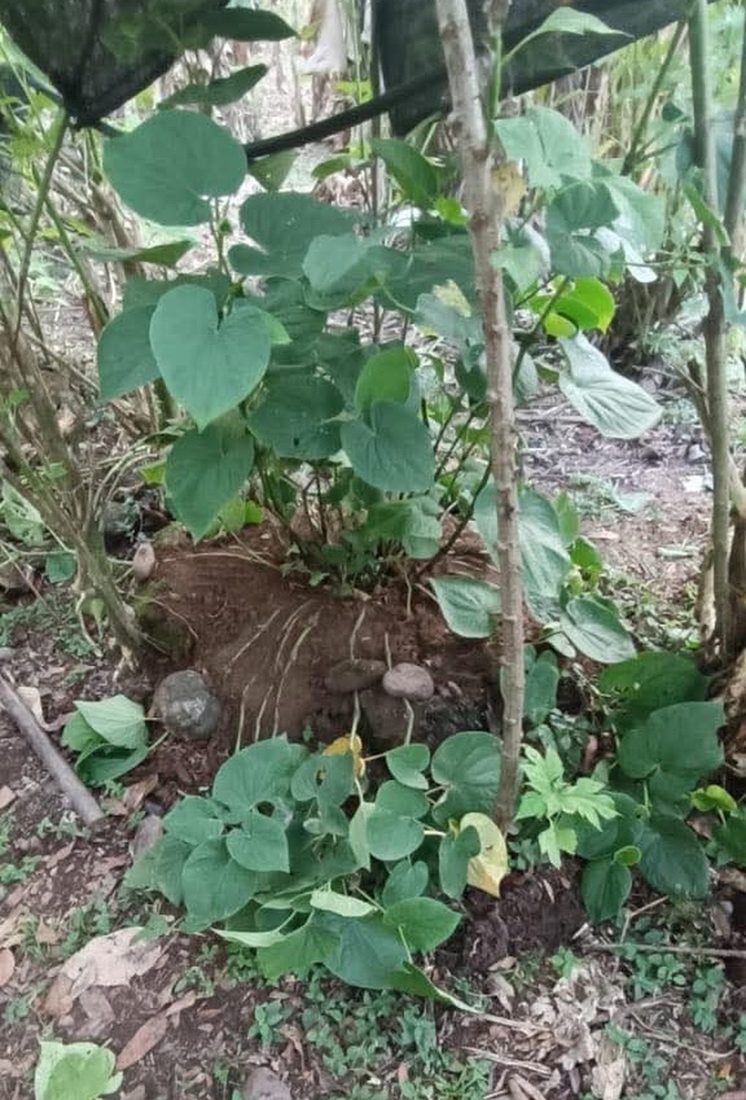
The technique here draws on two propagation traditions. The first is ground layering, in which lateral stems are bent to contact moistened soil and secured with a stone, inducing adventitious roots at the node–soil interface. In black pepper, runners trailed over a raised soil mound root at the nodes and the rooted pieces are harvested and potted on, giving 90.7% establishment against 62.9% for conventional propagation. The second is the Hawaiian practice of propagating kava in moss beds, which the authors have observed in ʻawa cultivation between 2010 and 2025. This method combines the two: fresh sphagnum moss inoculated with mycorrhizal and bacterial amendments, packed around hormone-treated nodes and enclosed in a two-piece pod that creates a stable rooting microenvironment.
Method
Plant material
Layers were established on Kali-ISA and Kali-Hiwa, obtained from Kali Kava, Sacramento in October 2024 as tissue-culture-derived nursery stock, propagated under greenhouse conditions at the Kali Kava research nursery in Boca Raton and then grown on in nursery containers held outdoors on open benches under shade cloth. All plants were 12 to 18 months old at pod installation. Three replicates of 40 layers each (n = 20 per variety) were drawn from the same maintained stock-plant population.
Two identity caveats, stated up front — The number of individual stock plants supporting the 120 layers was not recorded, and stock plants were drawn from the same population in all three replicates, so some plants likely carried layers in more than one replicate. Neither the plant count nor the layer-to-plant mapping is available. Separately, Kali-ISA and Kali-Hiwa are trade designations used in the American kava nursery trade rather than formally registered or morphotype-verified cultivars, and no herbarium vouchers or genetic accessions were deposited. Variety identity is provenance-based.
Air-layer preparation
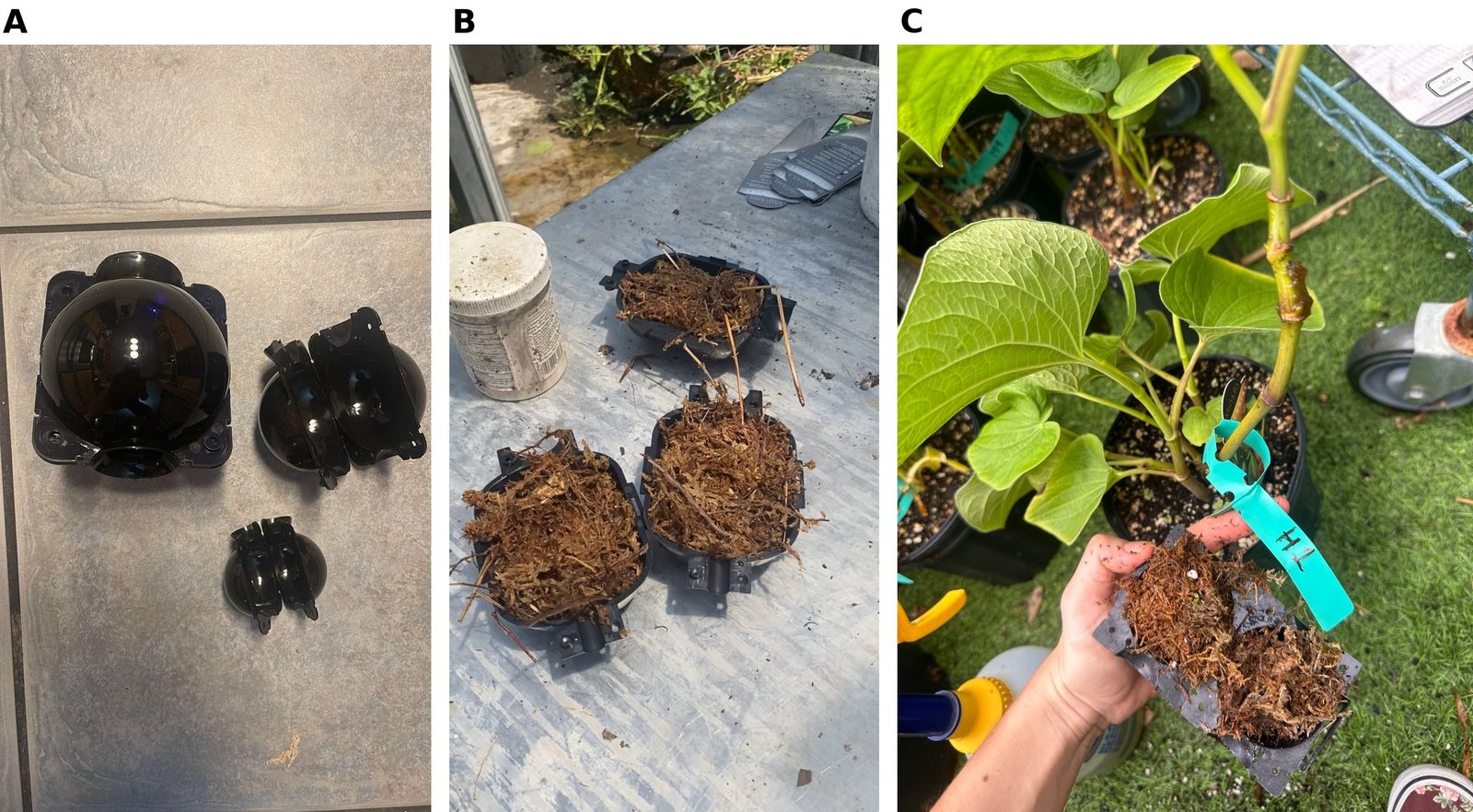
- Layering performed on intact nodes without wounding or girdling — mid-canopy stems 0.5–1.0 cm in diameter, first through third node below the apical meristem, non-senescing with full turgor and uniform dark-green colour.
- A thin layer of Clonex® Rooting Gel (0.31% w/w indole-3-butyric acid with micronutrients) applied directly to the stem surface at the node.
- Approximately 10–15 g of inoculated sphagnum moss — pre-hydrated, saturated but not dripping — packed around the treated node.
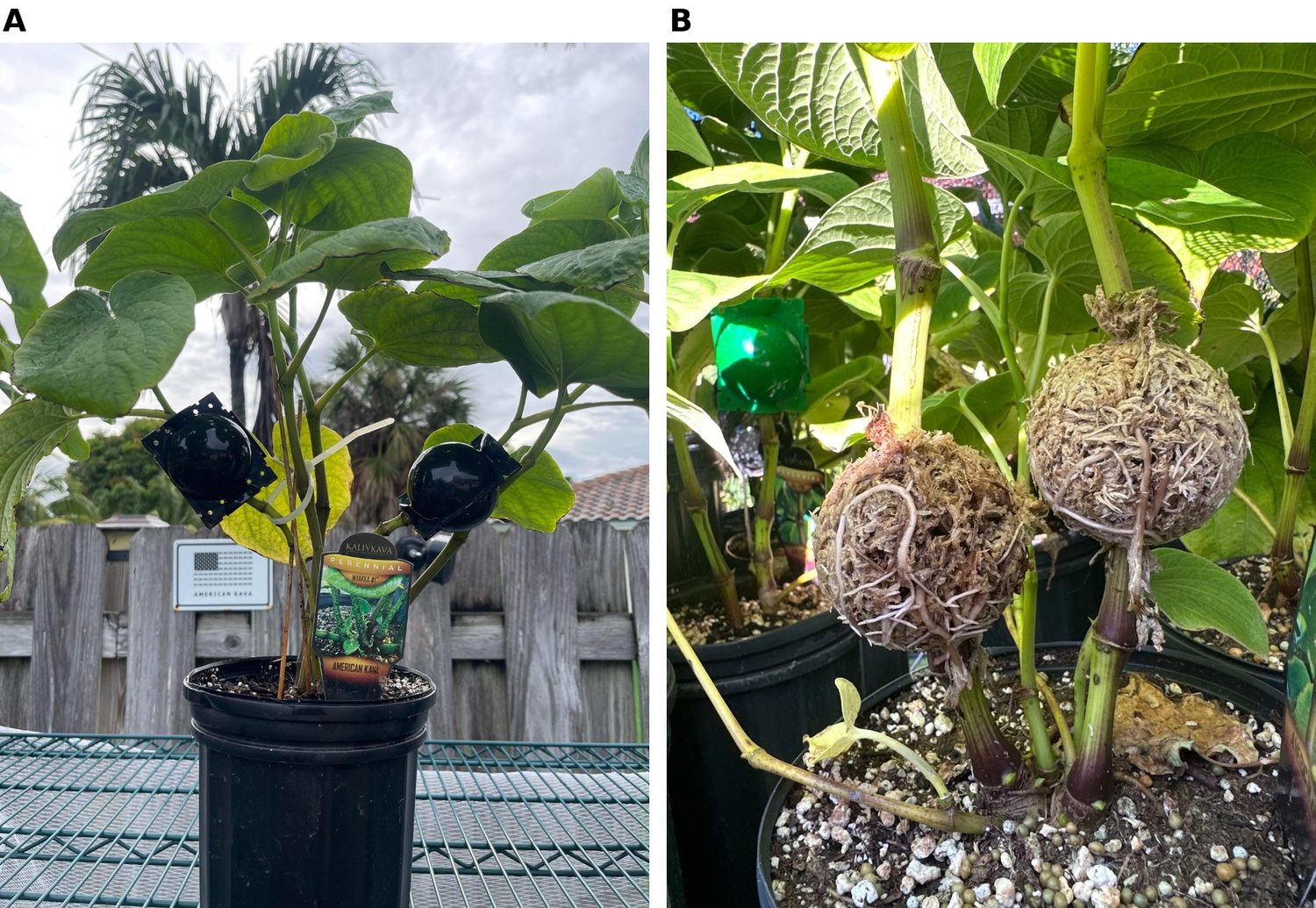
- Enclosed in an opaque black two-piece snap-together polypropylene pod, nominally 4.7 in (about 12 cm) outer diameter, closing at both ends around the stem.
- Left undisturbed outdoors for the full 21-day evaluation period, and never re-watered. Pods sanitized between replicates in 10% sodium hypochlorite with a clean-water rinse.
No greenhouse, propagation chamber or other controlled-environment enclosure was used at any point. Shade cloth and natural canopy shading from adjacent kava foliage reduced desiccation and direct insolation — that was the whole of the environmental management.
Inputs
A Bacillus amyloliquefaciens inoculant (Hydroguard®, labeled minimum 1.0 × 10⁴ CFU mL⁻¹) at 2 mL per gallon, together with Plant Success® Great White Premium mycorrhizal inoculant at 3 g per gallon, combined in 5 gallons of distilled water at 25 °C. Moss was soaked for 4 hours and wrung out immediately before packing. Inoculum viability was not independently assayed. The paper also notes that the manufacturer's marketing copy does not reconcile with the itemized guaranteed analysis on the lot used, and reports the label statement rather than treating it as a stable product specification.
The four-category scale
Outcome definitions, applied at day 21 by trained nursery staff from a common written rubric.
- Rotted — Complete tissue decay or necrosis at the treated node; no viable tissue
- Alive, no roots — Green, turgid stem, with or without new leaf expansion, and no visible root emergence
- Poorly rooted — One or more visible roots, but fewer than three reaching 2 cm — a residual class, so a layer with two roots of 3 cm scores here
- Well rooted — Three or more roots, each at least 2 cm, forming a branching root mass
Poorly rooted and well rooted are combined as “total rooted” throughout. Root length measured with a steel rule to the nearest 0.5 cm. Scoring was neither blinded to variety nor independently duplicated, so inter-rater reliability was not established.
The three weather windows
Environmental conditions, recorded as observed daily ranges from existing nursery instrumentation.
- June 2025 — summer wet — Daily highs: 33–35 °C · Overnight lows: 24–26 °C · Relative humidity: 80–88% · Character: Sustained heat, frequent afternoon thunderstorms
- October 2025 — fall transitional — Daily highs: 27–28 °C · Overnight lows: 20–23 °C · Relative humidity: 75–80% · Character: Modest diurnal swings, several rain events
- February 2026 — winter dry — Daily highs: 25–26 °C · Overnight lows: 18–19 °C · Relative humidity: 65–75% · Character: Coolest and driest; intermittent frontal passages
A continuous calibrated data logger was not deployed, which limits the precision of any climate–outcome inference.
Results
Root formation was observed in both varieties in all three replicates. Aggregate rooting was 75.0% in June, 80.0% in October and 72.5% in February — and the three-way test across seasons was clearly null.
Total rooting by variety and replicate
Figure A.
- June 2025 — Kali-ISA: 80 % · Kali-Hiwa: 70 %
- October 2025 — Kali-ISA: 85 % · Kali-Hiwa: 75 %
- February 2026 — Kali-ISA: 80 % · Kali-Hiwa: 65 %
- Pooled — Kali-ISA: 81.7 % · Kali-Hiwa: 70 %
Percentage of layers scored poorly rooted or well rooted at 21 days. n = 20 per variety per replicate; n = 60 per variety pooled.
Pooled outcome distribution by variety
Figure B.
- Rotted — Kali-ISA: 8.3 % · Kali-Hiwa: 13.3 %
- Alive, no roots — Kali-ISA: 10 % · Kali-Hiwa: 16.7 %
- Poorly rooted — Kali-ISA: 13.3 % · Kali-Hiwa: 18.3 %
- Well rooted — Kali-ISA: 68.3 % · Kali-Hiwa: 51.7 %
- Total rooted — Kali-ISA: 81.7 % · Kali-Hiwa: 70 %
All three replicates pooled, n = 60 per variety. Total rooted is poorly rooted plus well rooted.
Table 4. Pooled rooting outcomes across all three replicates (n = 60 per variety; n = 120 total).
- Rotted — Kali-ISA (n = 60): 5 (8.3%) · Kali-Hiwa (n = 60): 8 (13.3%) · Combined (n = 120): 13 (10.8%)
- Alive, no roots — Kali-ISA (n = 60): 6 (10.0%) · Kali-Hiwa (n = 60): 10 (16.7%) · Combined (n = 120): 16 (13.3%)
- Poorly rooted — Kali-ISA (n = 60): 8 (13.3%) · Kali-Hiwa (n = 60): 11 (18.3%) · Combined (n = 120): 19 (15.8%)
- Well rooted — Kali-ISA (n = 60): 41 (68.3%) · Kali-Hiwa (n = 60): 31 (51.7%) · Combined (n = 120): 72 (60.0%)
- Total rooted — Kali-ISA (n = 60): 49 (81.7%) · Kali-Hiwa (n = 60): 42 (70.0%) · Combined (n = 120): 91 (75.8%)
Yates-corrected χ² = 1.64, df = 1, p = 0.20; Mantel–Haenszel common OR = 1.92 (95% CI 0.81–4.52), p = 0.14. Wilson 95% CIs: Kali-ISA 70.1–89.4%; Kali-Hiwa 57.5–80.1%; combined 67.4–82.6%.
Tables 1–3. Rooting outcomes by replicate (n = 20 per variety per replicate).
- Rotted — Jun ISA: 2 (10%) · Jun Hiwa: 3 (15%) · Oct ISA: 1 (5%) · Oct Hiwa: 2 (10%) · Feb ISA: 2 (10%) · Feb Hiwa: 3 (15%)
- Alive, no roots — Jun ISA: 2 (10%) · Jun Hiwa: 3 (15%) · Oct ISA: 2 (10%) · Oct Hiwa: 3 (15%) · Feb ISA: 2 (10%) · Feb Hiwa: 4 (20%)
- Poorly rooted — Jun ISA: 3 (15%) · Jun Hiwa: 4 (20%) · Oct ISA: 2 (10%) · Oct Hiwa: 4 (20%) · Feb ISA: 3 (15%) · Feb Hiwa: 3 (15%)
- Well rooted — Jun ISA: 13 (65%) · Jun Hiwa: 10 (50%) · Oct ISA: 15 (75%) · Oct Hiwa: 11 (55%) · Feb ISA: 13 (65%) · Feb Hiwa: 10 (50%)
- Total rooted — Jun ISA: 16 (80%) · Jun Hiwa: 14 (70%) · Oct ISA: 17 (85%) · Oct Hiwa: 15 (75%) · Feb ISA: 16 (80%) · Feb Hiwa: 13 (65%)
Fisher's exact test, total rooted vs. not rooted: June OR = 1.71, p = 0.72; October OR = 1.89, p = 0.69; February OR = 2.15, p = 0.48. All three replicate confidence intervals overlap substantially.
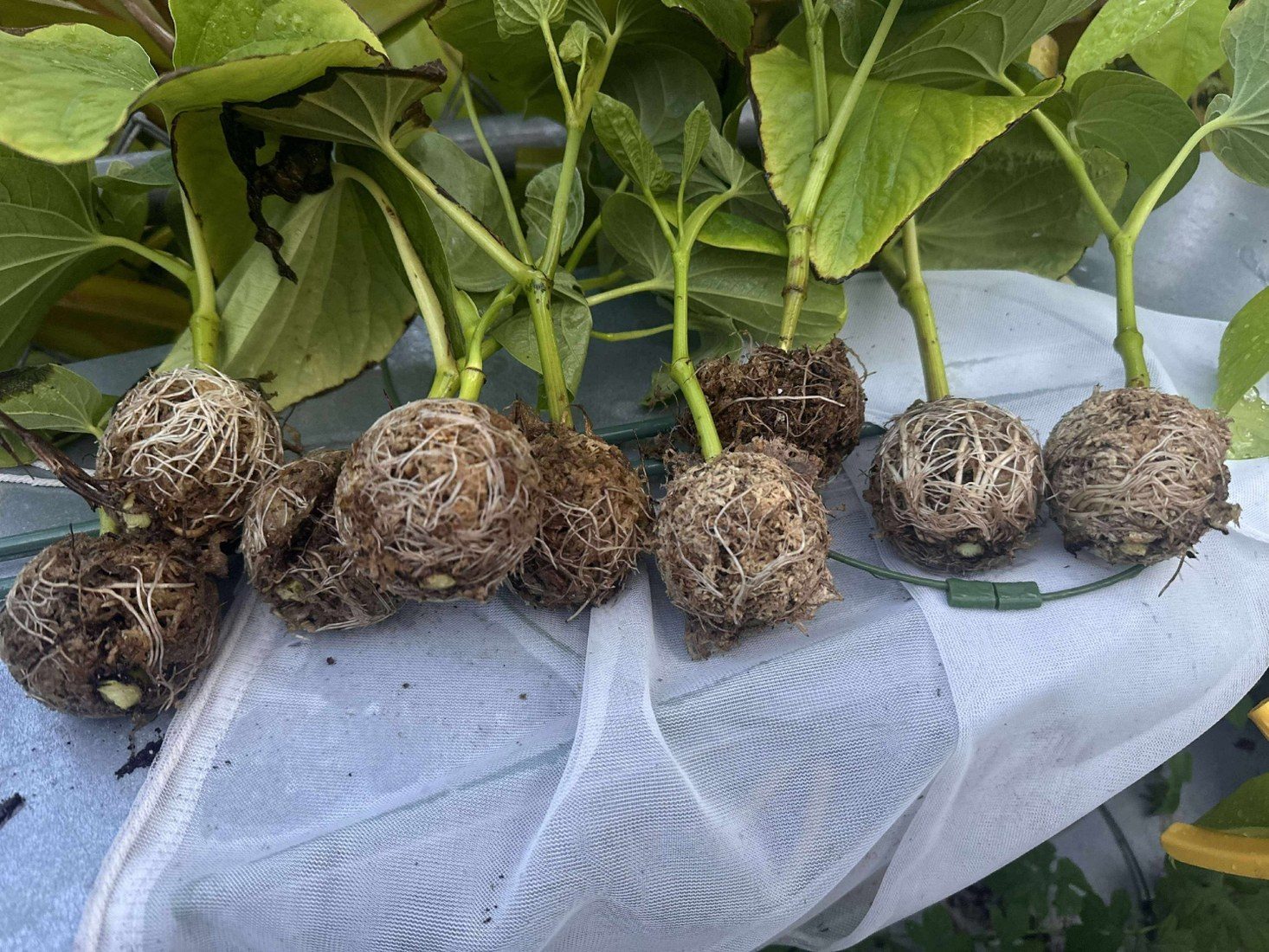
What the rooting classes look like
The photographs below were selected to illustrate the category definitions and were not drawn by random sampling from the scored units. They are documentary rather than quantitative evidence.
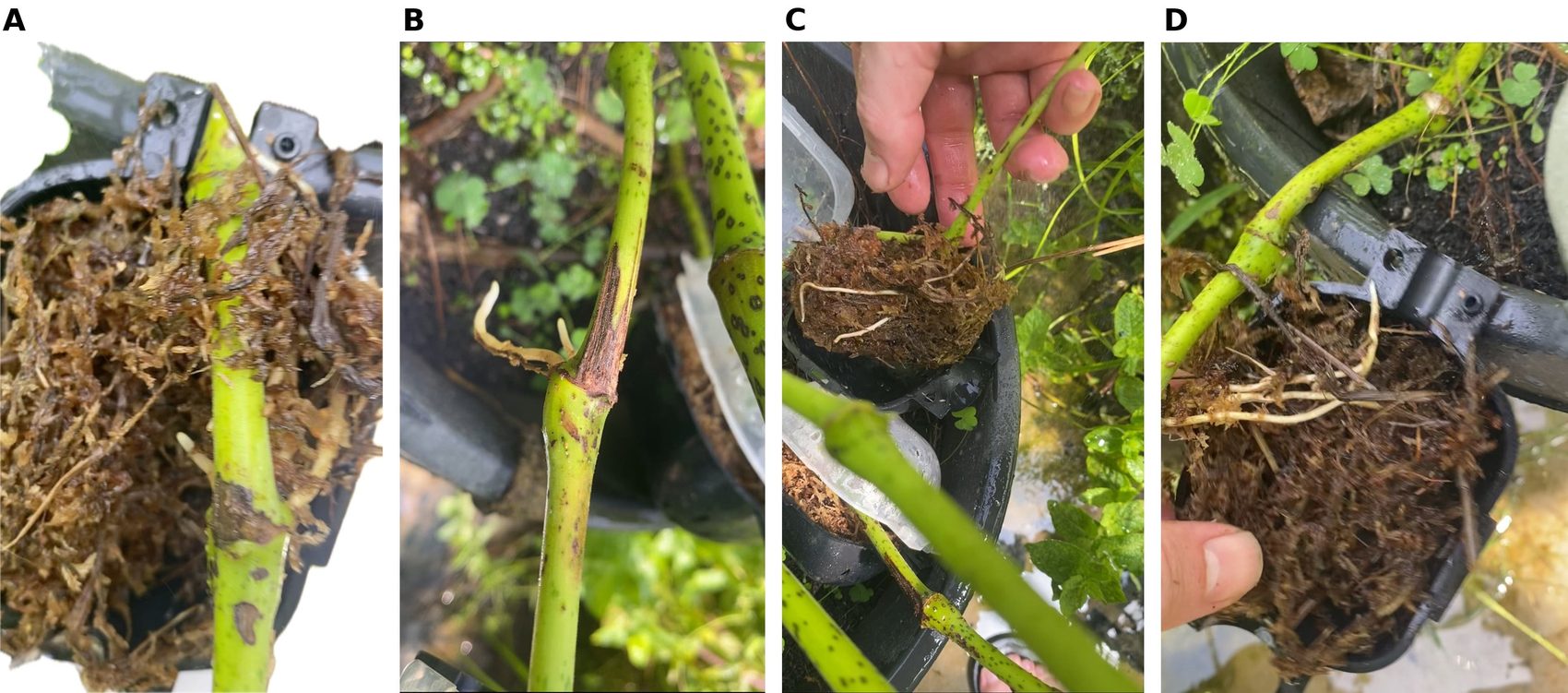
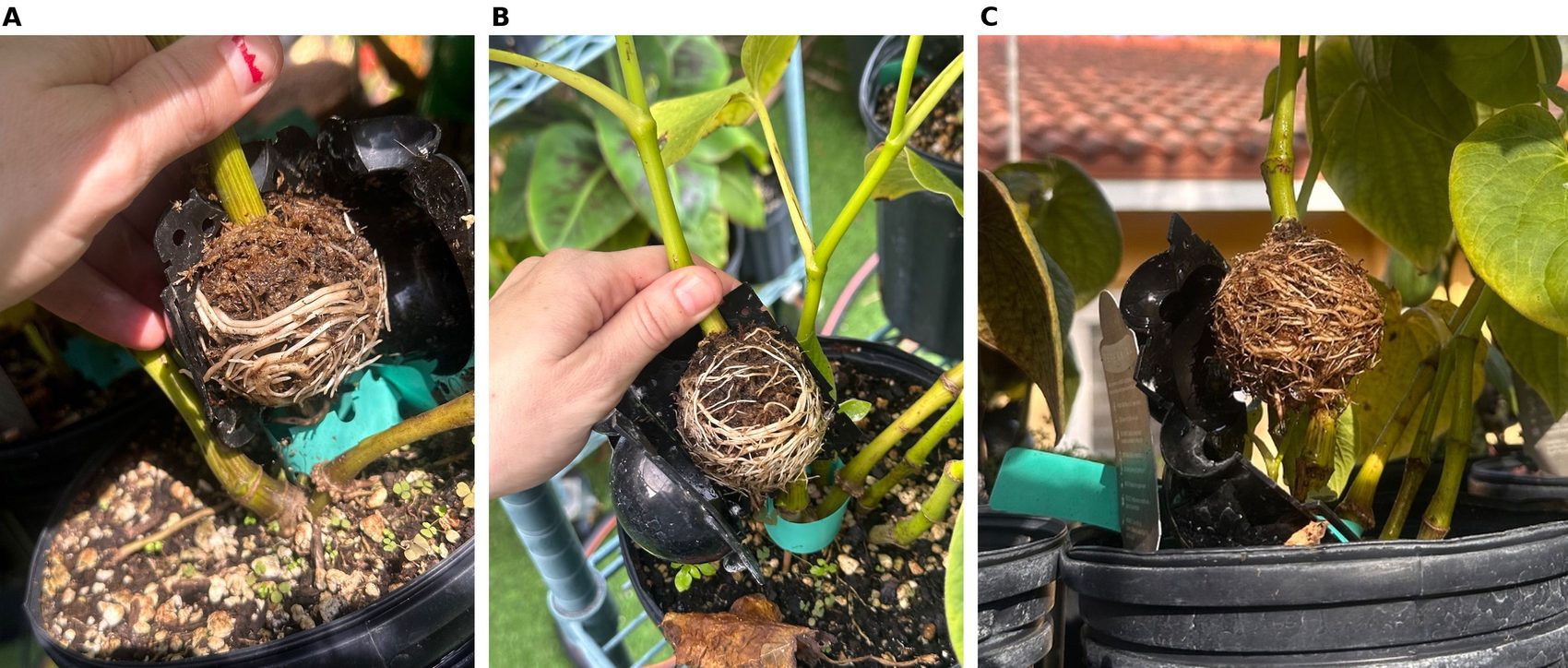
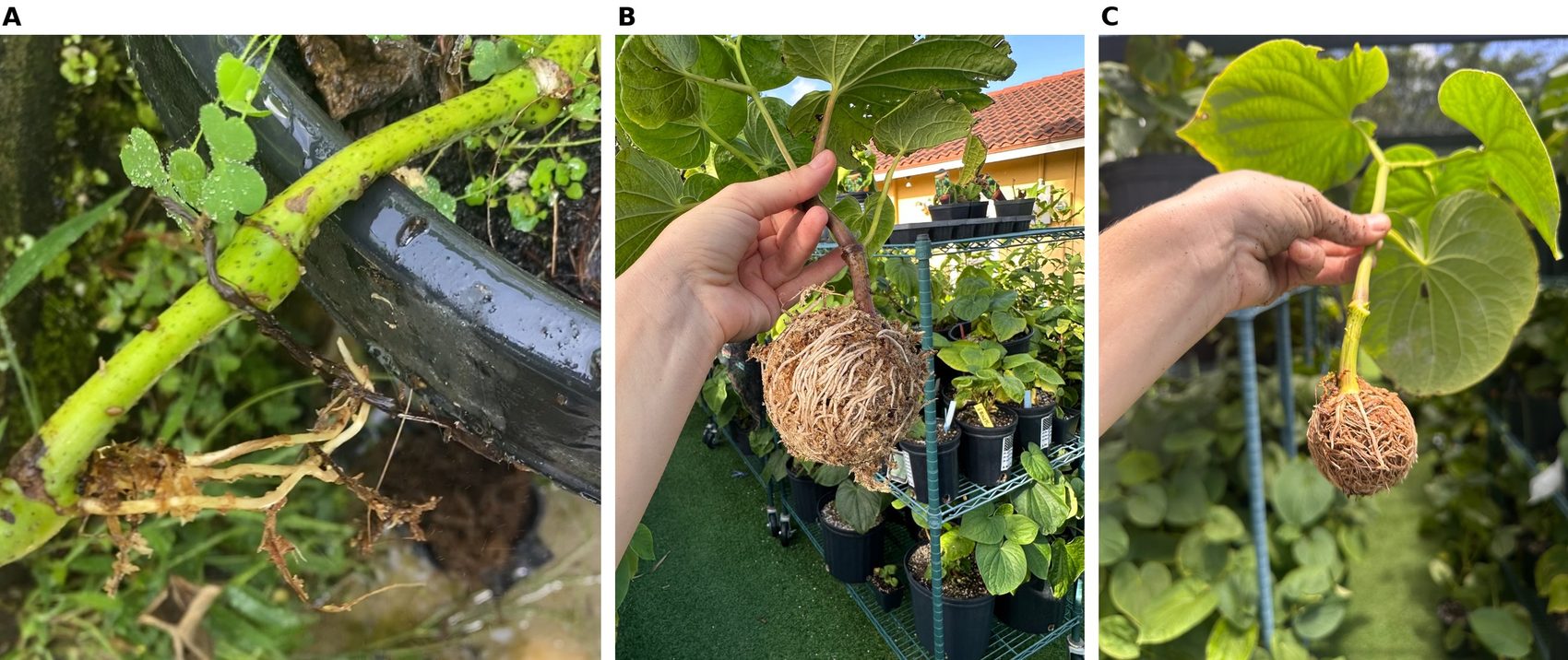
Post-transplant establishment
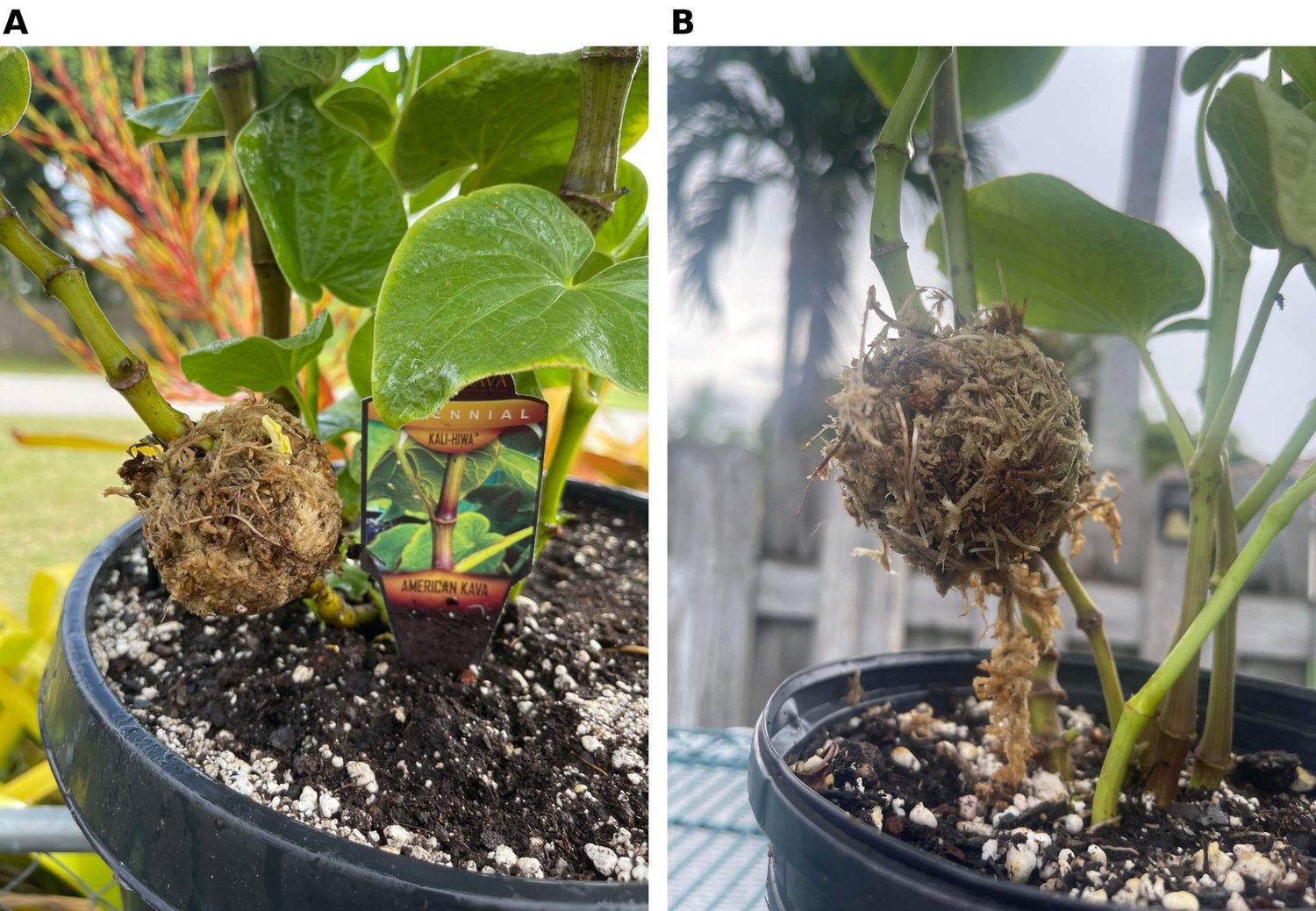
All rooted layers were severed at 21 days and potted into 1-gallon nursery containers with standard medium, then held under 30% shade cloth at the same site without supplemental humidity control. Across all three replicates and both varieties, 91 of 91 transplanted layers survived to the 30-day assessment (95% CI 95.9–100), with no observed transplant shock, wilting or mortality.
What 100% survival does and does not mean — Survival was recorded as a binary presence/vigor observation. No growth, biomass or root-development measurements were taken, and 30 days is too short an interval to speak to establishment in any agronomic sense. Surviving plants were later moved to open-field plantings, but that transfer happened after the observation window closed and no field outcomes are reported.
Against the published benchmarks
Aggregate rooting exceeded the values reported for the alternative systems. One-sample binomial tests against each reference proportion return p < 0.001 in every case. Those tests treat the published figures as fixed, known constants, which they are not — they show only that the difference is larger than sampling noise in this sample, not that a controlled between-method effect exists.
Table 5. Reported rooting or establishment outcomes across propagation methods. Rows are not concurrent controls; endpoints and materials differ.
- Air layering, outdoor nursery, South Florida — pooled (this paper) — Interval: 21 d · Reported outcome: 75.8% (91/120), CI 67.4–82.6 · Endpoint and caveats: Rooting at fixed interval; ambient outdoor nursery; vascular continuity maintained
- Air layering — October 2025 replicate (this paper) — Interval: 21 d · Reported outcome: 80.0% (32/40), CI 65.2–89.5 · Endpoint and caveats: Best single replicate; difference from other replicates not significant (p = 0.73)
- Soft-stem cuttings in peat cubes, greenhouse — Interval: 21 d · Reported outcome: 47% · Endpoint and caveats: Excised tissue; source not externally peer reviewed
- Soft-stem cuttings in aeroponics, greenhouse — Interval: 14 d · Reported outcome: 51% · Endpoint and caveats: Shorter interval; high technical and energy input; source not externally peer reviewed
- Nodal cuttings, field, South Pacific — Interval: To establishment · Reported outcome: 20–60% · Endpoint and caveats: Cuttings that formed plants, not a rooting score; strong node-position and planting-month effects
The nodal-cutting figures are Davis & Brown's Table 9: 20%, 49% and 60% for basal, middle and apical nodes planted in March, and 39%, 60% and 56% for the same positions in August. The full range is 20–60%; citing “49–60%” alone would select the more favorable subset, and the paper declines to do so.
Why it might work — offered as a hypothesis
One candidate explanation is the preservation of vascular continuity with the mother plant, and it is worth being explicit that this runs against the conventional account of adventitious rooting rather than following from it. Auxin is the central regulator, acting through canalization to responding target cells and a downstream cascade involving AUX/IAA proteins, TOPLESS, ARFs and SAUR-like proteins. But in cuttings, the early auxin accumulation that initiates rooting is generally attributed to the interruption of the basipetal auxin drain caused by excision, together with wound signaling. On that account an attached layer, which retains its drain, should have less auxin stimulus, not more — and the applied IBA presumably substitutes for it.
What an attached layer does retain is the resource network that excision removes. Adventitious rooting in cuttings proceeds under isolation from the whole-plant resource and signal network, with wound-induced ethylene and jasmonate signaling, altered auxin conjugation and catabolism, and reduced invertase activity that impairs sink establishment at the rooting zone. A layer keeps receiving water and photosynthate from the mother plant throughout induction — which is the more plausible basis for any advantage, and is consistent with the fact that no layer required misting or humidity control.
This is a hypothesis, not a finding — The design tests none of it. No hormone, carbohydrate or transport measurements were made, and no excised-cutting arm was run in parallel. The account above is a proposal for a future factorial experiment. The higher absolute rooting rate reported here is equally consistent with differences in plant material, node selection, substrate and assessor between this trial and the historical comparators.
What the numbers support, and what they don't
Seasonal effects were not detected. October gave the highest point estimate and February the lowest, but the three-way test was clearly null (p = 0.73) and the intervals overlap. Rather than reading a season optimum into the ordering, the useful result is a negative one with practical value: the method did not fail in peak summer heat or in the cool dry winter window, and rooting stayed above 70% in every replicate. Temperature and moisture during induction are established determinants of adventitious rooting, so a season effect may well exist — this study simply lacked the resolution to find one.
The variety difference is inconclusive, not negative. Kali-ISA led by 11.7 points pooled, in a consistent direction across all three replicates, with a homogeneous stratum-specific odds ratio (common OR 1.92, test of equal odds p = 0.98). But neither the pooled chi-square (p = 0.20) nor the stratified test (p = 0.14) nor any within-replicate test reached significance, and the risk-difference interval (−3.5 to +26.8 points) is compatible with no difference and with a substantial one. With achieved power near 0.32, the consistency of direction is suggestive enough to justify a properly powered trial — about 209 layers per variety.
Nothing here speaks to the inputs. The auxin gel and microbial inoculum were applied together to every layer. No factorial arms, no auxin-only or inoculum-only treatment, no untreated control. Any statement that microbial inoculation improved rooting here would be unsupported, and the same applies to the moss substrate and the enclosure.
- 75.8% — Pooled rooting at 21 days (91/120)
- 0.32 — Achieved power for the variety comparison
- 209 — Layers per variety needed for 80% power
- 91/91 — Rooted layers surviving 30 days post-transplant
What it costs
Air layering shifts investment away from fixed capital and environmental control and toward per-plant labor. At US$25.00 per hour, installing a layer took roughly 3–10 minutes of hands-on time, with a further 2–7 minutes to detach and pot a rooted one.
Table 6. Estimated labor and material cost per air layer installed and per rooted layer potted. Labor at US$25.00/hr.
- Labor — air-layer installation — Time (min): 3–10 · Cost low: US$1.25 · Cost high: US$4.17
- Labor — detachment and transplant — Time (min): 2–7 · Cost low: US$0.83 · Cost high: US$2.92
- Total labor per rooted layer potted — Time (min): 5–17 · Cost low: US$2.08 · Cost high: US$7.08
- Consumables — hormone, inoculants, fasteners and sanitation — Time (min): — · Cost low: US$0.18 · Cost high: US$0.90
- Reusables amortized — pod and moss charge — Time (min): — · Cost low: US$0.08 · Cost high: US$0.25
- Total materials per layer installed — Time (min): — · Cost low: US$0.25 · Cost high: US$1.10
- Total per air layer installed — Time (min): 3–10 · Cost low: US$1.50 · Cost high: US$5.27
- Total per rooted layer potted — Time (min): 5–17 · Cost low: US$2.33 · Cost high: US$8.18
Reusables assume 10–20 pod reuse cycles that were not verified over a full service life; sanitization labor is not monetized.
Why these ranges are so wide — The site kept two independent time-and-motion records that do not agree — one logged 3–6 minutes per installation and 2–4 per transplant, the other 6–10 and 4–7. Neither was collected under a stopwatch protocol, so the figures span both records rather than selecting the more favorable one. They exclude stock-plant maintenance, overhead, sanitation labor, capital recovery on the pod inventory, and the inputs absorbed by the roughly 24% of layers that did not root. Success-adjusting for the 75.8% rooting rate gives about US$2.81–9.87 per rooted plant potted. Do not use these for commercial planning without validation at production scale.
Limitations
- Single site. All three replicates ran at one nursery. Site, soil, canopy, crew and stock-plant genetics are fully confounded with the outcome. Nothing here establishes performance anywhere else.
- No concurrent control or comparator arm. No untreated node, no auxin-only or inoculum-only arm, no parallel cutting arm. The protocol was tested as an undifferentiated package.
- Pseudoreplication. Multiple layers were installed on individual stock plants, so layers are not fully independent — and neither the number of stock plants nor the layer-to-plant mapping was recorded, so clustering cannot be modeled retrospectively. Because the same population served all three replicates, the replicates are not fully independent of one another either. The reported intervals and p-values assume independence and are therefore likely anti-conservative: the true intervals are wider than stated and the effective sample size is smaller than n = 120.
- Underpowered for the variety comparison. Achieved power roughly 0.32. The non-significant results are inconclusive, not evidence of equivalence.
- No randomization and no blinding. Layers were not randomized to canopy position or plant, and scoring was performed by staff who knew the variety and had also installed the layers. Categories 3 and 4 involve judgment at the margin, and no layer was scored by a second assessor, so observer bias cannot be excluded.
Where this goes next
The most valuable next experiment is a properly powered factorial trial. At roughly 209 layers per variety, crossed arms of auxin (present/absent) and microbial inoculum (present/absent) would resolve both the variety question and the contribution of each input. Adding a concurrent nodal-cutting arm scored on the same scale by the same blinded assessors would convert the benchmark comparison from historical to controlled.
- Multi-site replication across subtropical and tropical environments, including Pacific Island and continental American growing regions.
- Record layer position on the stock plant so within-plant clustering can be modeled with mixed-effects or GEE methods rather than assumed away, and deploy calibrated continuous environmental logging so a season effect can actually be estimated.
- Expand germplasm beyond two trade varieties, with vouchered accessions and recorded morphological covariates — stem diameter, internode length, node position, tissue maturity — so recommendations rest on traits rather than names.
- Systematically optimize the physical and biological parameters: hormone concentration, inoculant composition, moss type and volume, pod size and opacity.
- Track cohorts from transplant through to harvest, assayed for root biomass and kavalactone content alongside plants raised from cuttings and tissue culture, and rebuild the economic model from audited production-scale data.
That last point carries the most commercial weight. Rooted propagules were straightforward to detach and pot, and all survived to 30 days — a useful signal of handling robustness. But whether early rooting vigor translates into comparable growth rate, root-mass development, kavalactone accumulation or harvestable yield relative to plants raised from cuttings or tissue culture is untested here, and is the single most consequential open question for anyone considering the method commercially.
What this study supports
Air layering can be carried out on containerized stock plants under ambient outdoor nursery conditions in a subtropical climate — without greenhouse, misting or other controlled-environment infrastructure, without destroying mother-plant biomass, and with predictable per-plant labor — and rooted layers can subsequently be potted on and moved to open-field plantings.
It does not, on this design, establish that air layering is superior to cuttings or aeroponics, that the microbial inoculant contributed to the outcome, that any season is preferable, or that the varieties differ. Each of those requires a controlled, adequately powered, multi-site trial. What this study supports is a narrower and still useful claim: under the conditions tested, the method worked reliably enough to justify that larger investigation.
Companion field manuals — Nos. 4.1a through 4.1f

Technical White Paper No. 4.1a — abbreviated instructional manual for Fijian farmers. A condensed, Fijian-language (Vosa Vakaviti) field guide to the air-layering protocol described in this paper, produced for distribution to kava growers in Fiji and illustrated throughout with field photographs from the trial. It covers the materials required, the seven-step installation procedure, the four-category rooting scale used at day 21, detachment and potting, and the limitations that apply when the method is taken outside the single Florida trial site. Download No. 4.1a (PDF, Vosa Vakaviti, illustrated, 6 pages).

Technical White Paper No. 4.1b — abbreviated instructional manual in Latin American Spanish. The same illustrated field guide in Latin American Spanish (Propagación de kava por acodo aéreo), produced for distribution to Spanish-speaking kava growers. Its contents and figures correspond to No. 4.1a; where the translations and the English text differ, the English No. 4 is authoritative. Download No. 4.1b (PDF, español, illustrated, 6 pages).

Technical White Paper No. 4.1c — abbreviated instructional manual in Brazilian Portuguese. The same illustrated field guide in Brazilian Portuguese (Propagação de kava por alporquia), produced for distribution to Portuguese-speaking kava growers. Its contents and figures correspond to Nos. 4.1a and 4.1b; where the translations and the English text differ, the English No. 4 is authoritative. Download No. 4.1c (PDF, português, illustrated, 6 pages).

Technical White Paper No. 4.1d — abbreviated instructional manual in Bislama. The same illustrated field guide in Bislama (Mekem rus long kava wetem air layering), produced for distribution to kava growers in Vanuatu. Its contents and figures correspond to Nos. 4.1a–4.1c; where the translations and the English text differ, the English No. 4 is authoritative. Download No. 4.1d (PDF, Bislama, illustrated, 6 pages).

Technical White Paper No. 4.1e — abbreviated instructional manual in Tok Pisin. The same illustrated field guide in Tok Pisin (Mekim rus long kava wantaim air layering), produced for distribution to kava growers in Papua New Guinea. Its contents and figures correspond to Nos. 4.1a–4.1d; where the translations and the English text differ, the English No. 4 is authoritative. Download No. 4.1e (PDF, Tok Pisin, illustrated, 6 pages).

Technical White Paper No. 4.1f — abbreviated instructional manual in Jamaican Patwa. The same illustrated field guide in Jamaican Patwa (Grow kava wid air layering), produced for distribution to kava growers in Jamaica. Its contents and figures correspond to Nos. 4.1a–4.1e; where the translations and the English text differ, the English No. 4 is authoritative. Download No. 4.1f (PDF, Jamaican Patwa, illustrated, 6 pages).
Disclosures and conflicts of interest
No external funding was received. This paper is published by the American Kava Association. The corresponding author is affiliated with Root of Happiness, a commercial kava retailer, and holds an interest in Kali Kava, a commercial kava nursery; the remaining authors are affiliated with Nakamal at Home, also a commercial kava retailer. The plant material was supplied by Kali Kava and all three replicates were conducted at the Kali Kava research nursery — so the trial site is a facility in which the corresponding author holds a commercial interest. These relationships are disclosed as potential conflicts. No manufacturer of any product named in this paper provided funding, materials, or input into the design, conduct, analysis or reporting of the study.
T.B. conceived the study, designed the protocol, performed the statistical analysis and drafted the paper. B.M. performed the majority of the air-layer installations and contributed to layer scoring and transplant handling. J.B. maintained the stock-plant population, installed and scored layers, recorded environmental data and contributed to transplant assessment. The authors thank the Kali Kava nursery staff in Boca Raton, and acknowledge the Hawaiian ʻawa cultivators whose moss-bed propagation practice informed the design of this method.
References
- Blythe, T., Bowman, J., & Masifilo, M. (2026). Soft-Stem Propagation of Piper methysticum Using Peat-Based Media and Aeroponic Cloning Systems. American Kava Association Technical White Paper No. 1, Version 1.0. — internally reviewed and audited by the authors; not externally peer reviewed.
- Coles, Z. S., & du Toit, E. S. (2020). Open air-layering of Moringa oleifera utilizing seedling plug containers. South African Journal of Botany, 129, 225–228. https://doi.org/10.1016/j.sajb.2019.07.016
- Davis, R. I., & Brown, J. F. (1999). Kava (Piper methysticum) in the South Pacific: its importance, methods of cultivation, cultivars, diseases and pests. ACIAR Technical Reports Series No. 46.
- de Klerk, G.-J., van der Krieken, W., & de Jong, J. C. (1999). The formation of adventitious roots: new concepts, new possibilities. In Vitro Cellular & Developmental Biology – Plant, 35(3), 189–199. https://doi.org/10.1007/s11627-999-0076-z
- Druege, U., Franken, P., & Hajirezaei, M. R. (2016). Plant hormone homeostasis, signaling, and function during adventitious root formation in cuttings. Frontiers in Plant Science, 7, 381. https://doi.org/10.3389/fpls.2016.00381
- Hartmann, H. T., Kester, D. E., Davies, F. T., Geneve, R. L., & Wilson, S. B. (2018). Hartmann & Kester's Plant Propagation: Principles and Practices (9th ed.). Pearson.
- Khandekar, R. G., Haldankar, P. M., Pande, V. S., Joshi, G. D., Bagade, D. S., Malve, D. B., Bhagwat, N. R., Rangwala, A. D., Jambhale, N. D., & Ramana, K. V. (2004). Studies on rapid multiplication of black pepper (Piper nigrum L.) on soil mound. Journal of Spices and Aromatic Crops, 13(1), 34–36.
- Kodithuwakku, R. D., Wijekoon, W. M. R. W. B., Kumari, I. S., & De Silva, D. P. P. (2016). Efficacy of single and combined application of Trichoderma spp. and Pseudomonas fluorescens along with bio-fertilizer (arbuscular mycorrhizae) on growth of nursery plants of black pepper. Sri Lanka Journal of Food and Agriculture, 2(1), 69–72. https://doi.org/10.4038/sljfa.v2i1.26
- Lebot, V., & Cabalion, P. (1988). Kavas of Vanuatu: cultivars of Piper methysticum Forst. South Pacific Commission Technical Paper No. 195.
- Lebot, V., McKenna, D. J., Johnston, E., Zheng, Q. Y., & McKern, D. (1999). Morphological, phytochemical, and genetic variation in Hawaiian cultivars of ʻawa (kava, Piper methysticum, Piperaceae). Economic Botany, 53(4), 407–418. https://doi.org/10.1007/BF02866720
- Pacurar, D. I., Perrone, I., & Bellini, C. (2014). Auxin is a central player in the hormone cross-talks that control adventitious rooting. Physiologia Plantarum, 151(1), 83–96. https://doi.org/10.1111/ppl.12171
- Prasad, R., Tyagi, A. P., & Taylor, M. (2008). Regeneration and establishment of whole plants from kava (Piper methysticum Forster) meristems in tissue culture. South Pacific Journal of Natural and Applied Sciences, 26, 39–44. https://doi.org/10.1071/SP08006
- Punasya, A., Kanwar, J., & Dubey, R. (2018). IBA and rooting media influenced survival, rooting and vegetative growth in air layering of guava (Psidium guajava L.) cv. L-49. International Journal of Current Microbiology and Applied Sciences, 7(8), 1505–1510. https://doi.org/10.20546/ijcmas.2018.708.171
- Smith, S. E., & Read, D. J. (2008). Mycorrhizal Symbiosis (3rd ed.). Academic Press.
- Tang, L., Syed, A.-u.-A., Otho, A. R., Junejo, A. R., Tunio, M. H., Hao, L., Ali, M. N. H. A., Brohi, S. A., Otho, S. A., & Channa, J. A. (2024). Intelligent rapid asexual propagation technology — a novel aeroponics propagation approach. Agronomy, 14(10), 2289. https://doi.org/10.3390/agronomy14102289
- Zhang, Z., Zhao, L., Chen, X., & Zheng, X. (2008). Successful micropropagation protocol of Piper methysticum. Biologia Plantarum, 52(1), 110–112. https://doi.org/10.1007/s10535-008-0020-9
Cite This
Blythe, T.; Bowman, J.; McDonnell, B. Outdoor Nursery Propagation of Kava (Piper methysticum) by Air Layering. American Kava Association Technical White Paper No. 4; American Kava Association: Las Vegas, NV, USA, 2026.
Supporting Data and Access
The records behind this paper are the complete unit-level scoring records for all 120 air layers, the environmental observation logs for the three replicate windows, and the analysis scripts used to generate every statistic reported here.
The discussion published on this page is complete as an argument. It states the method, the numbers, the limitations and the conflicts of interest, and it is free to read, cite and disagree with. The records underneath it are held for the Association’s members.
Access to those records is open to stakeholders in the American kava growing industry — growers with at least one acre in production and a contract in place for the purchase of licensed planting material.
The reason is simply who this organization is. The American Kava Association is funded by its members and operates for their benefit, and its members are American kava farmers with land, capital and years committed to the crop. This work is self-funded: it was paid for out of working farms, to answer questions those farms were already facing. What the people who paid for it are owed is a working advantage in their own fields. So we publish the findings in full, limitations included, so the work can be judged on its merits — and we keep the underlying files inside the membership that produced them. That is a decision about who we are resourced to serve, not a judgement on anyone who asks.
Researchers and institutions interested in working with this material are welcome to propose a funded collaboration. That is the basis on which the Association can extend it, and we would rather say yes to a properly resourced study than no to a request.
Write to admin@americankavaassociation.org to enquire.